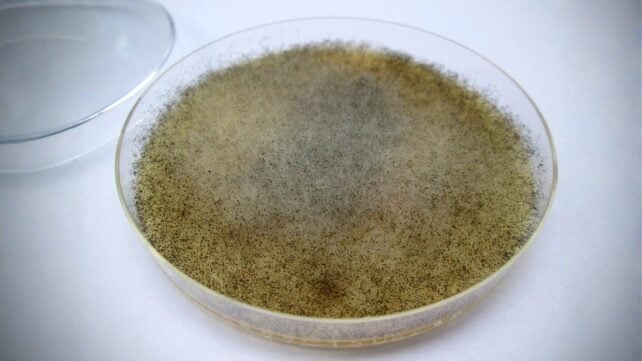
Mold isn't typically something you want growing inside your body.
But in the case of Mucor racemosus, there may be compelling reasons to make an exception.
That's because this symbiotic fungus that lives inside the human gut appears capable of protecting us from radiation, according to a new study in PNAS.
It might sound a bit hard to believe, but this isn't the first time we've seen fungi doing weird things with radiation.
We know that there are different kinds of radiation-resistant fungi, including species that survive being blasted with up to 200 times the fatal human dose of X-rays.
There's also the funky world of radiotrophic fungi, which use radiation as an energy source – like the bizarre fungus living its best life in the radioactive remains of the Chernobyl Nuclear Power Plant.
M. racemosus has a different kind of parlor trick for radiation, but it's no less impressive.
In their research, a team of scientists from China found the fungus can confer protection from radiation to its host through a couple of different mechanisms, suggesting M. racemosus may be a beneficial presence in the gut.
In experiments with mice exposed to radiation, the researchers found that animals administered M. racemosus experienced less weight loss, inflammation, and oxidative stress than control mice that weren't given a fungal dose, suggesting M. racemosus provided the treated animals with a radioprotective effect.
This radioprotective effect was boosted when the researchers preadapted the fungus to the oxygen-poor conditions of the gut.
When germ-free mice (raised to be free of microorganisms) were administered the fungus, they too showed reduced markers of radiation damage compared to control animals, suggesting M. racemosus helps to protect against the harms of radiation independent of host microbiota.
"These results demonstrate that M. racemosus directly alleviates radiation-induced intestinal injury in mice," the researchers explain.
As for how M. racemosus achieves this, subsequent testing on irradiated intestinal cells and mice revealed three amino acids produced by the fungus that might explain its radioprotective effects – L-glutamic acid, L-aspartic acid, and DL-lysine.
According to the researchers, these three amino acids directly facilitate DNA repair and intestinal tissue recovery after radiation exposure.

But that's not the only way the fungus does its thing.
Another chemical produced by the fungus, called methylthioadenosine (MTA), plays an important radioprotective role too, even if it doesn't work directly to heal radiation damage like the three amino acids.
Instead, it seems that M. racemosus's MTA production modulates the growth of a bacterium called Limosilactobacillus reuteri and also reprograms it to increase production of a chemical called methionine, higher levels of which seem to boost radiation protection.
In a final experiment to gauge the therapeutic potential of M. racemosus, the researchers gave irradiated mice a cheese fermented with the fungus, and found it reduced intestinal inflammation, enhanced intestinal barrier integrity, and lowered systemic markers of inflammation, compared to mice fed cheese without the fungus.
Related: Chernobyl Fungus Seems to Have Evolved an Incredible Ability
A lot more research will need to be done before we can conclude that everybody should be eating M. racemosus as part of a balanced diet, but the researchers note that the fungus already occurs naturally in or is added to some fermented foods, and is FDA-approved for dietary use.
However, because M. racemosus may present a health threat to immunocompromised individuals, we should tread carefully in terms of figuring out how the fungus might best find a home in the food pyramid or your medicine cabinet – and maybe some of its pals too.
"More broadly, these findings establish filamentous fungi as underappreciated yet influential agents in the microbiota–host axis," the researchers write, "with potential applications for mitigating radiation-induced damage and other health conditions."
The findings are reported in PNAS.
This article was fact-checked by Rebecca Dyer and edited by Rebecca Dyer. While we pride ourselves on our process, we are only human. If you spot a mistake, please let us know.