Smell is a powerful sense. It signals to your body whether something will taste good (or terrible), that you are finally home, that it's about to rain, or spring has arrived, or the dog needs a bath.
But of all the senses, smell may be the least understood.
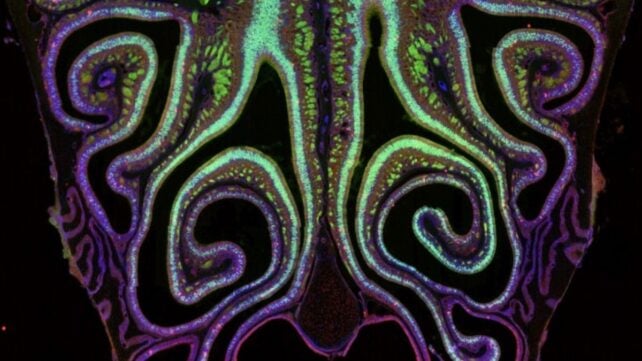
Now, scientists have brought us closer to understanding this mysterious sense by creating a detailed map that shows the arrangement of the thousands of different types of smell receptors embedded in the noses of mice.
The result is absolutely hypnotic.
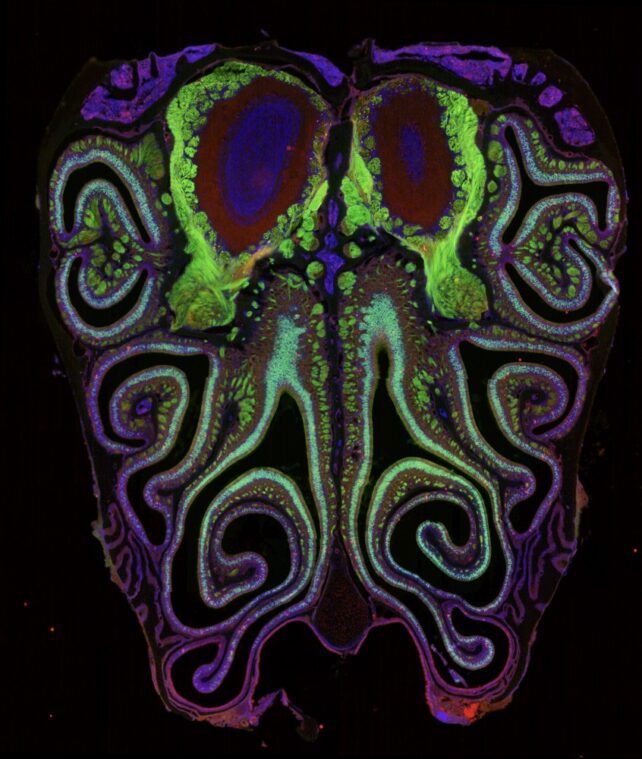
"Olfaction is super-mysterious," says neurobiologist Sandeep Datta, senior author on the study. "It's the sense that has been missing a map for the longest time."
The map is based on data from more than 300 mice.
In the nose of a mouse, there are around 20 million olfactory neurons that each express one of thousands of kinds of cell receptors. Each of those neurons carries scent information from the nose to the brain.
Datta and team sequenced the genes of around 5 million individual nasal tissue cells, giving them a dataset of around 2.3 million olfactory sensory neurons to work with.
Then, they mapped out where active genes related to scent receptors were located.
"Our results bring order to a system that was previously thought to lack order, which changes conceptually how we think this works," Datta says.
Previously, scientists had trouble detecting the receptors, and they assumed their arrangement must be random: any olfactory sensory neuron could express any one of the 1,100 possible olfactory receptors.
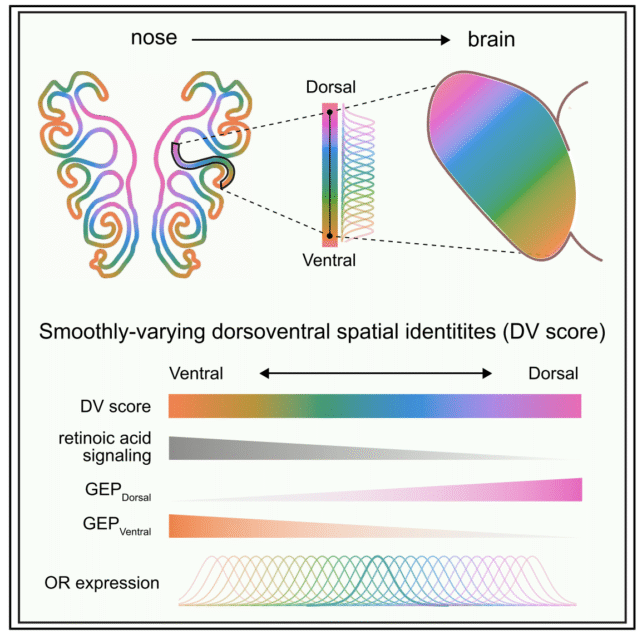
The new map, however, reveals that the kind of receptors these neurons express is very much based on the specific order in which they are arranged.
Because of this, they form a gradient of receptors in narrow horizontal bands that span from the top to the bottom of the nose.
As Datta and team write in their paper, spatial order in the olfactory system "arises from a continuously varying transcriptional code that precisely organizes the many discrete channels responsible for smell."

Further experiments revealed that this layout is modulated by naturally occurring retinoic acid, a molecule that can adjust gene expression within cells.
By using drugs to adjust the levels of retinoic acid in the mice, the team was able to shift the gradient of smell receptors in the nose.
They also found the arrangement of receptors in the nose aligns with how the brain's olfactory bulb is organized.
The team hopes that by getting a better grasp on the anatomy of smell in mice, they may better understand what's going on in the human nose, too.
Of course, there are many differences between the noses of mice and humans, but as mammals, we do tend to share some physical and genetic similarities.
Knowing how smell actually works could also one day help us understand how to restore it in people who have lost this world-enriching sense.
Related: Smelling This One Specific Scent Can Boost The Brain's Gray Matter
"Smell has a really profound and pervasive effect on human health, so restoring it is not just for pleasure and safety but also for psychological well-being," Datta says.
"We cannot fix smell without understanding how it works on a basic level."
The research was published in Cell.