As we age, the immune system gradually declines in function, leaving the body more vulnerable to disease. Scientists have discovered a new way to rejuvenate a key component of immune function, potentially boosting health in later years.
A team from the Broad Institute of MIT and Harvard focused on the thymus, a small organ in front of the heart that's crucial for the development of T cells. These immune cells act as guards, identifying and fighting threats such as cancer and infections.
From early adulthood, the thymus shrinks and slows, limiting T cell production. In mouse models, the researchers were able to repurpose part of the liver as a thymus substitute, sending the molecular signals that stimulate T-cell production.
Related: Shingles Vaccine Linked to Slower Biological Aging, Study Finds
"As we get older, the immune system begins to decline," says MIT neuroscientist Mirco Friedrich.
"We wanted to think about how can we maintain this kind of immune protection for a longer period of time, and that's what led us to think about what we can do to boost immunity."
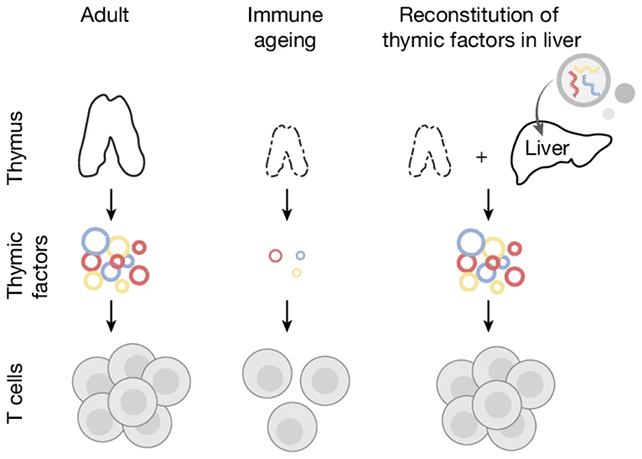
First, the researchers compared the immune systems of young mice with old mice to identify three key signaling proteins that decline with age: DLL1, FLT3-L, and IL-7. These handle the jobs of turning cells into T cells and keeping those cells healthy.
Next, an mRNA treatment package was assembled; mRNA (messenger ribonucleic acid) is like a set of instructions for protein production. This treatment was injected repeatedly into the livers of older mice, producing the desired signaling effects.
The liver is a high-output protein producer, even in old age. What's more, blood leaving the stomach and intestines must pass through the liver, and it's relatively easy to access for treatments like this, making it an ideal target.
In older mice given the mRNA treatment for four weeks, there were notable increases in both the number and diversity of T cells. They responded more strongly to vaccinations and were better able to fight off cancer tumors – signs of a boosted, younger, healthier immune system.

"Our approach is more of a synthetic approach," says MIT neuroscientist Feng Zhang. "We're engineering the body to mimic thymic factor secretion."
Importantly, the T cell production boost generated through the liver was temporary. This reduces the risk of overstimulating the immune system, which can lead to inflammation and the body attacking itself.
Related: Tattoos Affect Your Immune System in Ways We're Only Beginning to Understand
The results are promising, but this needs to be demonstrated to be a viable approach in humans as well as in mice. The researchers plan to expand their study in the future by looking at other types of animals, signal proteins, and immune cells.
There have been previous attempts to rejuvenate T cell production, including putting immune system boosters directly into the bloodstream, often with side effects and risks. These early results suggest this liver-based approach could offer a safe and effective alternative.
"If we can restore something essential like the immune system, hopefully we can help people stay free of disease for a longer span of their life," says Zhang.
The research has been published in Nature.