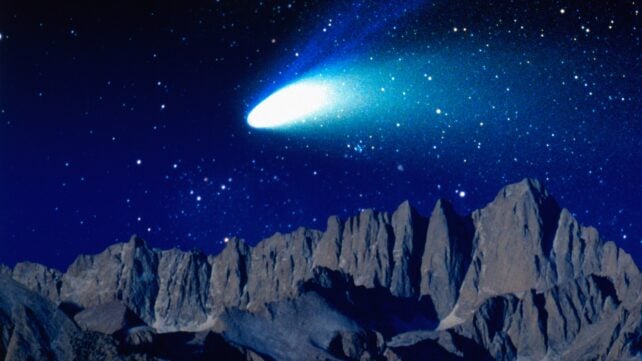
Where did we come from? The answer, many scientists have proposed, is space.
One longstanding theory, hypothesized for over a century, is that life on Earth emerged from fragments of prebiotic chemistry that arrived from the cosmic unknowns, possibly delivered by far-flung comets.
The idea is supported by a growing body of evidence, with scientists detecting signs of organic molecules in comets soaring through space, which hypothetically could seed the ingredients of life on worlds they come into contact with.
But according to new simulations, the chances of this actually happening are so improbable they're bordering on science fiction.
"It's kind of a romantic idea, but our results suggest it's highly unlikely," says astronomer Richard Anslow from the University of Cambridge.
In a new study in Scientific Reports, Anslow and fellow researchers ran simulations to test what would happen if comets, as hypothesized, did in fact carry prebiotic chemicals to Earth.
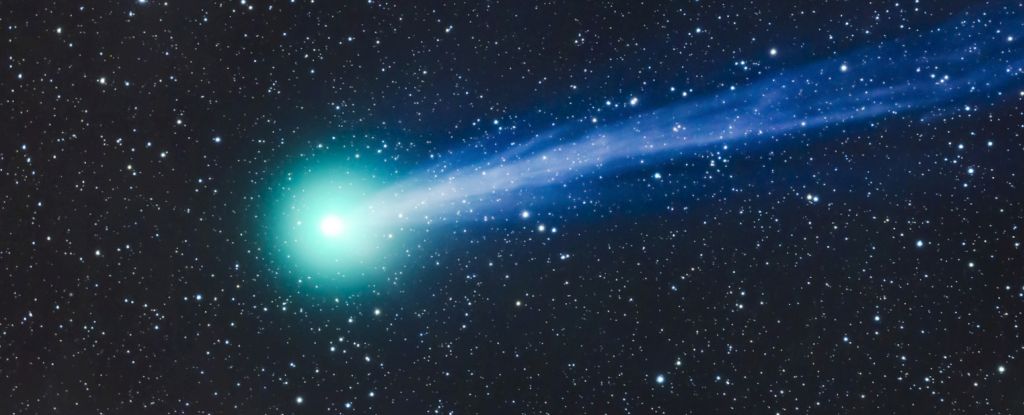
In the simulations, they focused on hydrogen cyanide, a 'feedstock' molecule that can help synthesize many of the building blocks of life – including lipids, sugars, nucleobases, and nucleotides.
Not only has hydrogen cyanide regularly been found in comets, but to date it's the only known feedstock molecule that's been found in sufficient abundance in comets observed in the Solar System to be considered prebiotically relevant, with other chemicals (such as cyanoacetylene and cyanogen) being found in much weaker concentrations.
But would a hypothetically fertile payload of hydrogen cyanide, transported safely to Earth aboard a comet, survive the cataclysmic culmination of its journey as its icy spaceship collided with Earth?
Across 100,000 simulations designed to recreate the conditions of Earth's early comet bombardment – during which time over 100,000 comets struck the planet – the researchers found it was exceedingly unlikely.
In 54 percent of simulations, not a single comet strike would have delivered a sufficient quantity of hydrogen cyanide to Earth's land, with comets breaking apart in Earth's atmosphere, losing their chemical payload in the heat of impact (the biggest factor), or striking oceans where any surviving hydrogen cyanide would be diluted.

The other 46 percent of simulations suggest at least one successful comet could have transported enough of the feedstock molecule to the surface, but even these successful deliveries would have offered only a fleeting opportunity for prebiotic chemistry.
Of course, these are only simulations, and the results don't prove that it didn't or couldn't happen, but they suggest that the cometary impact theory is much less likely than we may have realized before now.
"It would really have to be a one-in-a-million occurrence, because not only would you need an impact at just the right speed and just the right angle, you would also need everything to happen after that point, in terms of the concentration and the speed at which the chemical origins of life got going," says Anslow.
"We can't rule out for certain that it happened that way. But it seems to be a really rare occurrence – at best, a one-off fluke."
But just because the calculations suggest that life on Earth probably didn't get seeded by chemicals from comets, that doesn't mean the mechanism couldn't have worked on other planets.
Interestingly, the researchers found that Mars actually provides a better fit for the cometary impact hypothesis, with the red planet's thinner atmosphere and lower impact velocities enabling over five times as many successful transports as Earth.
By contrast, Venus's dense atmosphere would eat up most comets outright, even ones measuring several kilometers in diameter.
The findings are reported in Scientific Reports.
This article was fact-checked by Rebecca Dyer and edited by Rebecca Dyer. While we pride ourselves on our process, we are only human. If you spot a mistake, please let us know.