Prions are one of nature's cruelest tricks.
Proteins are chains of amino acids that need to fold in very specific ways – a process that does not always work as intended. Your body is pretty good at correcting these errors – but every so often, a prion emerges.
This isn't just a crooked, non-functional protein. It's a gnarly shape that shares instructions for how it got that way, while resisting the body's clean-up mechanisms. As these instructions spread through the brain, the result is rapid, progressive degeneration and, ultimately, death.
For years, scientists have noticed eerie similarities between prion diseases and many neurodegenerative conditions, such as Alzheimer's, Parkinson's, and corticobasal degeneration (CBD).
Both involve molecular misfolding – and there is mounting evidence that, like prions, misfolded proteins associated with these diseases can seed the misfolding and aggregation of other proteins, allowing the pathology to propagate through the brain.
But one crucial piece of the puzzle has been missing.
There was no direct evidence that the misfolded tau proteins involved in diseases such as Alzheimer's were passing on the blueprint for their particular horrible architecture.
Now, researchers led by structural biologist Sjors Scheres and neuroscientist Michel Goedert of the MRC Laboratory of Molecular Biology in the UK have found it.
They injected human tau proteins from individuals with Alzheimer's disease and CBD into mice – and found the mice's own tau proteins copying the introduced misfolds.
The shape of a protein is essential to its ability to function. It's a bit like a cog in a machine – if a cog's tooth is snaggled, it may not fit or turn in the machine the way it should.
What's particularly insidious about prions is that they are not just snaggled cogs – they're snaggled cogs that pass their snaggle on to other cogs, which then pass it on to others – a chain reaction that propagates through healthy tissue, leaving dysfunction in its wake.
This process is known as templated seeding, and different misfolded shapes can behave differently, producing what scientists call strains – distinct protein architectures associated with different patterns of disease.
Tau isn't normally a bad actor. It's a protein found abundantly in neurons, where it acts as structural scaffolding, assists nutrient transport, and helps transform short-term memories into long-term ones.
But sometimes tau goes wrong. In more than 20 neurodegenerative diseases known collectively as tauopathies, the protein assembles into abnormal filaments.
Just as different prion strains are associated with different prion diseases – such as bovine spongiform encephalopathy and Creutzfeldt-Jakob disease – those filaments aren't all mangled in the same way.
Different tauopathies are associated with different tau misfolds. Alzheimer's has characteristic structures, for instance, while CBD has another.
Previous experiments have shown that abnormal tau can cause healthy tau to misfold, and that abnormal tau taken from people with different tauopathies can produce different patterns of damage in animal brains.
That certainly looked prion-like. But researchers still didn't know whether the newly misfolded tau was actually copying the molecular architecture of the introduced tau that kicked off the chain reaction, or whether those distinct architectures could account for the different patterns of disease.
This is what Scheres and his colleagues wanted to find out.
They extracted misfolded tau from brain tissue generously donated to research by people who had died with Alzheimer's disease or CBD, and injected it into the brains of living wild-type mice.
This distinction matters because studies of tau pathology often use mice genetically engineered to express human tau or otherwise make the disease easier to model. These mice had their own ordinary mouse tau.
Then, they carefully tended, observed, and tested the mice over several months.
Within a week, human tau was no longer detectable in the mouse brains.
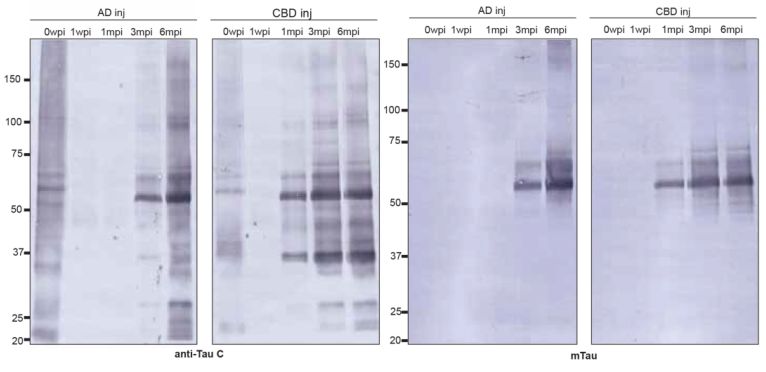
But over the following weeks and months, the mice's own tau started to crumple. And it didn't happen in the same way in the Alzheimer's and CBD groups.
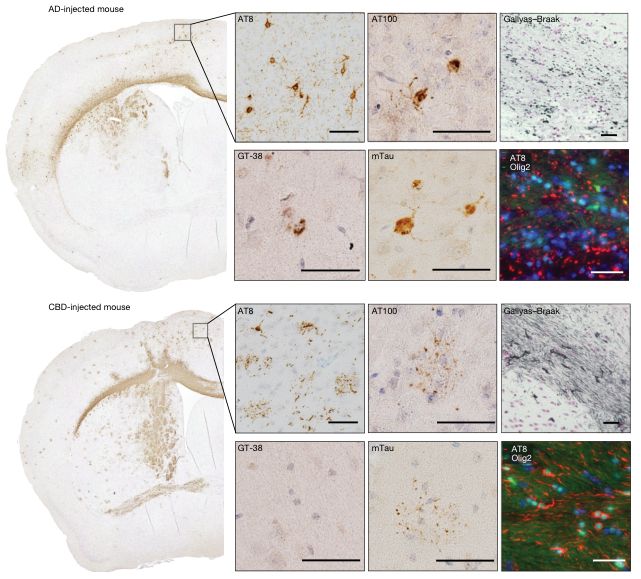
In mice given Alzheimer's tau, the misfolded mouse tau accumulated only in neurons.
In those given CBD tau, it accumulated in both neurons and supporting glial cells, producing structures resembling those seen in the brains of humans with CBD.
Next, the researchers peered at the misfolded mouse tau at the atomic scale using cryo-electron microscopy to see exactly how the proteins had folded compared to their parent human protein.
The resemblance was extraordinary.
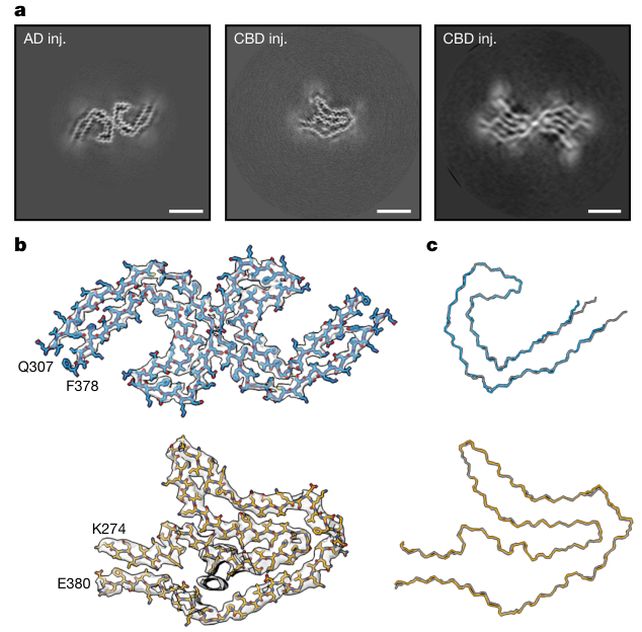
In mice injected with Alzheimer's tau, the mouse tau had folded into the same structure seen in human Alzheimer's disease. In mice injected with CBD tau, the mouse tau instead matched the structure seen in human CBD.
The original human tau had been long gone – but its legacy was imprinted in every snaggle of misfolded mouse tau.
And the different molecular architectures were associated with different patterns of pathology – the Alzheimer's fold with the neuron-only pattern, and the CBD fold with the distinctive mix of neuronal and glial inclusions.
Intriguingly, despite accumulating these abnormal tau structures, the mice appeared healthy.
It's not yet clear whether they simply didn't live long enough for symptoms to emerge, whether too little abnormal tau accumulated to cause them, or whether the spread of misfolded tau and the damage it ultimately causes are separate stages of disease.
It's also important to note that this does not mean that the tauopathies in question are directly analogous to prion diseases. One critical characteristic of the latter is that they are infectious. Tauopathies such as Alzheimer's disease and CBD are not known to naturally spread from person to person.
The researchers now want to tease apart the molecular processes that govern how tau seeds are taken up by cells, convert other tau proteins, and spread through the brain.
Their results suggest that ordinary mice could provide a powerful model for doing so.
By working out what drives this process, the researchers hope to better understand how different tau strains produce their distinctive patterns of disease – knowledge that could ultimately point toward new ways to diagnose and treat these conditions.
The research has been published in Nature.
This article was fact-checked by Rebecca Dyer and edited by Rebecca Dyer. While we pride ourselves on our process, we are only human. If you spot a mistake, please let us know.