
A breakthrough in chronometry decades in the making could redefine the limits of how we keep time.
Using atoms of thorium-229, physicists have built functional clocks based not on the oscillations of electrons, but on the back-and-forth energy shifts of atomic nuclei themselves.
What makes this achievement even more exciting is that it has been achieved twice, by two independent teams of scientists, in Europe and China.
Both teams have detailed their momentous work in preprints on arXiv.
"The system presented in this work," writes the team led by physicist Luca Toscani De Col of the Technical University of Vienna, "constitutes the first implementation of a nuclear clock that operates as a stand-alone device."
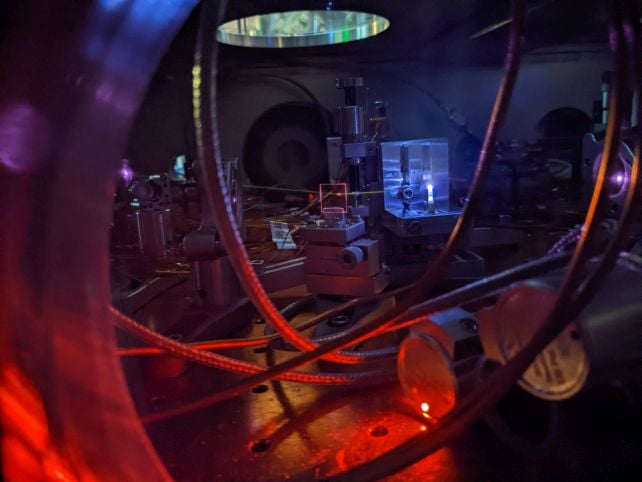
Atomic clocks, first built in the 1950s, can keep time with such precision that not a single second would be lost over billions of years.
They keep time based on the precise 'ticking' of electrons as they switch between energy states when stimulated by a laser.
A nuclear clock, first proposed in 2003, would measure time by tracking energy changes in the nucleus itself. Achieving this has proved far more difficult because nuclear transitions typically require much higher energies than electron transitions, placing them beyond the reach of most laser technologies.
But there is a very good reason for pursuing nuclear clock technology.
Electrons occupy the outer regions of an atom, which makes them – and atomic clocks – more vulnerable to influences from their surroundings.
The nucleus, by contrast, is ensconced deep at the atom's center and is far less susceptible to outside interference.
In theory, that could make nuclear clocks even more stable than today's atomic clocks, while also turning them into powerful tools for probing phenomena such as dark matter and possible changes in the fundamental constants of nature.
Thorium-229, as laid out in that 2003 paper, is such an excellent target for this technology because it has an exceptionally low-energy transition state, bringing it within reach of precision laser spectroscopy.
In 2024, researchers in Austria and Germany made multiple breakthroughs, triggering the energy transition in thorium-229, then getting it to 'tick'.
The next step was to develop that ticking into an actual clock that could keep time.
And this is what the two research teams have done.
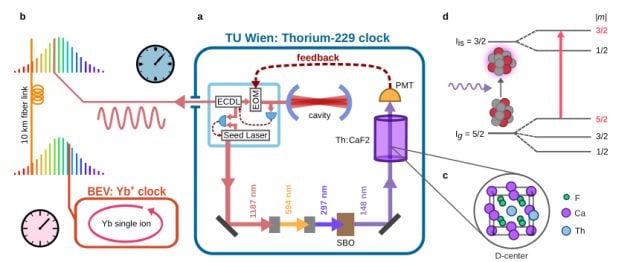
Both teams built their clocks around thorium-229 nuclei embedded in calcium fluoride crystals and interrogated with vacuum-ultraviolet laser light. From there, however, their approaches diverged.

The European team's device operated as a complete stand-alone clock, using the thorium nucleus to continuously stabilize a laser frequency.
The researchers compared their clock against an established ytterbium-ion atomic clock, demonstrating long-term operation and stability.
They also used the clock to search for signs of hypothetical ultralight dark matter, setting new constraints on several proposed models.
"Drawing benefit from the enhanced sensitivity of the thorium-229 transition, these constraints compete with the best atomic clocks concerning dark matter coupling to photons and go beyond previous measurements regarding coupling to the strong force and quarks," they write in their paper.
Meanwhile, the Chinese team, led by physicist Beichen Huang of Tsinghua University, had a slightly different focus.
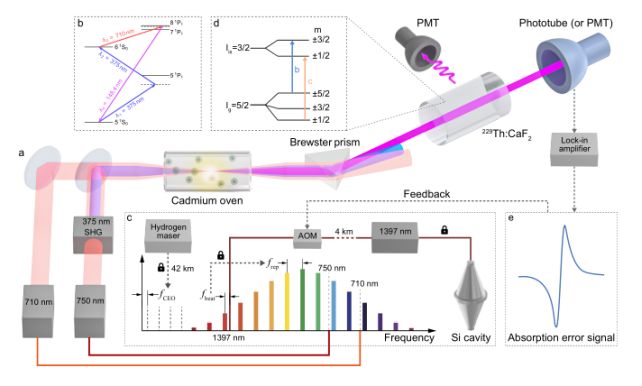
They tested their clock in two independently produced crystals to establish whether the ticking was consistent.
Their clocks yielded nearly identical frequencies, addressing a major challenge for solid-state nuclear clocks.
If the crystal environment altered the nuclear frequency unpredictably, each device would require its own calibration.
Instead, the close agreement suggests nuclear clocks could eventually become reproducible standards rather than one-off laboratory demonstrations.
Related: We Have a New Record For The Most Accurate Clock Ever Built
"By making a laser-addressed atomic nucleus an operational clock reference," the Chinese team writes, "this work extends quantum metrology from electronic to nuclear transitions, and opens a new platform for compact clocks, solid-state nuclear quantum sensors, and precision tests of fundamental physics."
The new devices do not yet outperform the best atomic clocks – which, let's be honest, have a 70-year headstart – but they do show that nuclear clocks are not just a theoretical dream.
They can and do work in the real world.
And if Technical University of Vienna physicist Thorsten Schumm's 2024 prediction proves correct, they may even outstrip today's best atomic clocks within just a few years.
The clocks have been described in preprints uploaded to arXiv, here and here.