A lot can change after a cancer diagnosis. The news may bring distress, anxiety, or depression, along with a cascade of recalculations from patients who suddenly see life in a different light.
A new study suggests it may also change something more unexpected. In the years after a cancer diagnosis, people are significantly more likely to be convicted of a crime, including those with no prior criminal record.
Yes, it's like Breaking Bad, the TV series about a mild-mannered high school chemistry teacher whose cancer diagnosis prompts a descent into criminality.
Most cancer patients who experience this effect don't become as ruthless as Walter White, however. According to the study, their convictions tend to reflect offenses such as shoplifting or drug possession.
Yet those transgressions can still cause trouble. Given the potential ramifications for convicted patients, their families, and victims, it's worth digging deeper to learn if cancer is really behind this pattern – and if so, why?
To do that, a team of economists combined data from several administrative registers in Denmark, producing a vast dataset covering demographics, labor, education, income, wealth, health, and criminal history.
They focused on 368,317 people diagnosed with cancer between 1980 and 2018. By linking health data and criminal records, they were able to compare patients' behavior with a control group who hadn't received a cancer diagnosis.
At first, newly diagnosed cancer patients show no signs of criminality, the study found. Crime rates actually decrease in the first year after diagnosis, which is plausible considering many of those patients are enduring intensive therapies like radiation or chemotherapy.
"The main reason for this initial decrement is intuitive," the researchers write. "Undergoing cancer treatment is physically strenuous and forces a cancer patient to visit or remain at the hospital for long periods."
Two years after a diagnosis, however, something changes: Patients' likelihood of a criminal conviction rises above their pre-cancer baseline and becomes statistically significant.
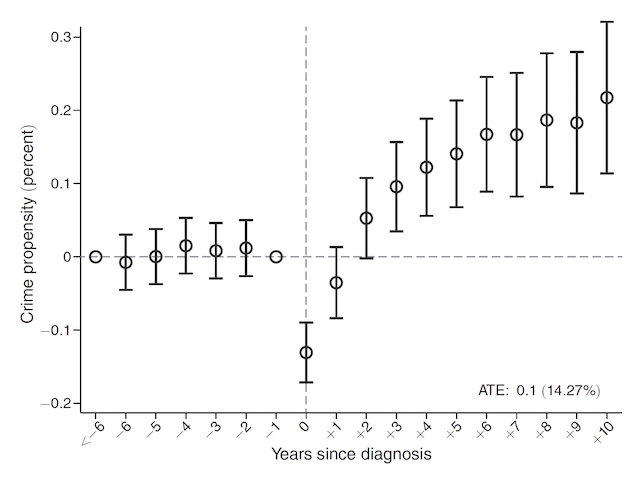
This effect continues to grow for five years after diagnosis, then stabilizes at high levels for another five years.
Overall, patients are 14 percent more likely to be convicted of a crime after being diagnosed with cancer, the study found.
Beyond demonstrating this correlation, the researchers sought to understand why a cancer diagnosis might compel people to break the law. They explored several possible mechanisms, starting with economics.
All patients in this study had health insurance, which is universal in Denmark, suggesting those who turned to crime weren't motivated by unpaid medical bills, the authors note.
Still, cancer takes a financial toll. Patients' probability of employment falls by 1.5 percentage points the year they're diagnosed, the authors report, and even those with jobs tend to work fewer hours and bring in less income.
"We show that the individuals who have the strongest crime-cancer relation also tend to experience the largest decline in total income," the researchers write.

Yet along with spikes in economic and property crimes, the study also found a substantial rise in non-economic crimes like violent offenses, hinting at additional factors.
The researchers also considered patients' survival probabilities, since the prospect of an earlier death may diminish the deterrent of long-term consequences like imprisonment.
They grouped patients into subsets based on five-year survival probabilities estimated from cancer type and patient attributes such as age, gender, and marital status.
The link between cancer and criminality was stronger for patients whose five-year survival probability fell more steeply during the year they were diagnosed.
Welfare policies might mitigate this effect. Capitalizing on variation caused by the 2007 Danish municipal reforms, the study's authors found cancer's crime boost was more pronounced in places where social support had been reduced.
Related: Most Preventable Cancers Are Linked to Just Two Lifestyle Habits
Cancer patients must continue adapting to new, often unwelcome circumstances. Many seek support from loved ones or focus on steps to boost their health, such as exercising and researching treatment options.
If the link holds up in other countries, it could point to a new kind of support gap.
"Our results indicate that policies that address the economic consequences of health shocks are important in mitigating the resulting impact on crime," the researchers write.
The study was published in the American Economic Journal: Applied Economics.