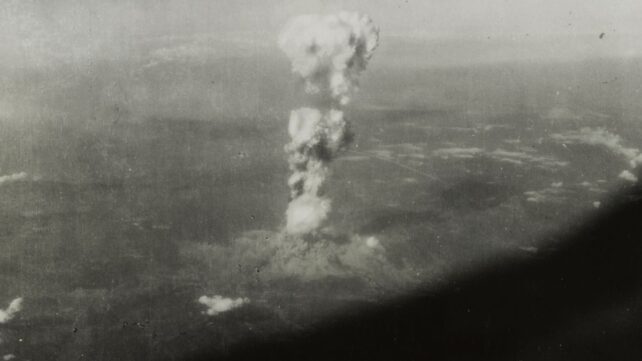
The world changed forever on 6 August 1945.
That was the day humanity first deliberately turned the most powerful weapon ever conceived upon itself – when the US unleashed an atomic bomb on the people of Hiroshima in Japan.
In seconds, the fireball reached temperatures above 7,000 °C (~12,600 °F), vaporizing flesh and metal alike.
And, as materials cooled in its terrible wake, something humanity had never seen before formed in the ashes.
In a speck of material retrieved from the sands of Hiroshima Bay, scientists led by geologist Luca Bindi of the University of Florence in Italy have identified a tiny grain of metallic alloy forged in the extreme circumstances of an atomic blast.
"A nuclear fireball exposes many different materials to extreme heat, violent mixing and extraordinarily rapid cooling, all within seconds," Bindi told ScienceAlert.
"In effect, it performs an enormous number of uncontrolled materials experiments at once, sampling combinations and structures that would take researchers years to explore deliberately in a laboratory."
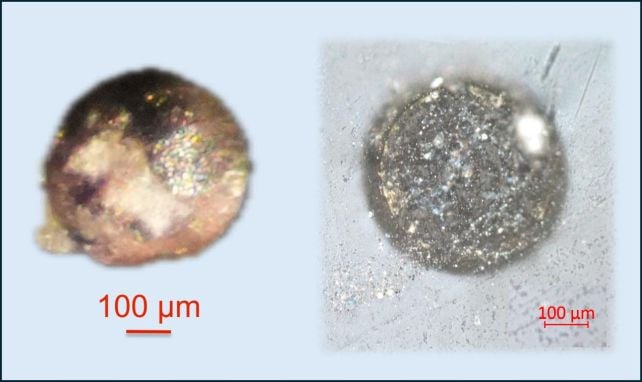
The 15-kiloton blast when the bomb known as Little Boy detonated over Hiroshima left behind many scars. Some are well known, like the shadows of victims etched on stone and concrete; others are more subtle.
Among the latter are microscopic particles of fallout debris known as hiroshimaites – tiny globs of glassy material formed as vaporized and molten matter was scrambled together and rapidly cooled during the airburst event.
These particles contain a physical record of the fireball. Different materials were all swept up and mixed together in conditions and combinations that wouldn't normally occur, even under artificial manufacturing conditions.
"Metals, glass, soil, and building materials are vaporized and mixed at very high temperature, creating chemical combinations that would rarely occur under normal conditions," Bindi explained.
"As the fireball expands, the material condenses and cools so quickly that unusual atomic arrangements can be frozen in place before they transform into simpler, more stable structures."
Previous work had already demonstrated that Hiroshima fallout products contain unusual condensates that form under those extreme but fleeting temperature conditions.
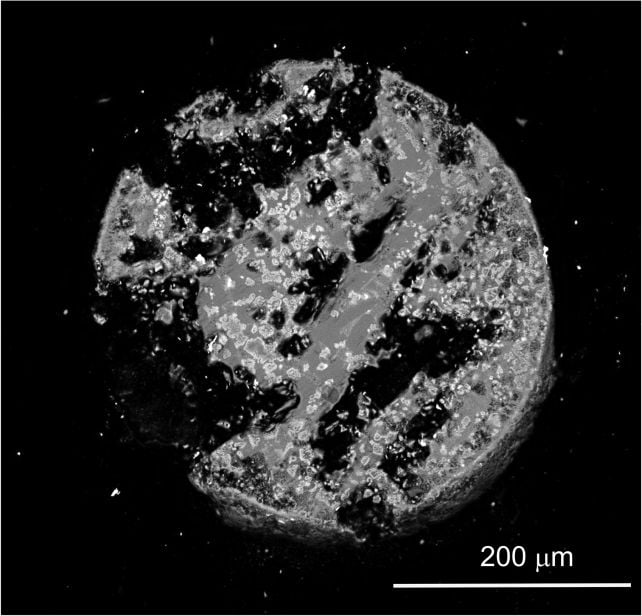
Bindi and his colleagues were broadly searching for unusual metallic phases preserved in the fallout when they undertook a study of 34 samples of hiroshimaite, using a variety of high-resolution techniques to probe the microscopic composition and structure of each tiny glob.
One of those samples proved particularly interesting. Embedded within its glassy matrix were numerous microscopic fragments of iron-chromium alloy.
Most of those metallic fragments were more or less as expected for the context.
But one stood out.
"The first clue came from the chemical analyses: one grain contained much more silicon than the surrounding Fe–Cr-rich metal particles," Bindi said.
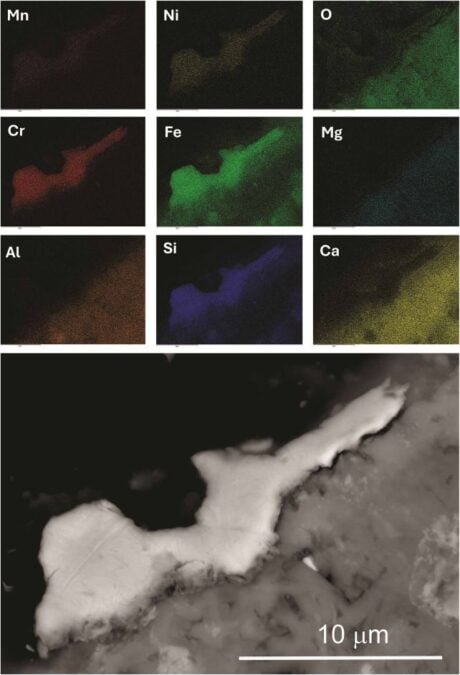
The grain is only about 10 micrometers across and, as electron-microprobe analysis revealed, contains predominantly iron, plus chromium, silicon, nickel, molybdenum, manganese, and aluminum. But it wasn't just the mix of elements that made it so peculiar.
The researchers selected four grains for a much closer look – their tiny oddball, and three others about the same size.
Using fine needles, they carefully extracted the grains by hand from the polished sample, then used a technique called single-crystal X-ray diffraction to determine the way the atoms were arranged inside each one.
The three comparison grains had the simple body-centered cubic structure expected for ordinary steel.
The oddball did not.
That was the decisive observation.
"The novelty," Bindi explained, "lies in that specific combination of chemistry and crystal structure, which does not match known industrial alloys or previously reported blast products."
An alloy isn't defined only by its ingredients; how those atoms are arranged matters too. Two materials containing broadly similar elements can have very different properties depending on their crystal structures. That's why the combination of chemistry and structure defined the new alloy's novelty.
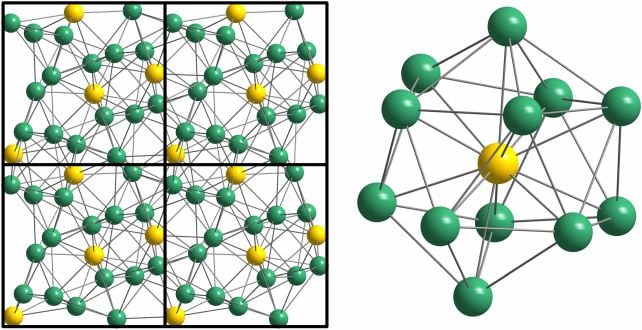
X-ray diffraction revealed that instead of the simple body-centered cubic arrangement found in the comparison grains, the atoms in the silicon-rich grain occupy a much more complex, highly ordered cubic arrangement called an AlAu₄-type structure, derived from the beta-manganese structure.
The researchers believe that it formed under the intense conditions of the nuclear blast – it condensed from a metallic vapor and then cooled extraordinarily quickly. Under more normal circumstances, the condensed blob would form a simpler structure as it cooled more slowly.
Instead, the alloy was trapped in a far more complicated configuration before it could relax into something more stable.

And that might not be all that unusual for nuclear fallout. Earlier this year, another team led by Bindi revealed a never-before-seen clathrate in the debris of the Trinity test conducted in July 1945.
"These discoveries suggest that historic blast debris may contain an entire population of rare metastable phases, many of them hidden in grains only a few micrometers across and therefore easy to overlook," Bindi said.
Related: The World's First Nuclear Explosion Created a Rare Form of Matter
That means the debris left in the ashes of nuclear explosions may contain a microscopic library of materials we don't yet know exist, forged under conditions so extreme and fleeting that they would be difficult to reproduce deliberately.
But it is important not to forget how they were created – the profound poignancy of discovering a previously unknown material inside the debris of one of humanity's greatest tragedies.
"That tension is always present," Bindi said.
"Scientifically, the material is extraordinary, but it cannot be separated from the human catastrophe that created it; the work must therefore be approached with humility, respect and a clear awareness that scientific knowledge here comes from the remains of immense suffering."
The findings have been published in Science Advances.
This article was fact-checked by Rachel Garner and edited by Rebecca Dyer. While we pride ourselves on our process, we are only human. If you spot a mistake, please let us know.