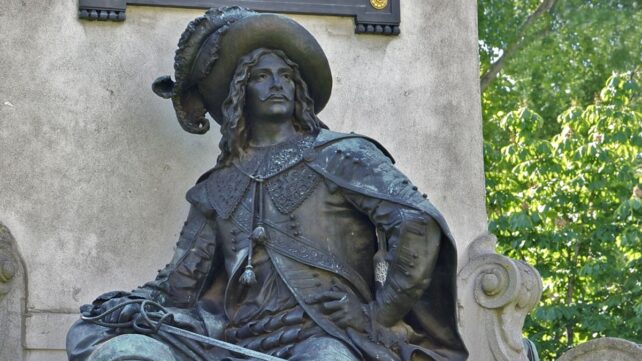
The swashbuckling 1844 adventures of French author Alexandre Dumas' The Three Musketeers were not entirely a work of fiction.
Each of the main characters was based on a real 17th-century French soldier – and now the remains of the fourth and most famous member of the crew, d'Artagnan, may have been discovered buried beneath a church in the Netherlands.
He was a minor noble named Charles de Batz de Castelmore d'Artagnan, who served King Louis XIV as captain of the Musketeers, and his remains have been missing for more than 350 years since he was killed, reportedly by a musket shot to the neck, during the siege of Maastricht in June 1673.
Now, beneath where an altar once stood at St Peter and Paul Church in Wolder, Maastricht, archaeologists have found remains that may be the long-lost hero – although they are being cautious until the identity of the bones can be confirmed by a DNA match with d'Artagnan's bloodline.
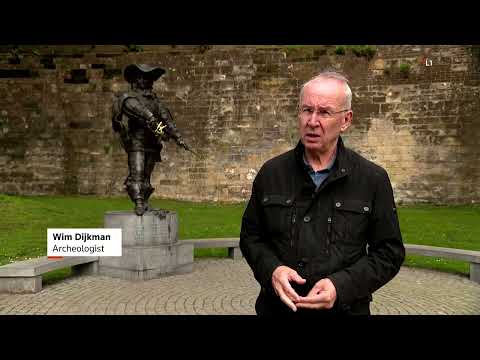
"This has truly become a top-level investigation, in which we want to be absolutely certain – or as certain as possible – whether it is the famous musketeer, who was killed here near Maastricht," archaeologist Wim Dijkman told Reuters.
Dijkman, now retired, has been searching for the soldier's final resting place for 28 years. One strong lead was Louis XIV's religion – the Sun King was Roman Catholic, and d'Artagnan was one of his top lieutenants.
Transporting the soldier's body back to France during high summer would have been an unpleasant task; instead, he may have been honorably interred on consecrated ground near where he fell.
St Peter and Paul Church has long been considered a top candidate. It sits close to the site where the French army camped, and, according to historian Odile Bordaz, who scoured contemporaneous local church registers, top-ranking individuals killed in battle were usually buried at the nearest church.

However, the register for St Peter and Paul was missing, and one cannot just excavate willy-nilly in historical buildings, so the question had to remain unanswered.
Until, that is, an opportunity arose. Ground subsidence had shifted a section of the church floor, cracking some of the tiling. It was repair workers who found the bones.
"A piece of floor had subsided in the church and during the repair work we discovered a skeleton," deacon Jos Valke told Dutch news organization L1 Nieuws.
"I immediately called Wim because he has been working with d'Artagnan for more than 20 years."
Bone by painstaking bone, the archaeologist unearthed the remains, which had been undisturbed since they were carefully laid to rest beneath the altar.
The skull was unfortunately badly damaged, but the remains were otherwise in remarkable condition. And there were other clues about who the individual may have been.
Related: Hidden Crotch Detail Solves a 500-Year-Old Leonardo Da Vinci Mystery
"He was buried under the altar in consecrated ground. There was a French coin in the tomb from that time [dated to 1660]. And the bullet that killed him was at the level of his chest. Exactly as described in the history books. The indications are very strong," Valke said.
Given that there was a war going on at the time, however, the presence of a bullet and a coin is insufficient to positively identify the remains as Charles de Batz de Castelmore d'Artagnan.
DNA was extracted from the skeleton's jawbone to compare with DNA from descendants of d'Artagnan's father, who donated their genetic material to aid the effort.
We probably won't have long to wait for an answer.
"I am anxiously waiting for an official confirmation and that should come within now and a few weeks," Dijkman told L1 Nieuws.
"At the moment, all kinds of analyses and studies are underway at home and abroad. It really has become a top study. We want to be absolutely sure that it is d'Artagnan."