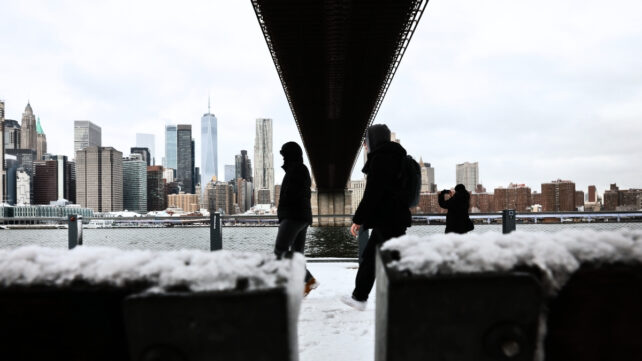
ATLANTA (AP) – Bread was flying off the shelves, salt was being loaded into trucks, and utility workers nervously watched forecasts Thursday as a huge winter storm that could bring catastrophic damage, widespread power outages, and bitterly cold weather barreled toward the eastern two-thirds of the US.
The massive storm system is expected to bring a crippling ice storm from Texas through parts of the South, potentially around a foot (30 centimeters) of snow from Oklahoma through Washington, D.C., New York, and Boston.
A final punch of bitterly cold air could drop wind chills to minus-50 degrees Fahrenheit (minus-46 Celsius) in parts of Minnesota and North Dakota.
Related: Dangerous Winter Storm Hammers Millions in The US
Forecasters are warning that the damage, especially in areas pounded by ice, could rival a hurricane. About 160 million people were under winter storm or cold weather watches or warnings – and in many places, both.
When will it start?
The storm was expected to begin on Friday in New Mexico and Texas, with the worst weather moving east into the Deep South before heading up the coast and thumping New England with snow.
Cold air streaming down from Canada caused Chicago Public Schools and Des Moines Public Schools in Iowa to cancel classes on Friday. Wind chills as low as minus-35 degrees Fahrenheit (minus-37 Celsius) could cause frostbite within 10 minutes, making it too dangerous to walk to school or wait for the bus.
Winter weather is forecast to impact a large part of the country in the coming days. Will there be snow, ice, rain?
NWS Meteorologist Haley Thiem explains how the temperature of the air between the clouds and the ground determine the type of precipitation you get. pic.twitter.com/hJ14ZTDWYa
— National Weather Service (@NWS) January 22, 2026
The cold punch coming after means it will take a while to thaw out, an especially dangerous prospect in places where ice and snow weigh down tree branches and power lines, and cut electricity, perhaps for days. Roads and sidewalks could remain icy well into next week.
Freezing temperatures are expected all the way to Florida, forecasters said.
A severe cold snap five years ago took down much of the power grid in Texas, leaving millions without power for days and resulting in hundreds of deaths. Gov. Greg Abbott said Thursday that it won't happen again, saying the power system "has never been stronger, never been more prepared."
The difficulty of predicting winter storms
Winter storms can be notoriously tricky to forecast – one or two degrees can mean the difference between a catastrophe and a cold rain – and forecasters said the places with the worst weather can't be pinned down until the event starts.
Georgia Gov. Brian Kemp declared a state of emergency while acknowledging Thursday that some forecasts have disastrous levels of wintery weather in Atlanta, while others have the Deep South's largest city mostly spared.

In the suburbs of Louisville, Kentucky, ice melt and snow shovels sold fast at the family-owned Brownsboro Hardware. Store manager Matthew Isham said the storm "has people on edge."
"I've heard a ton of people saying they don't think they're going to get in or out of their driveway if it does snow like they're saying," Isham said.
As a precaution, North Carolina's largest public school system was preparing for potentially several days out of physical classrooms next week.
The Wake County school system, with 161,000 students in and around Raleigh, told its nearly 11,000 teachers to create three days of assignments accessible online or through paper copies.
Brine trucks were already treating roads from Oklahoma to Tennessee, with more states expected to begin treating roads as the storm gets closer.
Virginia Gov. Abigail Spanberger told residents to prepare for days without power or the ability to leave their neighborhoods.
🥶January may be ready to fade, but the latest outlook shows the cold weather likely will not in the East as the month closes out. February also looks to start out cold. Get more details at: https://t.co/wYDLhvkLBm pic.twitter.com/cCtft8kmgB
— NWS Eastern Region (@NWSEastern) January 22, 2026
Arkansas Department of Transportation spokesman Dave Parker said that this "is not going to be your typical Arkansas storm system." He pleaded for people to be patient and stay home if possible once the storm hits, even if it takes days to clear sheets of ice off some roads.
Louisiana Gov. Jeff Landry implored people, "I beg you, please take this serious," as his team highlighted road preparations, warming centers, some 5,000 power line workers on standby, and a stock of 600,000 bottles of water.