A tiny robot so small it can barely be seen can still "sense, think, and act" autonomously, according to the engineers who built it.
To the team's best knowledge, this joint invention is the world's smallest programmable robot that can autonomously move through fluid, shrinking the volume of previous designs by some 10,000-fold.
The researchers at the University of Pennsylvania and the University of Michigan who developed the device claim that, until now, no one has ever put a real computer – equipped with a processor, memory, sensors, and a propulsion system – into a platform this small.
Related: Tiny Robots Have Successfully Cleared Pneumonia From The Lungs of Mice
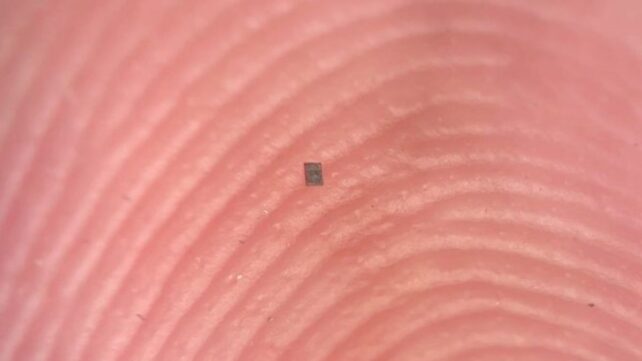
A freckle would outsize the infinitesimal device, which is no bigger than a grain of salt, and so small it can balance on the ridge of a fingerprint.
In fact, it is barely even visible, measuring just 200 by 300 micrometers wide, and 50 micrometers thick.
Placed on a penny, the microrobot is even smaller than the coin's stamped date.
Blink, and you might lose it.

The design has huge potential, despite its minuscule size.
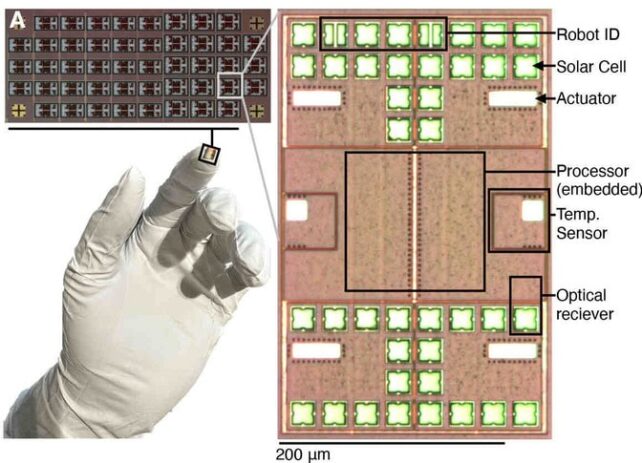
Its creators claim the fully programmable platform (which only works when submerged in fluid) can move, sense, act, and compute using solar cells that generate only about 100 nanowatts of power.
It can even measure the temperature of the fluid it is immersed in, and communicate those measurements by doing a little 'dance', similar to how honeybees communicate.
"This is really just the first chapter," says nanorobotics engineer Marc Miskin from the University of Pennsylvania.
"We've shown that you can put a brain, a sensor, and a motor into something almost too small to see, and have it survive and work for months.
"Once you have that foundation, you can layer on all kinds of intelligence and functionality. It opens the door to a whole new future for robotics at the microscale."
Before now, the smallest autonomous, programmable robots were more than a millimeter in size, an achievement first made more than two decades ago.
But attempts to shrink robotics any smaller hit a snag: the unique physics of the micrometer scale, where forces such as drag and viscosity take over from gravity and inertia.
"If you're small enough, pushing on water is like pushing through tar," explains Miskin.
The breakthrough was achieved by combining two recent inventions: a microscopic computer developed by University of Michigan researchers, and a specially designed propulsion system developed at the University of Pennsylvania.
The propulsion system doesn't rely on any moving parts; the microrobot has no limb-like extensions because they are hard to build small and would break easily.
Instead, it works by generating an electrical field that creates a flow of molecules around the robot's body.
"It's as if the robot is in a moving river, but the robot is also causing the river to move," says Miskin.

Cramming a computer onto such a tiny platform required a total rethink of computer programming and semiconductor circuits, says David Blaauw, a computer scientist at the University of Michigan.

The result is a microrobot, five years in the making, that can sync up with others, creating complex, moving groups similar to schools of fish.
Theoretically, these groups could continue operating autonomously for months, provided they are charged by LED light on their solar panels.
The researchers are optimistic that in time, with further advances, they will be able to increase the onboard memory of their rudimentary robots to enable more complex programming that produces more sophisticated autonomous behaviors.

Perhaps one day a microscopic device like this one could become a guardian of our body's cellular health.
From little robots, big possibilities grow…
The study was published in Science Robotics.