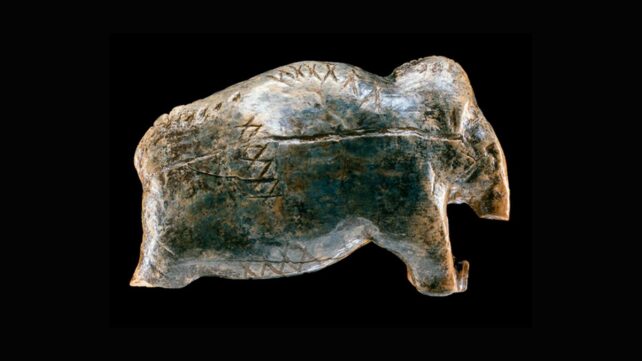
Thousands of marks carved into Paleolithic artifacts suggest that early modern humans were using structured symbols to communicate as far back as 40,000 years ago, a detailed analysis has found.
The marks, made by people of the Aurignacian culture between 43,000 and 34,000 years ago, are not complex enough to qualify as writing in the strict sense – they do not directly represent spoken language.
But the way they were arranged on various objects shows measurable structure comparable to the earliest protocuneiform systems that emerged around 5,300 years ago.
They may represent an early precursor to writing, according to the newly published research by linguist Christian Bentz of Saarland University in Germany and archaeologist Ewa Dutkiewicz of the Berlin State Museums.
This does not mean that these symbols encoded numbers or ideas the way protocuneiform did.
Instead, according to Bentz and Dutkiewicz, the marks "prove that the first hunter-gatherers arriving in Europe already applied sign sequences of comparable complexity in a deliberate, systematic, and conventional manner – several ten thousand years before the advent of genuine writing."
One of the traits that sets humans apart is our ability to create shared symbolic systems that store and communicate information, whether that's a writing system, tally marks carved in a bone, or the set of emojis in your phone's messaging app.
Many of these systems have been lost to time. The artifacts themselves may have decayed beyond recognition, or the cultural knowledge needed to understand them has vanished. That makes it difficult to trace when – or how – humans first began using marks to store information outside the mind.
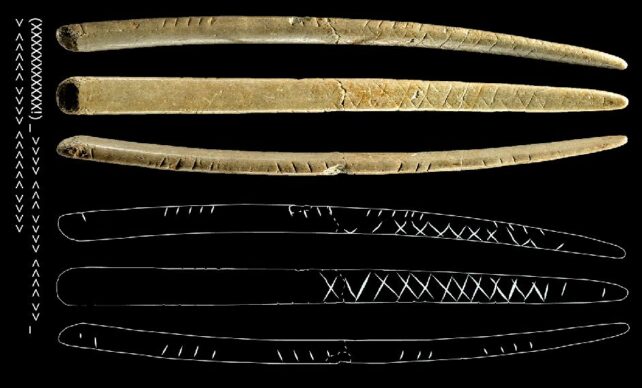
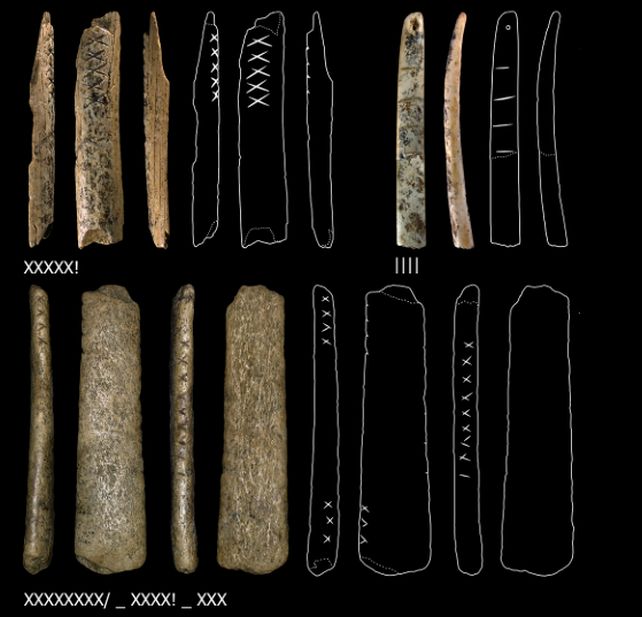
While we can't decipher what these particular symbols meant, patterns in how they were applied can reveal how they functioned. Bentz and Dutkiewicz focused their statistical analysis on 260 portable objects from the Aurignacian culture, which inhabited a cluster of caves in what is now southern Germany.
These included figurines and other artifacts carved from ivory, bone, and antler. Many were adorned with markings such as dots, lines, chevrons, crosses, zigzags, stars, and hatched grids.

Across the artifacts, the researchers cataloged more than 3,000 individual marks, grouping them into distinct categories and recording the type of object on which each appeared. That dataset served as the basis for their statistical analysis.
They looked for patterns in how the marks were arranged using algorithms and information-theoretic models. The team measured features such as repetition rates, diversity of symbol types, and entropy, a statistical measure of how much information a sequence can carry. These metrics are often used to study language and early writing systems.
The results suggest the carvings were far from random.
The symbols appeared in deliberate, repeatable sequences with measurable structure. Different types of objects bore different patterns: figurines, for example, carried sequences with information density – more structured variation within a sequence – roughly 15 percent higher than tools.
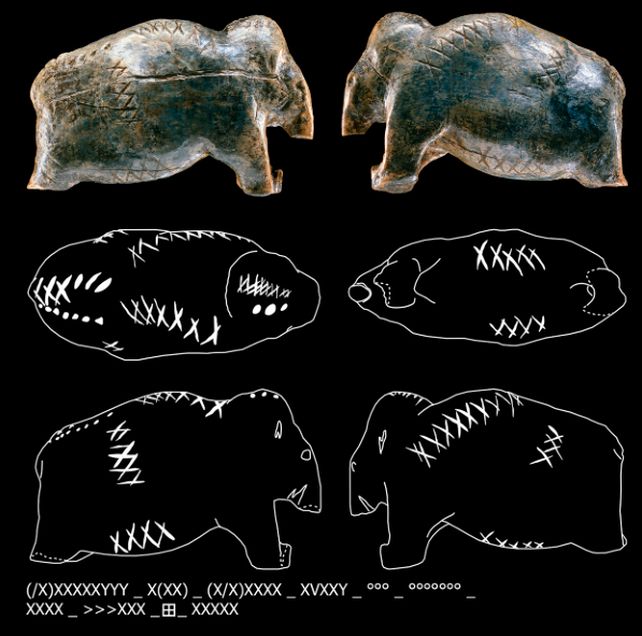
Tools, in turn, showed about 10 percent higher density than tubes or flute-like artifacts, and around 15 percent higher than personal ornaments.
These patterns remained stable for roughly 10,000 years, suggesting they served a consistent, shared function rather than simple decoration. The researchers remain very clear that this function is not to record spoken language; the patterns are inconsistent with writing, which is first known to have emerged about 5,000 years ago.
Related: Crucial Feature of Human Language Emerged More Than 135,000 Years Ago
The research suggests that the Aurignacian symbols represent a form of human intercommunication, even if their exact meaning is now lost. While we may never know what they signified, the findings indicate that humans were storing and structuring information tens of thousands of years before the first known writing systems emerged.
"It remains hard – or impossible – to prove that Aurignacian sign systems served the same numero-ideographic functions as protocuneiform. Moreover, there is another stark contrast between them: Protocuneiform developed into a full-blown writing system representing the Sumerian language within the subsequent 1,000 years," the researchers write.
"The sign sequences of the Swabian Aurignacian, on the other hand, were stable in terms of information density – for 10,000 years – and then disappeared."
The findings are published in the Proceedings of the National Academy of Sciences.