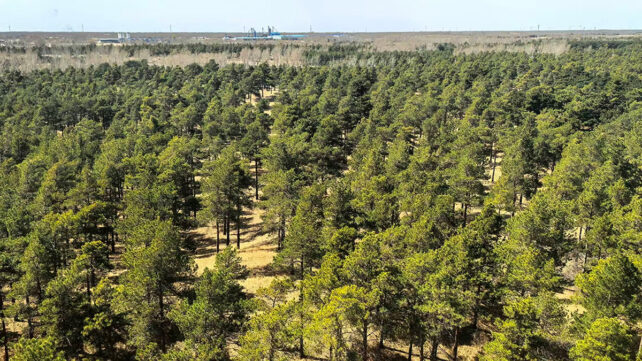
One of the driest regions in the world is being transformed into a carbon sink through a long-term, large-scale tree planting program, absorbing more greenhouse gases than it emits.
It's the result of almost five decades of work around the edges of the Taklamakan Desert in northwestern China, and evidence that with the right levels of funding and stability, these afforestation projects can – by some measures – be successful.
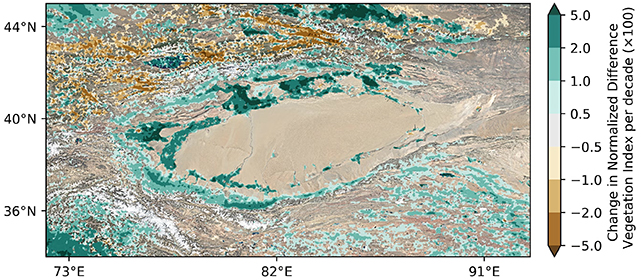
The changes at the desert's borders were evaluated by a team of scientists from the United States and China, who used several years of satellite sensor data modeling to analyze CO2 levels, vegetation cover, and weather patterns.
Where large tropical forests like the Amazon readily attract attention as carbon sinks, findings such as this reinforce the contributions smaller bands of trees and shrubs can make. The researchers suggest other deserts could be transformed in the same way.
"This is not like a rainforest in the Amazon or Congo," says King-Fai Li, an atmospheric scientist from the University of California, Riverside. "Some afforested regions are only shrublands like Southern California's chaparral."
"But the fact that they are drawing down CO2 at all, and doing it consistently, is something positive we can measure and verify from space."
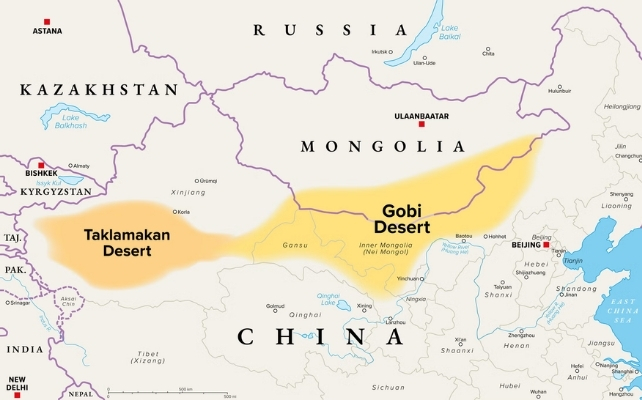
The researchers describe the Taklamakan Desert as a "biological void" and a "hyperarid environment", emphasising the harshness of the climate that covers some 337,000 square kilometers or 130,116 square miles (about three-quarters the size of California).
There's recent evidence to suggest that deserts can be carbon sinks, but there are numerous variables at play, from weather patterns to the movement of sands.
While tree-planting has only happened around the margins of the Taklamakan Desert, it seems it has been making a significant difference to carbon levels. The data gathered by the researchers shows a strengthening uptake of carbon from the desert region as a whole, particularly during the wet season (July to September), and in the areas where trees have been growing.
There are additional benefits – the afforestation program has impeded wind erosion, reduced the frequency and the intensity of sandstorms, and protected local agricultural land.

Part of the Three-North Shelterbelt Program, the scheme around the desert is expected to continue until 2050. The ultimate goal is to increase forest cover from 5.05 percent to 14.95 percent across 13 provinces in northern China.
"Even deserts are not hopeless," says Li. "With the right planning and patience, it is possible to bring life back to the land, and, in so doing, help us breathe a little easier."
It's important to bear in mind that the borders of the Taklamakan Desert do have some special features that mean this approach won't necessarily work everywhere – specifically the surrounding mountains that provide rain run-off for the trees.
And right now, the carbon uptake isn't huge. Even if the entire Taklamakan Desert were covered in green forest, we might only be looking at an offset of some 60 million tons of carbon dioxide, compared to global emissions of around 40 billion tons a year.
Nevertheless, it's also the case that every carbon sink makes a difference, and with atmospheric carbon overload becoming increasingly worrying, this research offers some hope for measures that can be taken in the future.
Related: Lightning Kills Way More Trees Than You Would Ever Believe
Studies are finding that due to climate change, numerous carbon sinks could stop pulling in carbon and start adding to the problem in the decades ahead, while in some regions the balance has already tipped. That means countermeasures are urgently required.
"We're not going to solve the climate crisis by planting trees in deserts alone," says Li.
"But understanding where and how much CO2 can be drawn down, and under what conditions, is essential. This is one piece of the puzzle."
The research has been published in PNAS.