When a massive windstorm in Colorado last Wednesday indirectly disconnected more than a dozen atomic clocks from their system, it threw out the US official time standard.
These touchstone atomic clocks are housed at the National Institute of Standards and Technology (NIST) in Boulder, Colorado. Last week, hurricane-force winds in the state wrought havoc on trees and electricity infrastructure in high-fire risk conditions, prompting the state's largest energy company to implement safety shutdowns.
NIST coordinated universal time, or UTC(NIST), which determines the official time in the US (and which is distinct from the global time standard also known as UTC), slowed by 4.8 microseconds when a backup generator at NIST failed to keep things running.
Related: Daylight Saving Could Be Harming The Health of Millions of Americans
That's an unimaginably short period of time at the human scale: the blink of an eye can take an entire 572,000 microseconds. It's certainly not enough to make a difference to your meeting schedule or school pickup time.
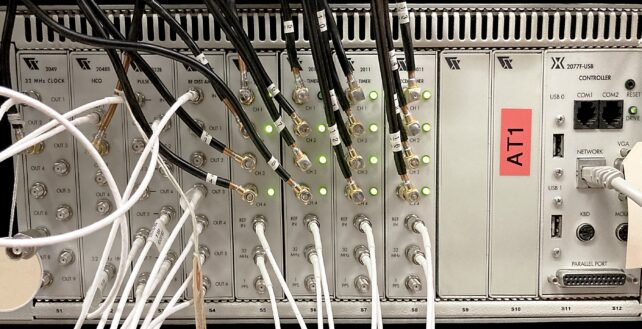
But it may have consequences for critical infrastructure, telecommunications, GPS signals, and more, NIST supervisory research physicist Jeff Sherman told Joe Hernandez at NPR.
"All of the atomic clocks continued ticking through the power outage last week thanks to their battery backup systems," Sherman said. "What failed was the connection between some of the clocks and NIST's measurement and distribution systems."
More than 20 atomic clocks – mostly hydrogen masers and some cesium beams – are on rotation at the NIST laboratory, with about 10 to 15 used to determine UTC(NIST) at any given time.

These clocks are measured continuously by primary and alternate multi-channel measurement systems (MCMS) that can quickly detect even the smallest changes in frequency.
Data from the MCMS is fed into a computer algorithm, which, together with several other machines, decides exactly what time it is in the US – a figure that contributes to the world's time standards.
Power is now restored to the NIST facility, and the crew has corrected the temporal blip.