Familiar things can look very strange when viewed under a microscope – which is why each week we bring you a fresh microscope mystery to put your detective skills to the test.
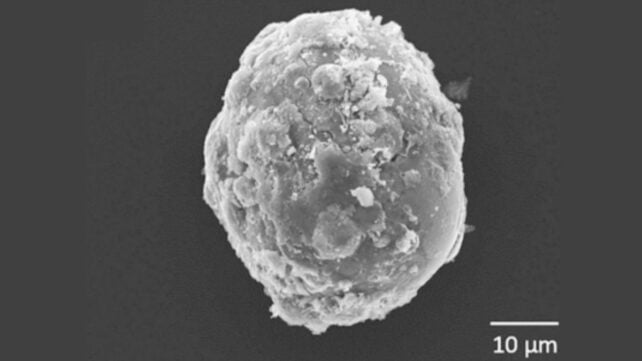
This week's mystery looks almost cosmic – a scatter of tiny, near-perfect spheres, like grains of metal that rained down from somewhere else entirely.
Or is this actually something closer to home: a group of cells or pollen?
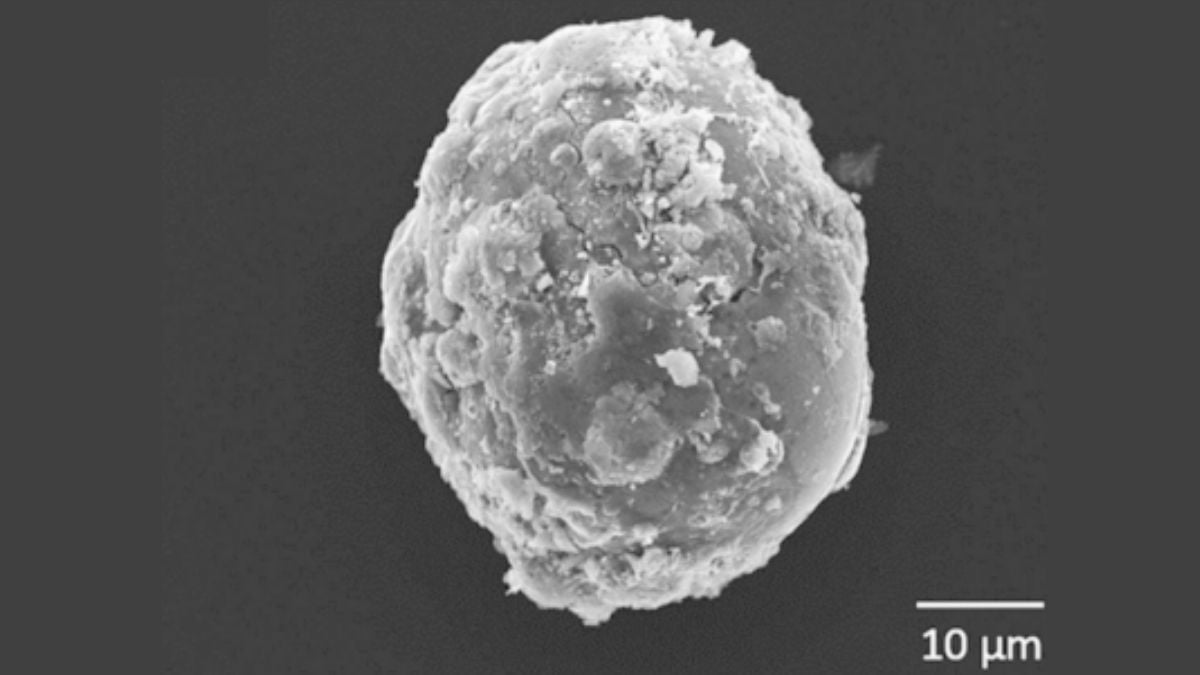
What do you think you're looking at?
- Click here if you want some options to narrow it down…
- Click here for the answer (spoiler alert, obviously)
There will be spoilers below, you have been warned!
For a visual break, here's the mystery of a 17th-century aristocrat's teeth.

Narrow it down…
Some ideas to narrow down what the image could be of:
A. Lymph node
B. Gunshot residue
C. Weathered microplastic bead
D. Pyrite grain
We'll show you the image one more time and will reveal the answer below.
Okay ready?
You sure?
Alright… here we go.
The answer
The answer is B: gunshot residue.
Those tiny, near-perfect spheres are gunshot residue (GSR) particles – microscopic debris left behind when a primer ignites, and a round is fired.
As the primer explodes, it briefly vaporizes metal inside the cartridge; that vapor then cools almost instantly in open air, condensing into droplets that solidify mid-flight into these characteristic round or spheroidal shapes, typically just a few micrometers across, though some can reach up to around 100 micrometers.
What makes a particle "characteristic of" GSR, rather than just some other bit of metallic dust, is its chemistry.
Primers traditionally combine lead styphnate, barium nitrate, and antimony sulfide, so a genuine GSR particle usually carries lead, barium, and antimony fused together within a single sphere.
Forensic scientists confirm this using SEM paired with energy-dispersive X-ray spectroscopy, which images the particle's shape and reads its elemental fingerprint at the same time.
That combination is what makes GSR useful as evidence. Residue like this can settle on the hands, face, hair, or clothing of anyone who fired a gun, or who was simply standing close enough when one went off.
Investigators lift it by pressing an adhesive stub against skin or fabric, then scan the stub for particles matching this exact spherical, lead-barium-antimony signature.
A single discharged cartridge can scatter thousands of these particles into the air. Most drift away or are washed off within a few hours, which is exactly why forensic teams try to collect samples as soon as possible after a shooting.
Images like this are captured with a scanning electron microscope, which fires a beam of electrons at the sample instead of light, producing a black-and-white image far more detailed than an optical microscope could manage.
This article was fact-checked by Rebecca Dyer and edited by Rebecca Dyer. While we pride ourselves on our process, we are only human. If you spot a mistake, please let us know.