
A tennis player might describe the ball seeming to slow down just before a shot. A musician might feel time passing differently when absorbed in a performance. Researchers are investigating whether preparing to move helps shape these changes in our experience of time.
One way to find out is to ask people how long a brief light stays on. A light can be visible for a fixed amount of time, but a person's judgment of its duration may shift, especially while they are preparing to reach toward a target.
A study published in iScience found that this shift can develop with practice. As participants repeated a reaching task, they became quicker to begin moving. Alongside that improvement, they increasingly judged brief lights shown before the movement as lasting longer.
"The effect was large: participants perceived stimuli as lasting 25% longer than a reference duration, which is a substantially sized distortion by illusory standards," cognitive neuroscientist Nicola Binetti of Italy's University of Rome Tor Vergata told ScienceAlert.
Earlier evidence connecting movement and timing gave the team reason to expect that practicing a movement would alter duration judgments. But practice didn't bring those judgments closer to the reference.
"What we did not expect was for practice to make the distortion stronger, rather than reduce it," Binetti said.
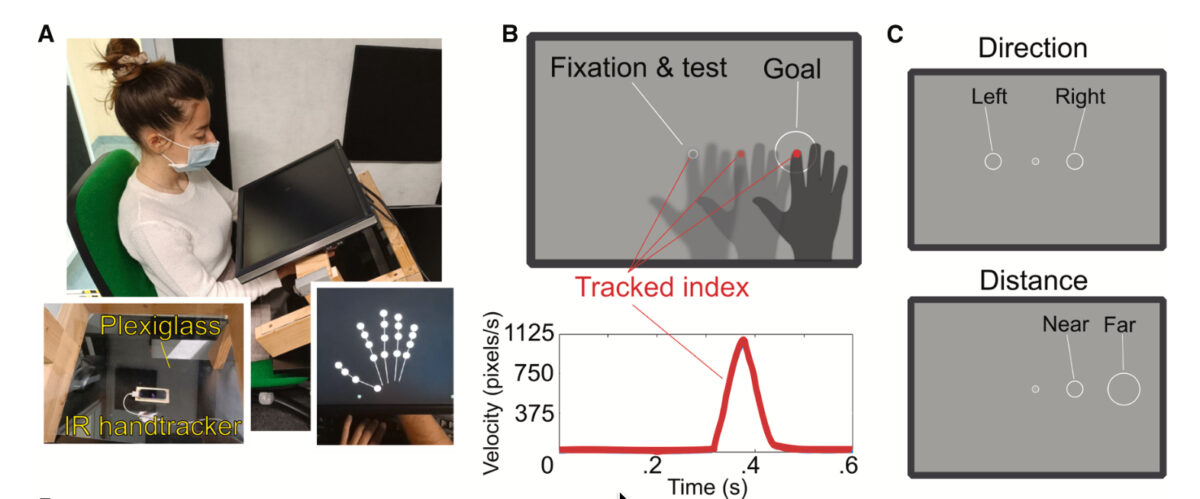
The team recruited 40 right-handed adults to reach toward targets shown on a screen. Half reached left or right, while the other half reached toward a nearby or more distant target.
Participants moved their right index finger across a surface beneath the screen, which hid their hand from view. A beep signaled when to move. After each attempt, the screen showed where their finger had landed.
They also had a second task. Before moving, they watched a circle briefly light up. After the movement, they judged whether it remained illuminated longer or shorter than a reference duration of 0.84 seconds they had learned beforehand.
In some trials, the target appeared in advance, allowing participants to prepare their reach while waiting for the beep. In others, its location was revealed only when the beep sounded. A separate condition tested duration judgments without reaching.
Knowing the target's location beforehand made the light appear to last longer, on average, than in either of the other conditions.
The more revealing relationship emerged across repeated attempts. Participants gradually began moving sooner after the beep and increasingly judged the lights as lasting longer.
The speed-up was most pronounced when participants had to wait until the beep to discover the target's location, but the two changes tracked each other in both conditions.
People whose movement initiation improved more also tended to show a greater increase in perceived duration. How accurately their finger landed didn't explain the overall shift.
"In a way, our brain uses the moment we intend to act as a reference for judging how long things around us last," Binetti explained.
The researchers also examined electrical brain activity using electrodes placed on the scalp, a technique called electroencephalography (EEG).
Their analysis linked the altered duration judgments to activity during two stages: while the light was visible and its duration was being processed, and after it disappeared, when that information was being used to form a judgment.
During the first stage, the relevant activity patterns were associated with planning a specific movement. Afterward, in the group that reached left or right, the patterns reflected broader involvement in preparing to move. A similar trend in the near-or-far group didn't reach statistical significance.
Previous research has explored connections between movement-related brain processes and time perception. The new study adds a view of how this relationship evolves with practice.
Binetti said similar mechanisms could play a role in skilled activities such as sports and music. However, those activities were not directly tested in this study.
The study can't prove that faster preparation causes time expansion. Motivation, reward expectations, or other changes during practice could contribute to both. The EEG analysis also averaged trials, preventing the researchers from tracking how relevant brain activity changed with each repetition.
The findings nevertheless suggest that even a simple judgment of duration may be intertwined with an upcoming action. As we become more ready to move, the brief events we see beforehand may come to feel longer.
The research has been published in iScience.
This article was fact-checked by Rebecca Dyer and edited by Rebecca Dyer. While we pride ourselves on our process, we are only human. If you spot a mistake, please let us know.