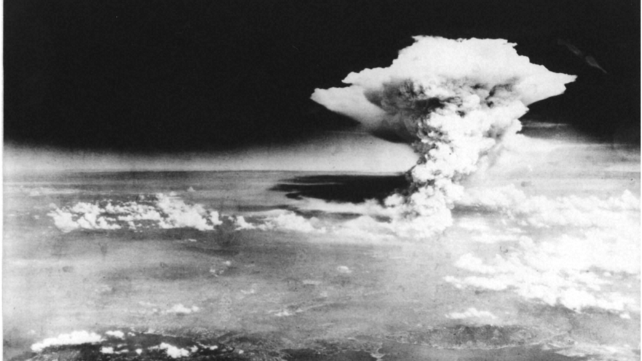
At 8.15 in the morning of 6 August 1945, the gates to hell opened on the Japanese city of Hiroshima when the US military unleashed the nuclear bomb.
As tens of thousands of people died on the ground below, the American bomber Enola Gay that dropped the warhead soared away. Meanwhile, a growing cloud of soot and smoke began to billow up from the firestorm that raged in the wake of the devastating detonation.
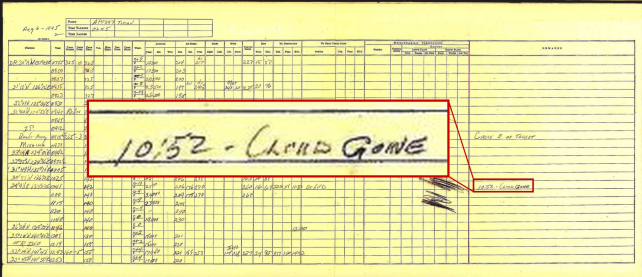
Just 97 minutes later, at 10.52 am Tinian time, navigator Theodore Van Kirk made a brief entry in the aircraft's flight log in scrawled uppercase letters.
"CLOUD GONE."
That tiny, overlooked detail has now given scientists a new window into the world's only nuclear firestorm on record.
According to a paper led by atmospheric scientist David Romps of the University of California, Berkeley, that note suggests that the plume of soot had risen at least 11.3 kilometers (7 miles) into the sky.
"The Hiroshima firestorm lofted soot well into the upper troposphere, consistent with nuclear-winter scenarios," the team writes in a paper published in Geophysical Research Letters.
The aftermath of a nuclear bomb is chaos. The explosion itself and its mushroom cloud are over relatively quickly, but the intense heat the explosion generates can create a furious storm of fires that rampages for hours.
As the fires lit by the explosion of the Little Boy atomic bomb spread and merged across Hiroshima, the blazing temperatures generated powerful updrafts that carried smoke and soot high into the atmosphere, forming a towering column of cloud.
Just how high that cloud can rise is crucial to understanding the consequences of nuclear warfare.
If enough soot reaches the stratosphere, it can linger for months or years, blocking sunlight and cooling the planet below.
In a large-scale nuclear conflict, the cumulative effects of many such fires could trigger a nuclear winter, with potentially catastrophic consequences for agriculture and food supplies around the world.
But some scientists have disagreed about whether nuclear firestorms can carry soot high enough. Some simulations suggest that most soot would remain in the lower atmosphere, where rain could wash it out before it had a lasting effect on the global climate.
The problem here – and thankfully so – is that we have very few real-world observations of nuclear firestorms. In fact, the bombing of Hiroshima is the only known instance; none eventuated from the bombing of Nagasaki three days later.
Previous researchers have tried to reconstruct the height of the Hiroshima plume using historical photographs, but the results relied on several uncertainties.
Romps and his colleagues, however, found another source of evidence in the historical record.
And their calculation is stunningly clever.
The movements of Enola Gay that day are documented in detail, almost down to the minute. When Van Kirk noted "CLOUD GONE" at 97 minutes after the detonation, the plane was an estimated 750 to 764 kilometers away, at an altitude of around 7,440 meters (24,400 feet).
And that suggests that the cloud was not quite so gone as the log indicates, but that, from their position, the crew could no longer see it.
A separate military memorandum recorded that the crew's "observation was then limited by haze and not curvature of the Earth."
That means that the cloud had not dipped below the horizon. It was obscured instead by atmospheric haze.
This distinction is key – because if the cloud was still above the horizon from such a vast distance, then it must have been extraordinarily tall.
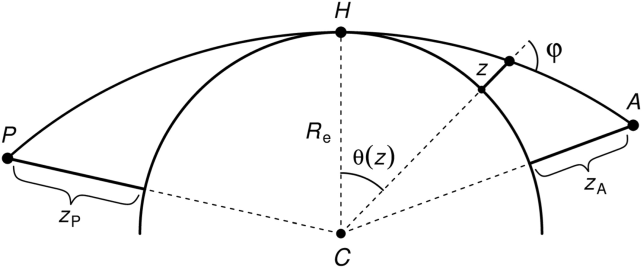
So, by calculating how far the crew could have seen from their altitude, the researchers could work backward to determine the minimum height of the plume.
But this isn't necessarily straightforward, either.
Light doesn't travel through Earth's atmosphere in perfectly straight lines. As air density changes with altitude, light bends slightly toward the surface, allowing us to see a little farther around Earth's curvature than geometry alone would suggest.
Accounting for this required the researchers to reconstruct the atmospheric conditions on the day of the bombing.
Using three historical weather reconstructions, they estimated how temperature and air pressure changed with altitude, allowing them to calculate how light would have bent through the atmosphere that day.
They then ran 100,000 simulations to account for uncertainties in the aircraft's position, altitude, and the atmospheric conditions.
This, obviously, still leaves a not insignificant degree of uncertainty.
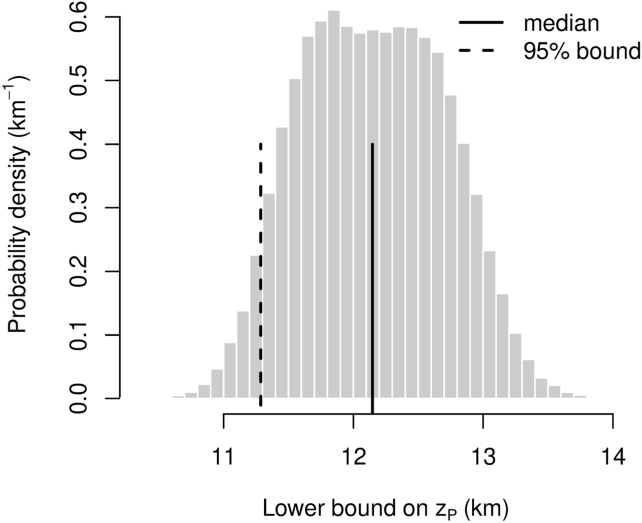
But even so, the researchers calculated with 95 percent confidence that the plume must have reached a minimum height of 11.3 kilometers – consistent with nuclear winter scenarios.
Now, the Hiroshima bombing did not cause nuclear winter. But nuclear winter is not expected to result from a single explosion. Rather, it is the potential cumulative consequence of vast amounts of soot injected into the atmosphere by multiple nuclear firestorms ignited during a nuclear war.
What Hiroshima shows is that nuclear firestorms can loft soot to altitudes relevant to this concept – an important piece of evidence consistent with the possibility of nuclear winter.
Let us truly hope the world never has to find out the hard way.
The research has been published in Geophysical Research Letters.
This article was fact-checked by Rebecca Dyer and edited by Rebecca Dyer. While we pride ourselves on our process, we are only human. If you spot a mistake, please let us know.