Looking at photographs of Earth suspended against the darkness of space, you'd be forgiven for thinking our planet is isolated and alone.
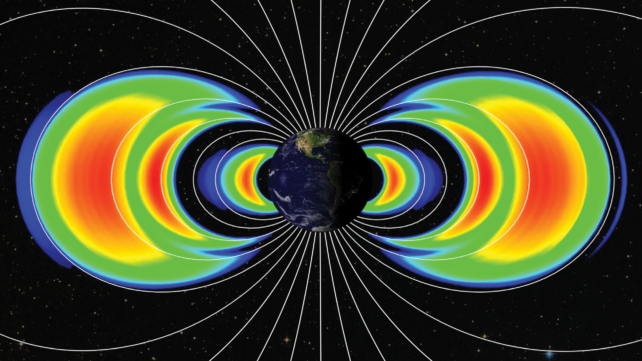
But there's more to near-Earth space than meets the eye. Our world is cozily snuggled in the Van Allen belts – two donut-shaped regions of space filled with energetic protons and electrons, confined by the planetary magnetic field.
The outer belt is populated largely by electrons energized by processes driven by the Sun, while many of the inner belt's protons originate from particles produced when cosmic rays strike Earth's atmosphere.
For more than a decade, it has been thought that this inner belt forms an impenetrable barrier to ultra-relativistic 'killer' electrons, preventing them from venturing too close to Earth.
But new evidence has emerged that, under the right set of circumstances, this region is not as secure as we thought.
During an insanely powerful solar storm that buffeted Earth in May 2024, a Japanese satellite recorded electrons in this region being accelerated to megaelectronvolt energies – in a place where scientists thought it wasn't supposed to happen.
"Here we show that this barrier can be breached under extreme space weather conditions," writes a team led by space physicist Yoshizumi Miyoshi of Nagoya University in a paper published in Geophysical Research Letters.

So-called 'killer' electrons, known for decades, are a big problem in low-Earth space. These particles can be accelerated to almost the speed of light by interactions with electromagnetic waves in Earth's magnetic environment, particularly during geomagnetic storms.
They carry so much energy that they can penetrate satellite shielding, potentially damaging sensitive electronics and shortening the lifespans of spacecraft. They're not good for humans, either, posing an elevated radiation hazard to astronauts.
But in 2014, researchers discovered something peculiar. Observations from NASA's Van Allen Probes revealed a weirdly sharp boundary, about three Earth radii from the planet's center, beyond which the most energetic electrons rarely ventured.
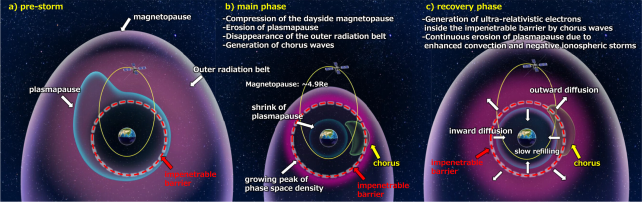
Scientists described this as an "impenetrable barrier," proposing that electromagnetic waves within a region of cold plasma surrounding Earth help scatter the electrons out of their trapped orbits, sending them plunging into the atmosphere. Combined with the electrons' slow inward migration, this seemed to create a natural barrier that kept them at bay.
Even as early as 2018, however, cracks began to appear in the so-called 'impenetrable' barrier.
Researchers proposed that the barrier wasn't a barrier at all, but an illusion created by the limited duration of geomagnetic storms.
Energetic electrons could be pushed inward by fluctuations in Earth's magnetic field, but the storms driving that movement typically petered out before the electrons could venture much farther.
Then, in 2024, researchers analyzing observations captured between 1996 and 2006 discovered that lightning-generated electromagnetic waves could send killer electrons already trapped in the inner radiation belt tumbling toward Earth's atmosphere.
These observations provided further evidence that megaelectronvolt electrons were already present well inside the supposedly impenetrable boundary.
But next, in May 2024, came the solar superstorm.
The Sun exploded in a series of flares and coronal mass ejections that blasted billions of tons of magnetized plasma screaming across the Solar System.
Here on Earth, the result was a level G5 geomagnetic storm – the most powerful category on the geomagnetic storm scale, so intense its effects were recorded even at the bottom of the ocean.
The storm dramatically depleted the cold plasma in Earth's plasmasphere, creating an unusually sparse environment in which a different kind of electromagnetic wave, called chorus, could thrive.
"When converted into audio, it sounds like a bird song," Miyoshi says.
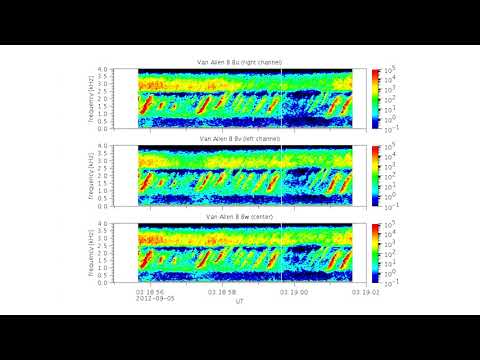
And, instead of scattering the electrons away, as other waves normally do, these waves appear to have accelerated them to ludicrous energies, right inside the 'impenetrable' barrier.
The evidence came from Japan's Arase satellite, which had been monitoring the radiation belts since 2017.
During the storm's recovery phase, Arase detected a dramatic increase in ultra-relativistic electrons inside the barrier. At energies around 3 megaelectronvolts, the electron flux ballooned by more than 5,000 times compared to pre-storm levels.
The timing and evolution of that increase were particularly revealing.
Lower-energy electrons emerged in number first. Around half a day later, electrons with higher energies followed. And roughly a day after the initial increase, electrons carrying more than 3 megaelectronvolts of energy had surged in number, too.
This staggered progression suggested that the electrons weren't simply being swept inward from elsewhere. They were gaining energy right there, inside the supposedly protected region.
Miyoshi and his colleagues found further clues in the distribution of the electrons, which formed a distinct peak near the barrier's boundary.
That pattern is difficult to explain through inward transport alone, but is consistent with electrons being accelerated locally before spreading farther inward and outward.
Put together, the evidence suggests that the depletion of the cold plasma created the perfect conditions for electrons to behave in a way that is normally only seen farther from Earth.
And it took months to recover. Arase continued to observe declining levels of ultra-relativistic electrons until October 2024, when another solar storm buffeted near-Earth space.
It's a finding that hints the dynamics of the space around Earth are far more complex than its apparent serenity suggests.
"This discovery highlights the need to understand and predict how energetic electrons behave under extreme space weather conditions," Miyoshi says.
"Such knowledge is important for assessing radiation risks to spacecraft and improving future space weather predictions."
The research has been published in Geophysical Research Letters.
This article was fact-checked by Fiona MacDonald and edited by Fiona MacDonald. While we pride ourselves on our process, we are only human. If you spot a mistake, please let us know.