A reserve of natural gas bubbling from a cage of ice discovered on the ocean floor to the west of Greenland may be the deepest gas hydrate cold seep on record, and it happens to be teeming with animal life.
The Freya gas hydrate mounds were discovered during the Ocean Census Arctic Deep EXTREME24 expedition, led by researchers from UiT The Arctic University of Norway and other partners. A water column gas flare alerted the researchers to unusual activity deep below their ship, prompting them to send a remotely operated vehicle (ROV) to investigate.
There, they encountered exposed mounds of a crystalline material known as a gas hydrate. The scientists guided the ROV to collect samples of the methane seepage and crude oil, along with sediment that contained a diversity of marine life.
Related: Deep-Sea Wonderland Found Thriving Where Humans Have Never Been
"This discovery rewrites the playbook for Arctic deep-sea ecosystems and carbon cycling," says the expedition's co-chief scientist Giuliana Panieri.
"We found an ultra-deep system that is both geologically dynamic and biologically rich, with implications for biodiversity, climate processes, and future stewardship of the High North."
The deep-sea animals that call the Freya gas hydrate mounds home feed on chemosynthetic microbes that turn chemicals like methane, sulphide, and other hydrocarbons into biological fuel.
This is exactly what is seeping out of the seafloor at the newly discovered Freya mounds, far below the surface of the Greenland Sea: methane, and, to a lesser extent, heavier hydrocarbons.
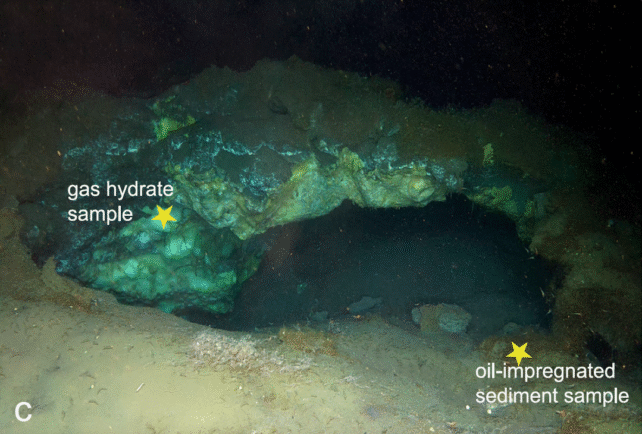
With a steady supply of these chemicals leaking from the Earth's crust, the inhabitants of the Freya mounds are quite unbothered by the 3,640 meters (roughly 11,940 feet) of ocean above their heads. Who needs sunlight when you've got gas hydrates, which are a frozen mixture of methane and water, held in a crystal state by the high pressures and low temperatures of the deep ocean.
Nearly one-fifth of the world's methane is in the form of gas hydrate, locked in deep marine sediments.
Discovering the Freya mounds more than 3.5 kilometers below the surface is unusually deep for such a seep, though. Most on record are less than 2,000 meters underwater.

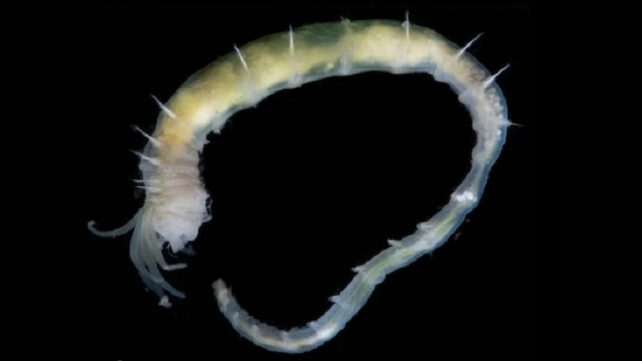
The animals include siboglinid and maldanid tubeworms, skeneid and rissoid snails, and melitid amphipods. The ecosystem has a similar composition, at the family level, to Arctic hydrothermal vents at similar depths.
Compounds found in the sediment samples suggest the oil and possibly the gases originate from flowering plants that once grew in a warm, forested Greenland back in the Miocene, a geological epoch stretching from 23 to 5.3 million years ago.
These carbon-rich deposits are what make the Freya mounds such a great place to live (if you're a maldanid tubeworm or a melitid amphipod). It's also a key reason why the world's mining industry and some governments have their eyes on the deep Arctic.
"Despite significant progress in understanding the distribution and concentration of gas hydrates, a major challenge remains in evaluating gas hydrates as an energy resource and their role in global climate change," the authors note.
So far, deep-sea mining has primarily focused on polymetallic nodules; potato-size lumps found on the seafloor that contain rare earth minerals used in devices like smartphones. But it's unclear what effect such a disruption to the deep sea floor would have on marine ecosystems of our already-destabilized planet.

"There are likely to be more very-deep gas hydrate cold seeps like the Freya mounds awaiting discovery in the region, and the marine life that thrives around them may be critical in contributing to the biodiversity of the deep Arctic," says marine ecologist Jon Copley of the University of Southampton in the UK, who was part of the expedition.
"The links that we have found between life at this seep and hydrothermal vents in the Arctic indicate that these island-like habitats on the ocean floor will need to be protected from any future impacts of deep-sea mining in the region."
The research was published in Nature Communications.