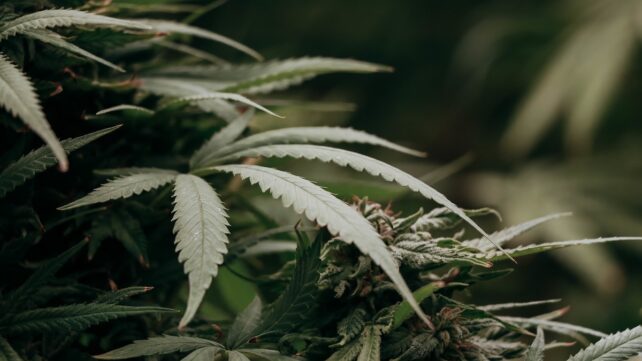
Cannabis is a talented plant, hiding a pharmacopeia in its flowers and foliage. Many of its compounds evolved millions of years ago to deter pests or pathogens, but humans have found a few extra uses in recent millennia.
A new study looks deep into cannabis's past to explore the evolutionary origins of some of its most famous bioactive compounds – tetrahydrocannabinol (THC), cannabidiol (CBD), and cannabichromene (CBC).
Using a technique called ancestral sequence reconstruction (ASR), researchers at Wageningen University & Research in the Netherlands shed light on long-extinct enzymes that produced these compounds in an ancestor of cannabis. They also 'resurrected' the ancient enzymes to test how they functioned.
Related: Microdosing Cannabis Pauses Alzheimer's Decline in Unprecedented Trial
While their findings are valuable for what they add to our understanding of evolution, they also have practical applications.
"These ancestral enzymes are more robust and flexible than their descendants," explains biosystematics scientist Robin van Velzen, "which makes them very attractive starting points for new applications in biotechnology and pharmaceutical research."
We've cultivated cannabis since prehistory, using it for food, fabric, medicine, and merriment. Today, scientists know the plant can produce hundreds of different cannabinoids, terpenes, flavonoids, and other phytochemicals, some of which have unique medicinal or psychoactive properties.

The study focuses on specific enzymes known as cannabinoid oxidocyclases, which convert cannabigerolic acid (CBGA) into various other cannabinoids with different bioactive effects, thus wielding significant influence over the therapeutic potential of cannabis.
Despite the clear importance of cannabinoid oxidocyclases, these enzymes are still poorly understood. With little clarity about their history or mechanics, the authors sought to learn more about them by retracing their history – and reconstructing their extinct ancestors.
For modern cannabis plants, the production of THC, CBD, and CBC depends on three distinct enzymes, each of which specializes in making only one of the cannabinoids. According to the study's authors, however, things may have worked differently millions of years ago.
"Through resurrecting and characterising three ancestral cannabinoid oxidocyclases, we experimentally tested the hypothesis that CBGA metabolization emerged in a recent ancestor of cannabis," they write.

Informed by related DNA sequences in modern plants, ASR lets scientists rebuild an ancestral gene from a multiple sequence alignment, making it possible to resurrect ancient proteins.
Using this approach, the team recreated extinct cannabis enzymes as they were millions of years ago, before the emergence of modern cannabis (or modern humans).
The common ancestor of modern cannabinoid oxidocyclases could apparently produce several different types of cannabinoids at once. Enzymes specializing in a single compound only appeared later, following gene duplications that occurred as cannabis evolved.
These results suggest the ability to metabolize CBGA did arise in a recent cannabis ancestor, and that early cannabinoid oxidocyclases were "promiscuous" enzymes, producing precursors for multiple cannabinoids rather than specializing in just one as their modern counterparts do.
The findings also "confirm that the acquisition of cannabinoid oxidocyclase activity arose independently" in the cannabis family and in distantly related cannabinoid-producing plants like rhododendrons, the researchers write.
Compared with modern enzymes, the reconstructed ancestors were easier to produce in microbes like yeast cells, the team found. That's relevant given the growing focus on biotechnological rather than botanical methods of cannabinoid production.
"What once seemed evolutionarily 'unfinished' turns out to be highly useful," says van Velzen.
CBC, for example, is a cannabinoid reported to have anti-inflammatory and analgesic properties, yet modern cannabis plants don't produce much of it.
One ancient enzyme reconstructed in the new study, however, represents an "evolutionary intermediate" that excels in CBC production.
"At present, there is no cannabis plant with a naturally high CBC content," van Velzen says. "Introducing this enzyme into a cannabis plant could therefore lead to innovative medicinal varieties."
The study was published in Plant Biotechnology Journal.