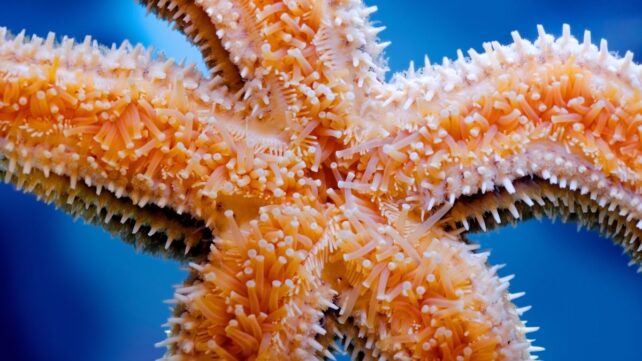
Starfish (aka sea stars) are master climbers. These many-armed invertebrates traverse vertical, horizontal, and even upside-down surfaces: it seems no substrate is too rocky, slimy, sandy, or glassy. And they do so without a centralized nervous system, let alone a brain.
A new paper written by an international team of biologists and engineers reveals that starfish locomotion is nonetheless rather clever, with built-in features that allow starfish to drastically adapt their motion depending on the challenge at hand (or, rather, foot), despite the absence of central control.
Related: Billions of Sea Stars Are Wasting Away, And We Finally Know Why
The underside of each starfish arm is studded with rows of hydraulic tube feet, or podia. The 'tube' is a flexible, muscular stem which pumps fluid through its water vascular system to enable movement; the 'foot' is a flattened, flexible disk at the tip of the stem, which oozes protein-rich adhesive slime to attach itself to surfaces (and, potentially, an unsticking slime too).
The common starfish (Asterias rubens) has four rows of tube feet on each arm, meaning to crawl around, they need to coordinate the timing of hundreds of independent limbs.
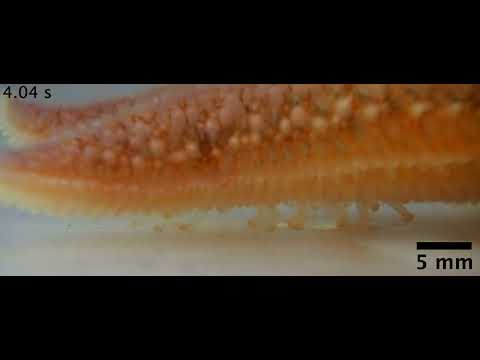
"Unlike many animals, sea stars display a less straightforward relationship between body mass and crawling speed," the paper's authors explain. Very broadly speaking, bigger bodies tend to equal slower speed, as do more appendages. Not so for Asterias rubens.
To get a good look at which feet were engaged in locomotion at any given time, the scientists measured changes in light as starfish crawled across lit-up, highly refractive glass in a lab. This method has proved useful in imaging insect, animal, and human feet.
Whenever a starfish made contact with the special glass, it would alter the way the light refracted, illuminating the contact area with the bright dot of a starfish footprint.
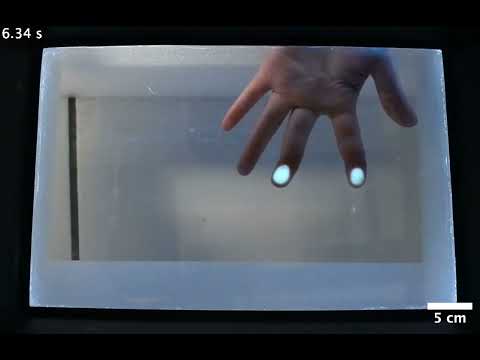
The starfish crawled at roughly the same pace regardless of how many of their tube feet were in contact with the substrate, but when tube foot adhesion time increased, their crawling speed slowed.
This suggests the starfish regulate the timing of each foot not through a central system of neurons, but by changing its contact duration in response to mechanical load: a theory further supported by giving the starfish weighted backpacks to see how the extra effort affected their 'gait'.
The backpacks added either 25 or 50 percent of the starfish's total body weight. As suspected, this extra load significantly increased adhesion time for each foot.

"We further investigated inverted locomotion [i.e., starfish walking on the 'ceiling' of their enclosure], both experimentally and through simulation, and found that tube feet adjust their contact behavior when the animal is oriented upside down relative to gravity," the authors report.
"Together, our findings demonstrate that sea stars adapt their locomotion to changing mechanical demands by modulating tube foot-substrate interactions, revealing a robust, decentralized strategy for navigating diverse and challenging terrains."
The research was published in Proceedings of the National Academy of Sciences.