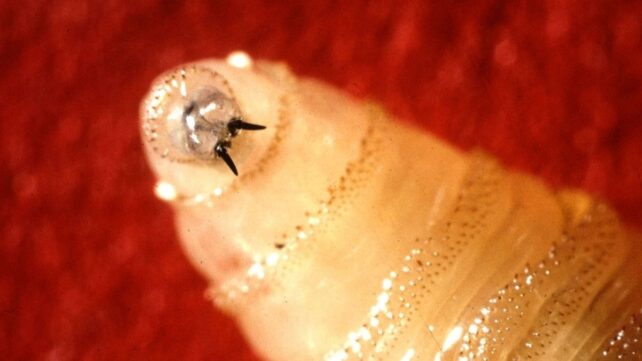
An outbreak of the flesh-eating New World screwworm (Cochliomyia hominivorax) has killed seven people and infected at least 1,190 more across Mexico and South America, and now the US Centers for Disease Control (CDC) and Prevention is alerting health workers of its northward spread.
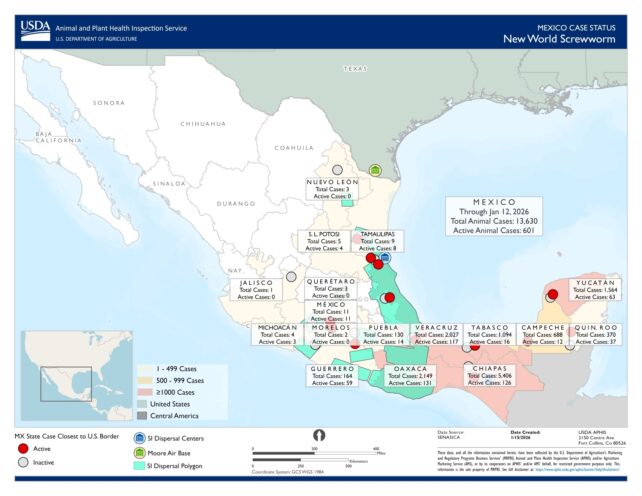
There are currently 601 animal cases active across Mexico, with eight in Tamaulipas – a state that borders Texas – leading the US CDC to issue a health advisory.
The alert warns doctors, veterinarians, and other members of the US health system to monitor for the screwworm, "a devastating pest" that was eradicated from the country in 1966, and again in 2017 after the fly larvae infected deer in Florida in 2016.
Related: Rare, Flesh-Eating Parasite Confirmed in US in Concerning Development
The New World screwworm is a fly larva that lives in and feeds on the wounds and mucous membranes of warm-blooded animals.
Cattle, horses, and pigs are the most common screwworm victims, but the parasite can also lay its eggs in the flesh of dogs, cats, and even humans. Without treatment, infections can be fatal, capable of killing even a mature cow in just one week.
Before the 1960s, Texan cattle farmers were treating around 1 million cases of screwworm each year.
This is why encroachment on Texas specifically is of such concern: As the largest cattle-producing state in the US, a screwworm outbreak could cost roughly $1.8 billion, according to the US Department of Agriculture.
A quirk of the New World screwworm's biology aided original efforts to control the flies: Female flies usually only mate once in their 21-day lifespan, while males mate many times.
In 1962, scientists began to use gamma radiation to create sterile male flies, each of which would mate with many more wild females to produce unfertilized eggs.
Billions of sterilized males were released from planes across southern Florida, Texas, California, Arizona, and New Mexico. By 1982 the fly was declared locally extinct in the US, Mexico, and parts of Central America, thanks to the 'sterile insect technique', along with chemical treatment of cattle and favorable weather conditions.
A facility in Panama – a country situated between North and South America, known for an inhospitable strip of wilderness called the Darien Gap – has been continuously releasing many more sterile screwworm flies to act as a barrier. But in 2023, the worm somehow breached this wall, resuming its northward spread and reaching Mexico by November 2024.
In September 2025, Mexican officials confirmed an infection in an 8-month-old cow just 70 miles from the US border.

According to the CDC, "unregulated cattle movement, increased movement through the Darien Gap, and new areas of farming contributed to rapid northward spread of NWS."
Scientists have also warned that climate change could be giving the flies a boost, with warmer temperatures expanding their 'boom' period and their geographic range.
So far, no infestations related to this outbreak, human or animal, have been reported in the US.
"However, given the potential for geographic spread, CDC is issuing this Health Advisory to increase awareness of the outbreak and to summarize CDC recommendations for clinicians and health departments in the United States on case identification and reporting, specimen collection, diagnosis, and treatment of NWS, as well as guidance for the public," the agency explains.
The US CDC's full health advisory is available here.