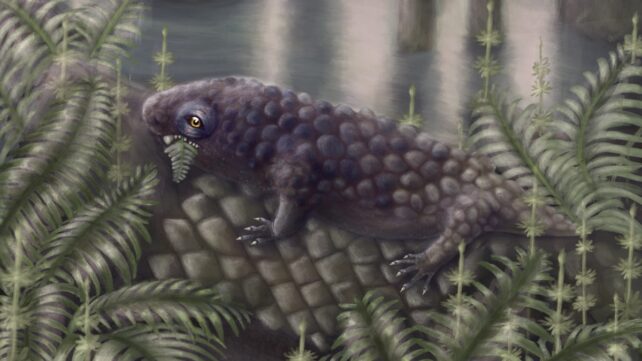
Meet Tyrannoroter heberti, a newly described species that was one of the largest, most feared land animals of its time – at least, if you were a fern. Hailing from 307 million years ago, this strange tetrapod was among the earliest known terrestrial creatures to experiment with a herbivorous diet.
By the time the first vertebrates pulled themselves out of the water, around 370 million years ago, plants had already been living a pretty peaceful existence on land for more than 100 million years.
Luckily for the plants, these creatures seemed content eating each other for eons – but it was only a matter of time before something evolved a way to tap into this bountiful new food source.
CT scans of its skull revealed that Tyrannoroter was one of the first to figure it out. Its teeth and jaws were well adapted for a predominantly plant-based diet.
"This is one of the oldest known four-legged animals to eat its veggies," says Arjan Mann, evolutionary biologist at the Field Museum in Chicago and co-lead author of a study describing the find.
"It shows that experimentation with herbivory goes all the way back to the earliest terrestrial tetrapods – the ancient relatives of all land vertebrates, including us."
Despite its fearsome name, Tyrannoroter was probably only about 25 centimeters (10 inches) long. It's thought to belong to a group of animals called pantylids, which were related to the last common ancestor of reptiles and mammals.
"The pantylids are from the second phase of terrestriality, when animals became permanently adapted to life on dry land," says Mann.
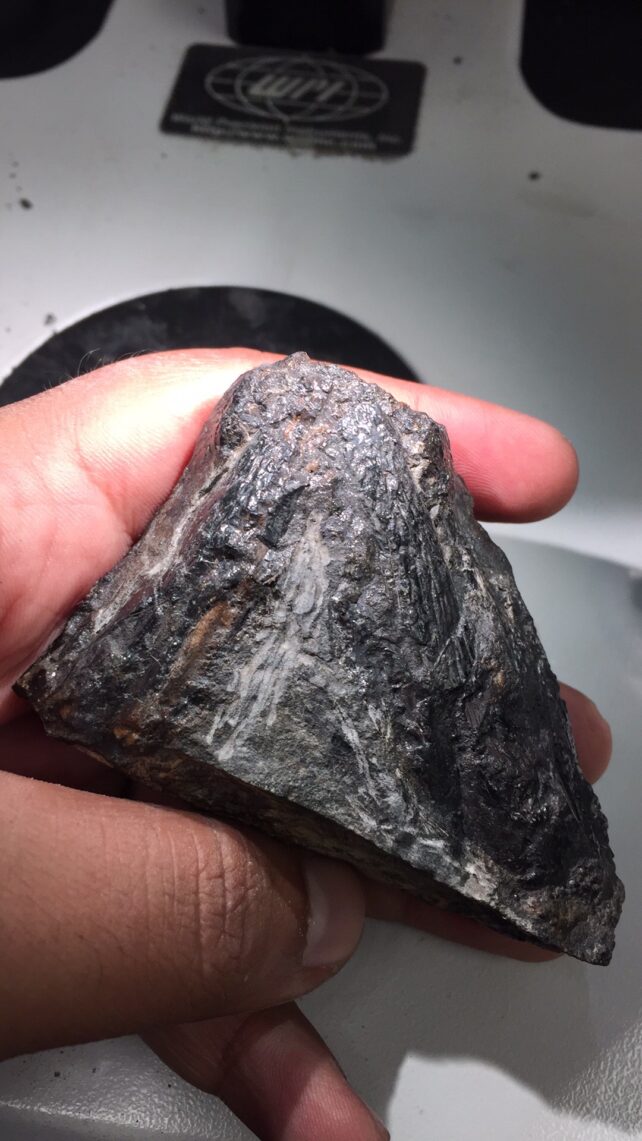
Paleontologists discovered Tyrannoroter's skull inside a fossilized tree stump in Nova Scotia, Canada. The researchers on the new study performed high-resolution micro-CT scanning on the skull, to see what story its teeth would tell.
Along with a row of familiar-looking teeth along the jawbone, Tyrannoroter had sets of bony plates called dental batteries on the roof of its mouth and in its lower jaw. As seen in many later herbivores, including dinosaurs, these plates would have rubbed together to grind down tough plant matter.
"We were most excited to see what was hidden inside the mouth of this animal once it was scanned – a mouth jam-packed with a whole additional set of teeth for crushing and grinding food, like plants," says Hillary Maddin, paleontologist at Carleton University in Canada and senior author of the study.

Tyrannoroter may have been vegetarian, but it probably wasn't vegan, according to the researchers. It likely wouldn't have turned down a meal of insects or arthropods if the opportunity arose.
In fact, it might owe its herbivorous diet to its ancestors eating those creatures to begin with. Dental batteries could have evolved as a way to crush those tough exoskeletons, before some industrious animal worked out that they could also work on unsuspecting plants.
And since the insects themselves ate plants, eating them could have primed the tetrapods' guts with the right microbiome to digest cellulose.
Related: One of The First Animals to Venture Onto Land Went Straight Back Into The Water
Intriguingly, after the researchers identified suspiciously herbivorous dental structures in Tyrannoroter, they re-examined other pantylid specimens and found similar features. That includes one as old as 318 million years.
"These findings, among other recent studies, provide direct evidence that revise the timeline of the origin of herbivory, revealing that various herbivorous forms arose quickly following terrestrialization of tetrapods," the researchers write.
The study was published in the journal Systematic Palaeontology.