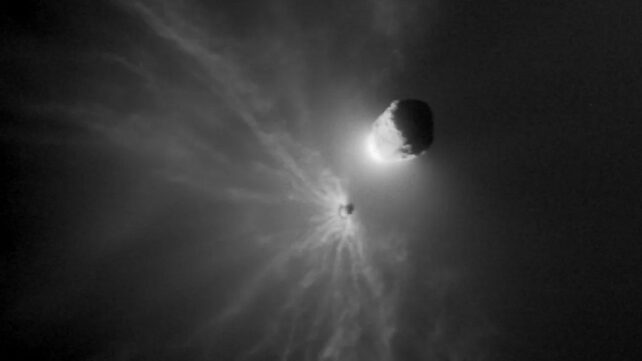
In 2022, NASA made history, deliberately smashing a spacecraft into an asteroid to see if it could alter the object's orbit around its larger companion asteroid.
We already knew that the Double Asteroid Redirection Test (DART) mission was wildly successful, reducing the orbital period of the asteroid pair Didymos and Dimorphos by an astonishing 33 minutes.
But new measurements have revealed something even bigger: The impact also changed the entire orbital path of the Didymos-Dimorphos system through space.
This achievement marks the first time humanity has directly altered the orbit of a natural object around the Sun.
"This work adds the capability of deflecting a binary asteroid system in its heliocentric orbit to the list of novel technologies demonstrated by the DART mission," writes a team led by aerospace engineer Rahil Makadia of the University of Illinois at Urbana-Champaign.
The DART mission was conducted in the interest of planetary safety. There are a lot of large rocks out there in the Solar System, and while none are known to be likely to hit Earth anytime soon, humanity would like to be prepared for the possibility.
The premise of DART was straightforward. The target was a pair of asteroids gravitationally bound to one another; the larger, named Didymos, measuring about 780 meters across (2,560 feet), and the smaller, called Dimorphos, about 160 meters across (525 feet). Since Dimorphos is the smaller of the two, it would be easier to move.

This system was chosen in part because its orbital period was very well characterized, making any changes easy to measure. For the DART mission to succeed, the impact had to change the course of Dimorphos enough to alter its orbital period around its partner asteroid.
The science team expected a change of around 7 minutes, so the 33-minute change that actually occurred was tremendously exciting.
However, the asteroid system is only part of a larger whole – the entire Solar System. Makadia and his team wanted to know whether the DART mission managed to alter, not just the orbital period of Dimorphos around Didymos, but the macroscopic path of the two objects around the Sun.
Because Dimorphos and Didymos are gravitationally bound, they orbit a shared center of mass known as a barycenter. When DART struck Dimorphos, the impact didn't just give the smaller asteroid a push; it also sprayed debris into space.
#DART Mission#LICIACube - #Luke -
target: #Didymos #DimorphosNASA/ASI/j. Roger pic.twitter.com/S8Jqoqv4d7
— landru79 Jacint Roger (@landru79) November 3, 2023
That escaping material carried momentum away from the system, which scientists predicted would impart a tiny recoil that could slightly alter the motion of the Didymos-Dimorphos pair around the Sun.
In the years since the September 2022 collision, instruments have been carefully monitoring the asteroid system. Makadia's team analyzed data from 22 stellar occultations, 5,955 ground-based measurements of the system's position, three navigation measurements from the DART spacecraft itself, and nine ground-based distance measurements.
Together, these data revealed that the impact did indeed give the Didymos-Dimorphos system a tiny push, slowing its orbital velocity by about 11.7 micrometers per second – about 42 millimeters per hour (roughly the width of an Apple Watch).
In space, however, even the smallest push can eventually add up to a very large change in position. Over a decade, a change of 11.7 micrometers per second would accumulate to about 3.69 kilometers.
This means that over the timescales relevant to planetary defense – years or decades of advance warning, if we're lucky – even a tiny nudge could be enough to shift a hazardous asteroid safely away from Earth.
Related: Scientists Reveal The Hidden Danger of Deflecting Asteroids
Future missions will provide an even clearer picture of what happened during the impact. The European Space Agency's Hera spacecraft, scheduled to arrive at the Didymos system later this decade, will study the impact crater left by DART and measure the asteroids' masses and structure in detail.
But what has been accomplished so far is nothing short of extraordinary. For the first time, humanity has altered the path of a natural object moving through the Solar System.
"By demonstrating that asteroid deflection missions such as DART can effect change in the heliocentric orbit of a celestial body," the researchers write, "this study marks a notable step forward in our ability to prevent future asteroid impacts on Earth."
The research has been published in Science Advances.