
As Pi Day rolls around for another year, researchers at StorageReview, a leading publication in enterprise IT, have a fitting number to celebrate: A world-record calculation of the mathematical constant π (pi) to a mind-boggling but extremely satisfying 314 trillion digits.
That's 314,000,000,000,000 decimal places for a number that, according to NASA's Jet Propulsion Laboratory, only needs about 37 decimal places to calculate the circumference of the observable Universe to within the width of a hydrogen atom.
"StorageReview has reclaimed the pi crown with 314 trillion digits," wrote StorageReview lab director Kevin O'Brien in a blog post in December 2025.
"The result wasn't just beating the existing pi record; we obliterated it across numerous metrics. Nothing comes close to our run in terms of performance, power consumption, and most impressively, reliability. We are also the only large-scale pi world-record run without a second of downtime."
Unlike some previous π record attempts that relied on massive cloud computing resources or distributed clusters, this run was carried out on a single Dell PowerEdge R7725 server by the StorageReview team.
Their system used dual AMD EPYC processors and 40 high-capacity NVMe solid-state drives, 34 of which ran the specialized number-crunching software y-cruncher continuously for roughly 110 days to complete the calculation.
The race to best the previous π record using y-cruncher has been running for more than 15 years, starting with a 5-trillion-digit calculation in 2010. The competition has been both heated and friendly, with many attempts deliberately incorporating a nod to π itself, a number often abbreviated as 3.14.
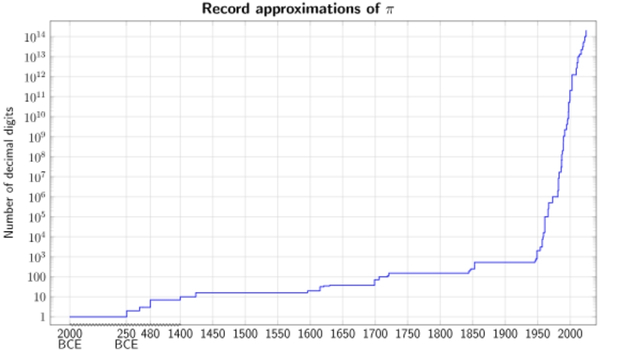

"In 2019, we calculated 31.4 trillion digits of π – a world record at the time," wrote Google's Emma Haruka Iwao in 2022 on reaching the 100 trillion-digit benchmark. "Then, in 2021, scientists at the University of Applied Sciences of the Grisons calculated another 31.4 trillion digits of the constant, bringing the total up to 62.8 trillion decimal places."
Since then, efforts have focused more on hitting higher numbers than making those numbers thematically apropos, pushing the record steadily higher. StorageReview's latest effort brings the race back to a pleasing symmetry.
So why do it?
At this scale, calculating π becomes less about the mathematics and more about managing extraordinary amounts of data. Computing hundreds of trillions of digits generates vast temporary datasets, meaning the speed and capacity of the storage system can become the limiting factor rather than the processors themselves.

Even so, StorageReview's run was significantly leaner than the 300-trillion-digit record set by Linus Media Group and storage company Kioxia in May 2025.
Part of that efficiency came down to how the system handled storage. Instead of relying on a sprawling cluster, StorageReview configured its server so the NVMe drives were connected directly to the processors via high-speed PCIe lanes, minimizing bottlenecks when enormous files were written and read during the calculation.
That approach, the team says, avoids the massive power and cooling costs associated with large shared-storage systems.
The 300-trillion-digit calculation by Linus Media Group relied on a much larger storage array and significantly higher power draw, highlighting how brute force has often been the simplest way to push π calculations further.
With enough processors, memory, and storage bandwidth, researchers can keep extending the constant's digits – but doing so efficiently is a far trickier prospect.
Related: Astronomers Discover 'Pi Earth' Exoplanet Orbits Its Star Once Every 3.14 Days
Efforts to date have shown that calculating π to ever more decimal places is relatively easy if you have enough hardware to throw at the problem. StorageReview says its latest run raises the bar by emphasizing efficiency rather than sheer computing power.
Given the rate at which the π record continues to be smashed, and the shrinking time between records, the next may not be long coming – perhaps only a matter of months. But StorageReview has thrown down a sizeable gauntlet.
"If someone wants to take the record, we would like to see them take the whole thing: more digits, less power, shorter wall time, and the same zero-downtime reliability," O'Brien wrote. "Until then, this is the benchmark for efficiency."
Well, 'tis the season. Any takers?