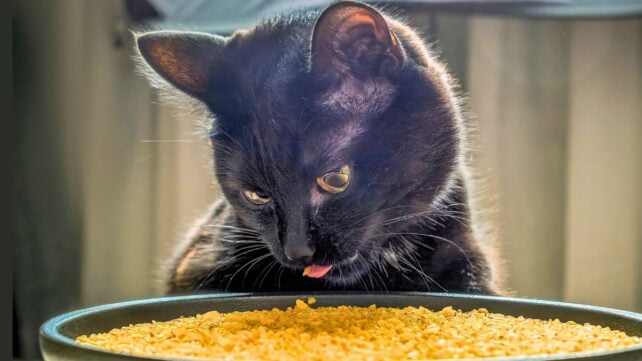
Cats who mysteriously stop eating may not be full, but simply bored, a new study suggests.
This underlying physiological principle in humans is called olfactory sensory-specific satiety, and it explains why we can stuff ourselves full of pizza, then immediately regain our appetite when we catch a whiff of dessert.
Yet this feeding mechanism remains a puzzling phenomenon in felinology, stumping scientists and cat owners alike.
"Cats often stop eating before finishing a meal, even after fasting. Yet, they immediately resume eating the same food after a short interval," the researchers from Iwate University in Japan write in their published paper.
"This suggests that meal termination is not fully explained by gastrointestinal satiety alone."
Cats can seem baffling, both behaviorally and genetically, but their feeding behaviors are shaped by their complex evolutionary origins.
For example, while both dogs and cats are members of the order Carnivora, dogs generally wolf down their food – sometimes so voraciously that they bring it back up shortly afterward. This all-out eating behavior may represent their ancient past as pack hunters.
But cats usually eat numerous smaller meals – their ancestors, the African wildcat (Felis lybica), were solitary predators that hunted small prey multiple times a day.
So in the new study, the scientists sought to determine whether cats' feeding habits are primarily modulated by sensory influences, such as scent, or by external factors, such as food availability.
They recruited 12 healthy, mixed-breed domestic cats, none of whom were neutered, and placed them on a controlled feeding regimen.
They first performed a baseline feeding assay by subjecting the cats to a 16-hour fast and then presenting them with 20 grams (0.7 oz) of dry food.
Surprisingly, across 10 repetitions of this trial, only four of the cats ate an entire meal within 10 minutes of it being given, revealing that even fasted felines voluntarily stop eating after finishing only about a third of their portion.
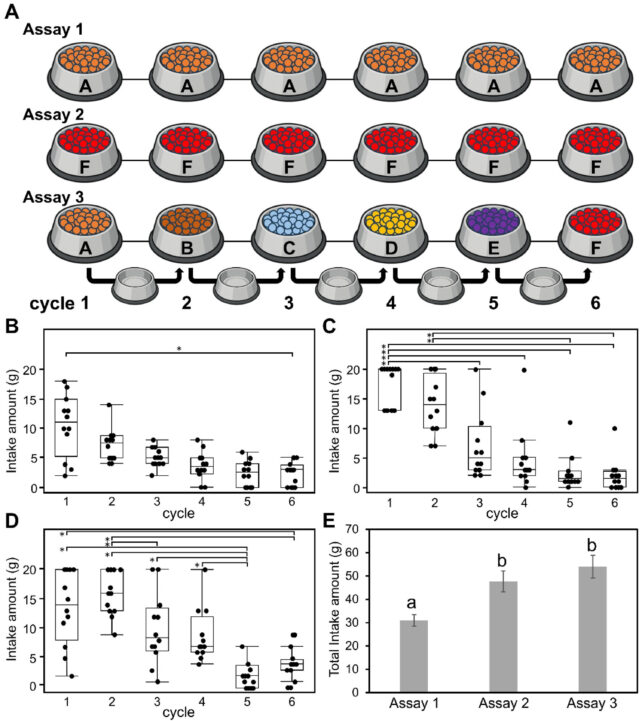
The scientists also performed a similar assay with six different, unspecified cat foods, labeled A-F, to determine the palatability of each food.
A measure of volatile organic compounds (VOCs) confirmed that each food emitted a distinct odor profile, though this 'smelliness' did not directly correlate with palatability.
Then, the scientists conducted a series of feeding tests. Each test consisted of six cycles, comprising a 10-minute feeding period followed by a 10-minute 'resting' interval with an empty bowl.

The scientists observed that when the cats repeatedly received the same food, their intake progressively decreased, regardless of the food.
Conversely, the cats ate more when they were presented with six sequentially different food choices.
The researchers then offered the same food choice for five consecutive cycles before introducing a novel food in the sixth cycle. As expected, the cats' intake gradually declined but was restored by the new food, even if that was less palatable.
Interestingly, when cats received the same food but with a different odor that wafted up through a two-compartment bowl, their appetite was restored despite the food remaining unchanged.
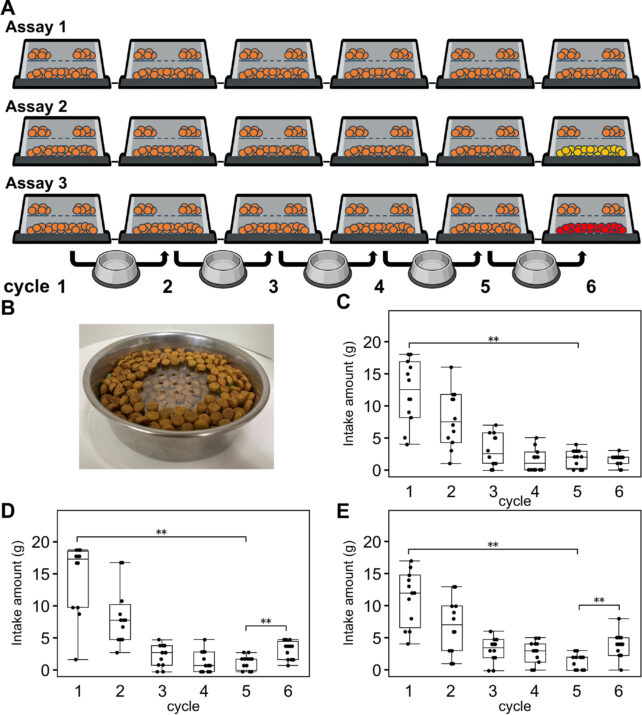
Finally, the cats ate less when pre-exposed to the odor of the food they received, but ate more when they were pre-exposed to the odor of a different food.
"These findings suggest that cats do not stop eating simply because they are full," explains animal behavior scientist Masao Miyazaki.
"Rather, their feeding motivation decreases as they become accustomed to the smell of the food, and it can be restored by introducing a new odor. Sensory novelty, especially olfactory novelty, can reactivate feeding motivation in cats."
Intriguingly, this olfactory habituation may not be as pronounced in dogs, previous research suggests, which may be one reason why canines, rather than cats, are employed to sniff out bombs and other illicit materials.
This research can also benefit the health of cats across both ends of the Body Condition Score spectrum, the veterinary version of the 'chonk chart' popularized on social media.
It's possible that exposure to food odors could help curb overeating in overweight or obese cats without putting them on an 'Ozempic' regimen.
Related: Scientists Discover a New Twist in Why Falling Cats Land on Their Feet.
And despite Garfield's preference for lasagna, it is not safe for felines; however, perhaps modulating the culinary scent may help improve nutrition for aging or sick cats who need extra encouragement to eat.
This research was published in the journal Physiology & Behavior.