Nuclear fallout events, whether triggered deliberately or accidentally, are something we hope will never happen.
But if they do, understanding the consequences is a crucial part of safety planning and disaster management.
With that in mind, researchers from the Lawrence Livermore National Laboratory (LLNL) in the US ran controlled experiments in a high-temperature plasma tube, simulating a portion of a nuclear fireball to see how particles vaporized in a fission reaction would react when cooling.
The three starting elements the researchers used were uranium (the fuel in many weapons and reactors), cesium (a radioactive byproduct of nuclear fission), and cerium (used as a stand-in for plutonium, which is used in nuclear weapons).
Crucially, the team modeled two different scenarios (thermal histories) to gather their results: a consistent, continuous cooling scenario, and a scenario where temperatures were kept very high before dropping rapidly.
"Changing how long materials remain at high temperature can alter chemical reactions and how volatile elements like cesium are incorporated into particles," says chemist Rakia Dhaoui.
"Historical fallout studies indicate that the path materials take as they cool is important."
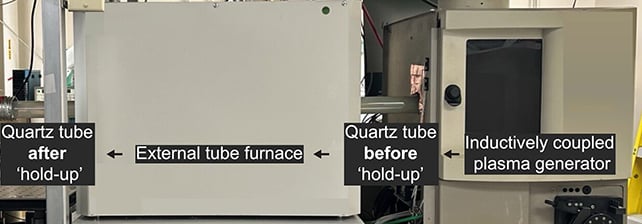
Using their plasma flow reactor, measuring about a meter (39.4 inches) in length, the team heated their elements up to temperatures of around 5,000 Kelvin (that's 4,727 degrees Celsius or 8,540 degrees Fahrenheit).
The initial ultra-hot fireball vaporized everything, as would happen in a nuclear blast, but it's then how the three original elements condense and become particles that the researchers were most interested in.
For uranium and cerium, the patterns were fairly similar.
Both condensed relatively early once the temperature started dropping, in both the continuous cooling and the delayed cooling scenarios, though there were some differences in the extra compounds the elements took on.
Cesium was the biggest surprise for the researchers, as it did something unexpected.
It condensed much later than uranium and cerium in both cooling scenarios, and in the scenario where the temperature was kept higher for longer, it mixed more with other elements and formed more complex compounds.
Besides understanding nuclear fallout ahead of time, these findings can help scientists work backwards as well – looking at the results of a nuclear event and figuring out the conditions that created the condensed particles.
"These particles preserve a record of how they formed," says Dhaoui.
"By studying these processes in a controlled system, we can replace assumptions with measurements, improve the models used to interpret nuclear debris, and support decision-making when it matters most."

The variety in the experiments carried out here is in contrast to traditional methods of modeling radioactive clouds, known as equilibrium models.
These approaches assume chemical reactions that are more stable and consistent, and may miss the nuances caused by changes in cooling speeds – as shown here with cesium.
Admittedly, this is still a simplified, lab-controlled system, and no nuclear reactions actually took place inside the plasma tube.
However, the researchers suggest their new findings can be assessed alongside the results from other models to get a clearer picture of nuclear fallout chemistry.
There are implications that go beyond nuclear incidents too. The discoveries made here could apply to other high-temperature environments, while the system setup can be expanded to incorporate other types of elements and compounds.
Related: The World's First Nuclear Waste Tomb Is Nearly Ready to Open
In the future, this type of experiment can be made more complex and modeled in ways that make it close to real-world scenarios – where a nuclear reactor, for example, would be surrounded by concrete, water, glass, soil, and everything else.
"Although the reactor cannot reproduce the full chemical complexity of a nuclear fireball, it provides a controlled platform for isolating mechanisms that delay or advance interaction between volatile and refractory components," write the researchers in their published paper.
"This capability strengthens efforts to interpret fractionation signatures in simplified debris systems."
The research has been published in Analytical Chemistry.