The constant, omnidirectional hail of cosmic rays that stream through the Solar System from the galaxy beyond may not be as uniform as we thought.
According to China's Chang'e 4 lander on the far side of the Moon, there's a strange 'cavity' in the cosmic ray flux between the Earth and Moon that appears when the two bodies line up in just the right way.
It's a discovery that suggests galactic cosmic rays are not as evenly distributed as we had assumed, possibly opening opportunities for space exploration that could help mitigate the radiation hazard these charged particles pose.
Space can be a hectic place, alive with all sorts of wacky hijinks that spray the cosmos with energetic particles – such as supernova explosions and supernova remnants that fling cosmic rays out willy-nilly at high speeds. These are mostly protons, some helium nuclei, and a small amount of heavy atomic nuclei, and they're thought to be relatively ubiquitous.

They are also ionizing radiation – you know, the stuff that can knock electrons off the atoms in your body, damage your DNA, and increase the risk of mutations that can give you cancer – so, not a good time.
Galactic cosmic rays (GCRs) are mostly absorbed by Earth's atmosphere before they can reach the surface. However, they pose a significant radiation hazard to astronauts and high-altitude pilots, which is accepted as part of the job and taken into account when designing missions and the technology that supports them.
The GCR flux – that is, the strength of the GCR background – can change based on what the Sun is doing. It drops a lot during solar maximum because the increased solar wind and magnetic activity deflect a large percentage of the particles.
The Sun is not the only source that can block GCRs, according to a new analysis from an international team, Earth's magnetic field can, too – but the Sun is still indirectly involved.

The observation comes from Chang'e 4, which has been sitting on the far side of the Moon using its Lunar Lander Neutron and Dosimetry (LND) instrument to monitor protons since 2019. It can only do this during the lunar daytime, when its location is lit by the Sun, since the Moon becomes too cold for the lander to operate when darkness falls.
But this dayside activity is an excellent opportunity to measure the impact of Earth's magnetic field on the GCR flux. The researchers collected data from 31 lunar cycles and looked for changes in the proton flux as the Moon traveled its path around Earth.
They found that, in one section of its orbit – the prenoon sector, before it reaches local noon relative to the Sun – the Moon experiences a region where the proton flux is about 20 percent lower than it is in the rest of the orbit.
This, the researchers believe, may have something to do with the alignment of the interplanetary magnetic field, which is the part of the Sun's magnetic field that stretches out far into the Solar System.
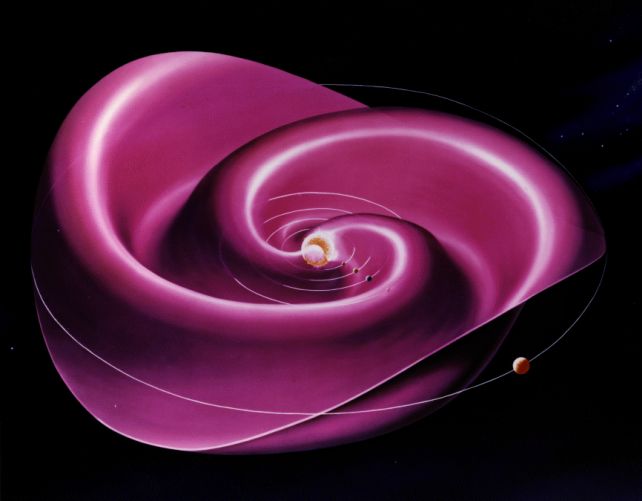
As the Sun spins, its magnetic field twists into a spiral known as the Parker spiral, and when this aligns with the Earth-Moon system in just the right way, a GCR cavity yawns.
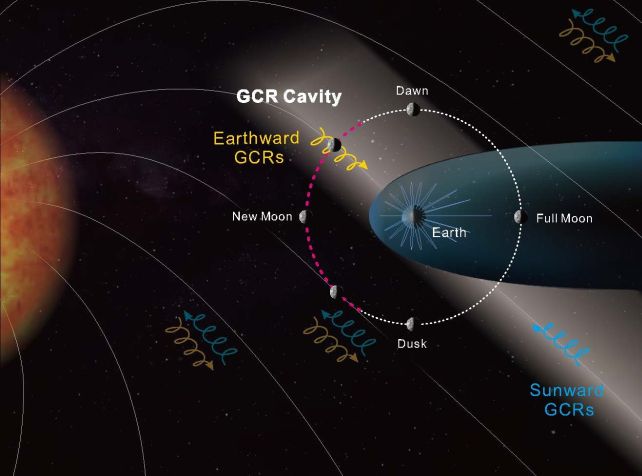
"In general, the motion of charged particles in a magnetic field is characterized by a helical spiral along magnetic field lines," the researchers write.
"When the Moon is located in the prenoon sector under the Parker spiral conditions, the local IMF lines may align in such a way that they connect the Moon to Earth's strong magnetic field region. Hence, the motion of particles along those field lines, in particular the protons we report here, is affected by the strong magnetic field of Earth."
So the curved lines of the interplanetary magnetic field arc through space that, in a specific position, tilt toward Earth and intersect the planetary magnetic field, creating a sort of GCR "shadow". When the Moon passes through that shadow, a process that takes about two days, Chang'e 4 records a dip in the proton flux from GCRs.
Related: It's Official: NASA Artemis II Moon Mission Has Launched
It's a discovery that, the researchers say, could offer a way to minimize astronaut exposure to radiation.
"This finding provides a potential strategy for mission planning, especially for [crewed] lunar missions and extravehicular activities, as operations could be timed to coincide with these lower radiation periods to reduce exposure risk," the researchers write.
"Future studies with extended datasets could further clarify the spatial extent and behavior of this cavity, offering deeper insights into potential radiation protection strategies, not only for the Earth-Moon system but potentially for missions near other magnetized bodies within the Solar System."
The findings have been published in Science Advances.