For all humanity's success as a species at the top of its game, it's likely that we'll never finish evolving.
From passive selection pressures to those that are self-inflicted, the forces that shape our ongoing evolutionary journey are as fascinating as they are diverse.
Now, new research has revealed a previously unknown way in which people living high in the Andes may be continuing to evolve, and the catalyst is surprisingly humble.
This population was among the first to domesticate the now-ubiquitous potato thousands of years ago – which could explain why their bodies show evidence of an enhanced ability to digest starch.
"The high-altitude Andes are known for being a rich region for understanding human evolutionary adaptation – for instance, hypoxia, in which tissues do not get enough oxygen," says anthropologist Abigail Bigham of the University of California, Los Angeles.
"This new research highlights how the Andes are useful for understanding human evolutionary adaptation to other selective environmental pressures like diet."
Evolution is a process that combines time with consistent exposure to a selection pressure, which some bodies can handle better than others.
That can include extreme conditions, such as scorching heat, complete lack of oxygen, or dangerous radiation levels, but also gentler pressures, such as constant low-level toxin exposure, or the kinds of foods people rely on.

A few years ago, a team of researchers including Bigham found that Indigenous populations living in the Peruvian Andes appeared to have genetic enhancements related to starch digestion when compared with populations that adopted potatoes more recently.
Now, the team has expanded their research to include genomes from around the world – and found that the Quechua people of highland Indigenous Andean ancestry seem better equipped for starch digestion than almost any other population on Earth.
"Biologists have long suspected that different groups of humans have evolved genetic adaptations in response to their diets," says evolutionary anthropologist Omer Gokcumen of the University at Buffalo, "but there are very few cases where the evidence is this strong."
The clue lies in a gene called AMY1, found in pretty much everyone in the world. This gene is involved in the production of the salivary enzyme amylase, which helps break down starch at the very start of the digestive pipeline – the mouth.
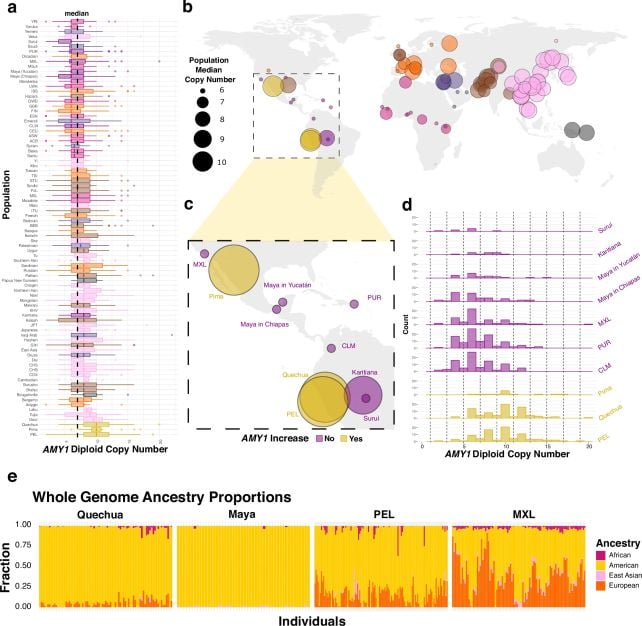
Individuals typically carry 2 to 20 copies of this gene per diploid cell; the global median, according to the data in the new study, is 7 copies.
After analyzing the genomes of 3,723 individuals from 85 populations around the world, the researchers found that Indigenous Quechua people from Peru have a median of 10 copies of the gene.
This, the researchers estimated, would have conferred a 1.24 percent survival or reproductive advantage per generation.

"Evolution is chiseling a sculpture, not constructing a building," Gokcumen explains.
"It's not as if Indigenous Andeans gained additional AMY1 copies once they started eating potatoes. Instead, those with lower copy numbers were eliminated from the population over time, perhaps because they had fewer offspring, and the ones with the higher copy numbers remained."
Using genetic dating methods and modeling, the researchers then traced the rise of this change. Their dating methods showed that the gene was present before the domestication of potatoes, but began to increase around 10,000 years ago.
We know that potato domestication in the Andes began around 10,000 to 6,000 years ago – a timing that aligns with an increase in the number of copies of the gene, which aids potato digestion.

Meanwhile, other populations descended from the Maya, without a long history of potato farming, do not have the same adaptation.
So the timing is probably not a coincidence.
"This direct comparison is one of the major reasons why we think their high number of AMY1 copies in the Peruvians did not evolve just by chance but instead linked to their long history of eating potatoes," says evolutionary geneticist Luane Landau of the University at Buffalo.
It's a result that shows that genetic adaptation to dietary changes is possible in a relatively short timeframe, adding a dimension to the debate about the so-called paleo diet.

In addition, some scientists have made a strong argument that technology is becoming the dominant force driving human evolution. This research presents an interesting aspect of that idea.
Related: Humans Are Still Evolving Before Our Eyes on The Tibetan Plateau
In the not-so-distant past, everyone more or less ate local food. Now, it's common to eat food that has either been imported directly or grown from imported species.
"For most of human history, people ate the same thing their ancestors had eaten for thousands of years. You quite literally needed to migrate across the world to change your diet. So what does it mean now that we eat food from all over the world?" says evolutionary geneticist Kendra Scheer of the University at Buffalo.
"And now that we've demonstrated the natural selection forces at play from eating potatoes, what does it mean now that the whole world eats French fries?"
The research has been published in Nature Communications.