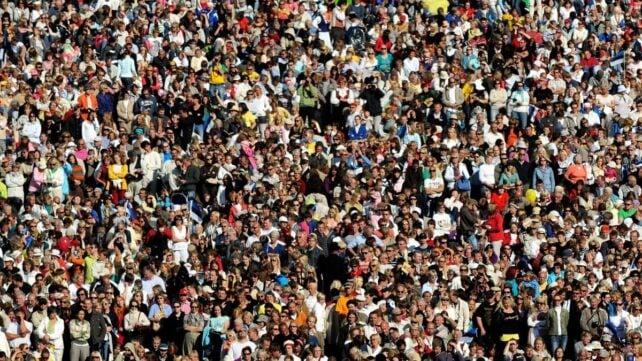
The human population has already grown too large and demanding for Earth to sustainably support at current consumption levels, a new study warns.
Based on more than two centuries of population data, a team led by Corey Bradshaw of Flinders University in Australia found humanity is living well beyond the bounds of what our planet can support long-term.
Ecologists describe the ability of an environment to sustain a species' population as its "carrying capacity". It's an estimate of the number of individuals from any given species that can survive long-term, based on the resources at hand and the rate at which those resources regenerate.
Our own species, Homo sapiens, is particularly good at pushing the limits of what that carrying capacity might be, with our penchant for finding technological solutions to overcome the natural limitations of resource renewal – especially by exploiting fossil fuels.
Interestingly, the term "carrying capacity" has its origins in the late 1800s shipping industry, when coal-powered ships were replacing those propelled by wind. It was first used to calculate the amount of cargo one of the new ships could carry, without displacing the essential coal and water needed to actually power the ship, or the crew necessary to operate it.
It was this transition to fossil fuels in shipping and other industries that fundamentally enabled rapid population growth in the 20th century – something we're all being reminded of as the US-Iran War sends the global fuel supply and the global populations that rely on it into shock. Earth's current population sits at roughly 8.3 billion.
"Today's economies, predicated on uninterrupted growth, apparently do not recognize the regenerative constraints of sustained population expansion, because fossil fuels artificially make up the difference," the team writes.
Bradshaw and team have created an evidence-based estimate of human carrying capacity, using models of ecological growth to track the changes in population size and growth rates across the past two centuries, globally and regionally.
They differentiate between the maximum carrying capacity – the theoretical, absolute limit, regardless of how much famine, disease, and war come with it – and the optimum carrying capacity, where the population size is both sustainable and meets a minimum standard of living.
"Earth cannot keep up with the way in which we are using resources. It cannot support even today's demand without major changes, with our findings showing that we are pushing the planet harder than it can possibly cope," Bradshaw says.
Prior to the 1950s, they found, the human population was growing at an ever-increasing rate, but in the early 1960s, that growth rate began to slow, though the population has continued to increase.
"This shift marked the beginning of what we call 'a negative demographic phase'," says Bradshaw.
"It means that adding more people no longer translates into faster growth. When we examined this phase, we found the global population is likely to peak somewhere between 11.7 and 12.4 billion people by the late 2060s or 2070s if current trends hold."
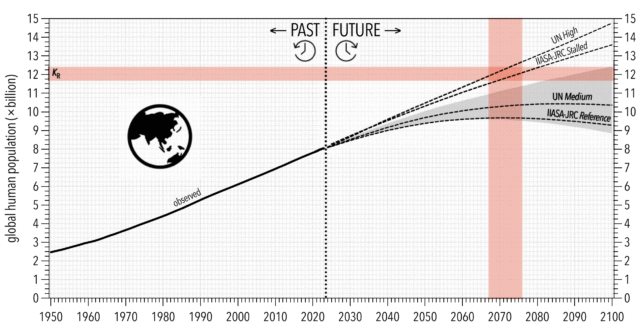
Around 12 billion is the absolute maximum estimated carrying capacity, but it's far from the optimum at our current levels of resource consumption, which Bradshaw and team calculate to be 2.5 billion.
This is the first study to investigate the relationships between the per capita rate of population change and the long-term mean population size.
It revealed that human societies have shifted from a trend where more people meant a higher rate of population growth, to one where the curve began to flatten: that is, with greater population sizes, the rate of increase declined.
But even with these slower rates of growth, our population is already far above the sustainable carrying capacity given by Bradshaw and team's models.
The gap between their optimum number of 2.5 billion and our current population size of 8.3 billion may help explain the problems with overconsumption our species currently faces.
For instance, in January this year, the UN announced the world is in a state of water bankruptcy. Animal populations are crashing due to their inability to compete with us for resources or to keep up with our appetites.
And our reliance on fossil fuels to increase Earth's carrying capacity in the short-term – to create the fertilizers that feed our crops, for instance, and to power our busy lives – is obviously not panning out too well for us, either. Fossil fuels are also driving human-caused climate change that is disrupting ecosystems and natural resources globally.

Notably, the study suggests variations in global temperature anomaly, ecological footprint, and total emissions are better explained by increasing population size than by increasing per-capita consumption.
"The planet's life support systems are already under strain and without rapid shifts in how we use energy, land, and food, billions of people will face increasing instability," Bradshaw says. "Our study shows these limits are not theoretical but unfolding right now."
But while the study paints a rather suffocating picture of human life on Earth, the researchers say time is not up yet.
"The Earth cannot sustain the future human population, or even today's, without a major overhaul of socio-cultural practices for using land, water, energy, biodiversity, and other resources," the study's authors write.
"Smaller populations with lower consumption create better outcomes for both people and the planet," Bradshaw says. "The window to act is narrowing, but meaningful change is still achievable if nations work together."
As with any global-scale modeling, there are limitations. There are far too many variables unfolding on Earth at all times for scientists to account for everything that affects population sizes, rate of change, and carrying capacity, so these numbers should be taken as estimates that are valid only within the limits of the datasets they were based on.
Related: Earth Could Have Billions More People Than We Ever Realized
Carrying capacity also has troubling ethical implications: not all humans on Earth have the same opportunities, or consume the same resources, and discussions around population control measures are often fraught with racism and ableism.
"The tragedy is that human endeavor has short-circuited the ultimately inevitable corrective feedback loops carrying capacity imposes, without replacing them with humane and environmentally friendly corrective feedbacks," the authors conclude.
The research was published in Environmental Research Letters.