
AI chatbots can act as a "cognitive crutch" that reduces our ability to retain information, a new study suggests.
The research was conducted by AI expert André Barcaui of the Federal University of Rio de Janeiro, who ran an experiment with 120 university students. Half were allowed to use ChatGPT to help them respond to an assignment on the topic of artificial intelligence, and half weren't.
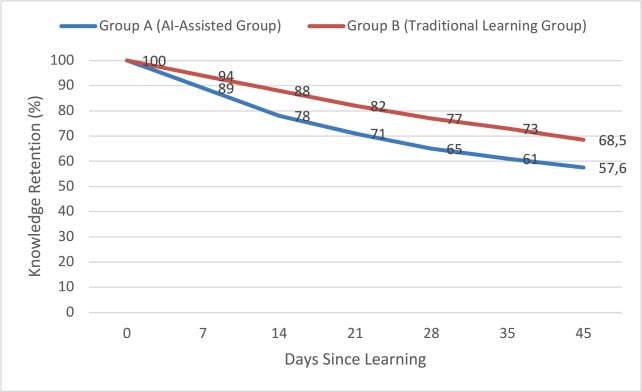
In a surprise test sprung on the participants 45 days after the assignment was given, the students who used ChatGPT scored an average of 5.75 out of 10. For those who took the traditional study route, the average score was 6.85 out of 10.
That's a notable difference, and while this is a relatively small study in terms of participants and timescale, it chimes with other research showing that using AI to find information means we just don't take as much in.
"This suggests that unrestricted ChatGPT use impaired long-term retention, likely by reducing the cognitive effort that supports durable memory," writes Barcaui in his published paper.
Open up ChatGPT or an AI tool like it, and you can get a summary on just about any topic you like: DNA, 1950s movies, Roman history, or the best workouts for the over-50s, for example. The information the AI provides draws on a vast amount of training data scraped from the open web and other sources, and is often incorrect.
In this study, the students were given a couple of weeks to learn about AI, after which they had to give a 10-minute presentation on the topic. For half the group, ChatGPT could be used to search for information online, and to synthesize, explain, and structure information, as well as to provide examples. The other half had to stick to traditional, non-AI research methods.
The two groups were also split evenly based on how much prior experience they had with AI chatbots such as ChatGPT. While there were no novices or experts, over half of the participants described themselves as frequent AI users.
In addition to scoring higher on the test by an 11 percent margin, which could equate to a full grade level in a standard exam, the marks for those who had used a traditional learning method were clustered towards the higher end. For those who had used ChatGPT to learn, the results were more spread out.
Learning was certainly faster with AI, though – the ChatGPT group spent an average of 3.2 hours on the assignment, compared with 5.8 hours for the non-AI group.
The idea of cognitive offloading, or using external tools to help our brains out, isn't new. In the old days, this would've involved calculators and textbooks.
In 2011, a team led by psychologist Betsy Sparrow of Columbia University first described what would later be named "digital amnesia" – the effect of search engines like Google on our ability to retain information.
With AI assistants now able to take on much of the mental workload, studies suggest they could be changing how we think, perceive, focus, and remember – and not necessarily for the better.

"The findings align with cognitive offloading theory and the 'desirable difficulties' principle: while AI assistance may ease initial learning, it appears to undermine the effortful processes needed for robust learning," writes Barcaui.
Several studies now suggest that using apps like ChatGPT could be depriving our brains of the exercise they need – and that has consequences.
That's not even taking into consideration AI's demands in terms of natural resources, or the mistakes that it often makes.
Barcaui is actually positive about the potential of AI as a research and educational tool, but says it must be used with care. In this student experiment, ChatGPT was shown to negatively impact both the ability to properly take in information and the ability to recall it later.
Related: Over-Reliance on AI May Harm Your Cognitive Ability, Experts Warn
"Future teaching strategies should aim to harness the benefits of AI without sacrificing the cognitive engagement and productive struggle required for durable learning," writes Barcaui.
"In the age of AI, the core principles of human learning are not outdated; in fact, they are more important than ever to uphold."
The research has been published in Social Sciences & Humanities Open.