The most precise measurement yet of how fast the Universe is expanding shows we have a real and serious problem on our hands.
The international H0DN Collaboration – a community consensus report on the Hubble constant – has remapped the markers we use to measure cosmic expansion, creating a framework that pins the rate at 73.5 kilometers per second per megaparsec for the local Universe, with a certainty of 7 sigma.
The problem is that independent measurements still return a rate of 67.24 kilometers per second per megaparsec for the early Universe – and these new efforts have brought us no closer to resolving the discrepancy, known as the Hubble tension.
Strap in, we can explain.
Our Universe burst into existence some 13.8 billion years ago and has been expanding ever since. The rate at which it does so is known as the Hubble constant, or H0, and it's one of the fundamental measurements that we use to understand the cosmos around us.
The Hubble constant helps calculate the age and size of the Universe. It helps us understand the influence of the mysterious dark energy that drives the Universe's expansion. It's one of the values required to calculate intergalactic distances.
Astronomers have several very precise tools for determining the rate of H0, and this is where the problems start.
All the tools for measuring it in the local, recent Universe give fairly consistent results, around 72 to 74 kilometers per second per megaparsec. The tools for measuring it in the distant, early Universe also give fairly consistent results, around 67 or 68 kilometers per second per megaparsec.
However, these two epochs can't be brought into agreement with each other, suggesting we're missing something important. The discrepancy is known as the Hubble tension.
The H0DN collaboration approached the problem by focusing on the local Universe. To measure H0 in local space, astronomers rely on something known as the cosmic distance ladder, where each of the rungs on the ladder represents a different measurement technique.
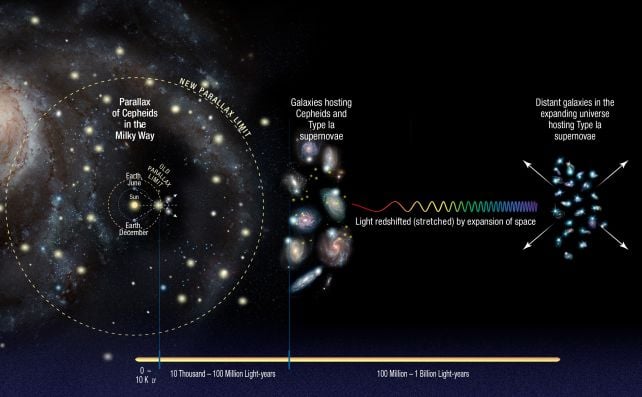
The first rung is parallax, which is the apparent shift in position of distant objects when viewed from different vantage points. As Earth moves around the Sun, the parallax of stars tells us how far away they are.
The second rung is stars of known brightness, such as Cepheid variables. The third rung is Type Ia supernovae, which have a known brightness peak.
One possible explanation for the Hubble tension is that there may have been a miscalculation in one of the rungs of the distance ladder, which was carried through to the final measurement.
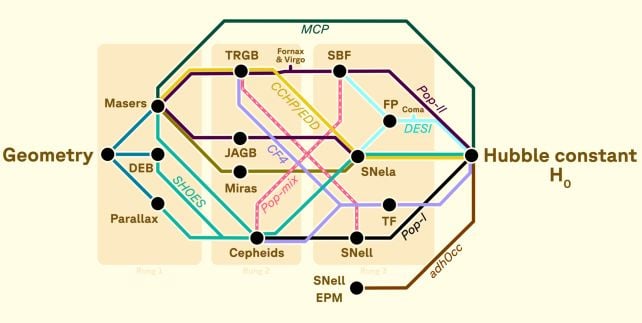
To address this, the collaboration built, not a ladder, but a distance network built from many overlapping techniques for measuring distance – including Cepheid variables, stars at the tip of the red giant branch, Mira variables, megamasers, Type Ia and Type II supernovae, surface brightness fluctuations, the Tully-Fisher relation, and the Fundamental Plane.
All these give accurate measurements to nearby stars and galaxies, some of which overlap with each other. The combined Local Distance Network suggests that the local Hubble constant sits at 73.5 kilometers per second per megaparsec.

Crucially, the researchers rigorously stress-tested their results. They tried removing, by turn, several of the methods and telescopes to see if taking one out changed the result – which would have indicated a flaw in that method.
They also tried using different datasets and changing the assumptions on which their analysis was based.
The needle barely moved. This is the most stringent examination of H0 at the local level to date, and it survived everything the H0DN Collaboration could throw at it.
But measurements of H0 in the distant Universe are also robust, and consistently hovering around the 67 kilometers per second per megaparsec mark.
In recent years, some efforts have focused on overturning the Hubble tension on the basis that our measurements may be wrong. Generally, if our two options are human error and unknown physics, the culprit tends to end up being the former, so that's not an unreasonable expectation.
However, this new research strongly indicates that the problem is indeed real – and may require new physics to resolve.
Related: This Is The Most Exciting Crisis in Cosmology
The researchers have made their Local Distance Network code freely available on GitHub so that others may try their hand at reproducing the results.
"Rather than serving solely to constrain dark energy models, as envisioned a decade ago, the improved accuracy of H0 now exposes a broader inconsistency within the standard cosmological framework and strengthens the case for new physics or a deeper reassessment of early-Universe inferences," the H0DN Collaboration writes.
"The evolving role of H0 has already reshaped our understanding of precision cosmology, and further surprises may lie ahead."
The paper has been published in Astronomy & Astrophysics.