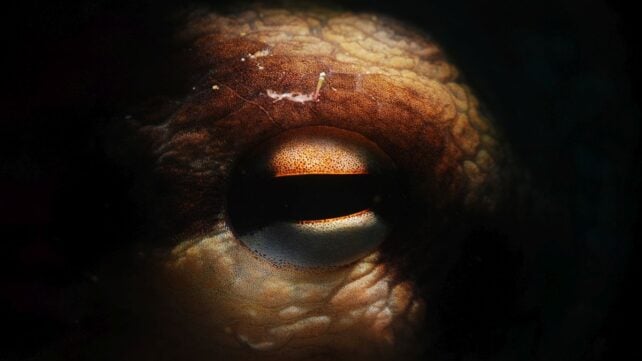
Long before Megalodon ruled the seas, something just as unsettling may have lurked in the depths – giant octopuses the size of whales.
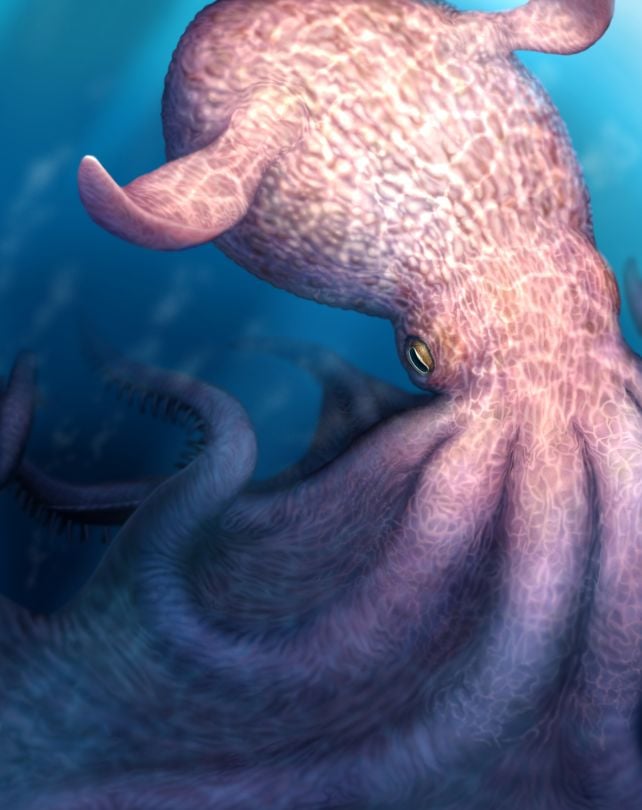
A new analysis of more than two dozen Late Cretaceous-era fossils reveals octopuses that may have reaching lengths of up to 19 meters (62 feet), rivaling the size of other giant marine predators of the time.
Moreover, the wear on these fossils – the jaws left behind by these otherwise soft-bodied animals – suggests heavy use crushing the skeletons of their prey, indicative of a top predator ruling its domain between 100 and 72 million years ago.
"These octopuses may represent the largest invertebrates thus described, rivaling contemporaneous giant marine reptiles," writes an international team led by paleontologists Shin Ikegami and Yasuhiro Iba of Hokkaido University in Japan.
"Our findings show that powerful jaws, and the loss of superficial skeletons, convergently transformed cephalopods and marine vertebrates into huge, intelligent predators."
Much of the life that has lived on this planet over the course of its history has been lost to time. This is especially true for invertebrates like octopuses and cartilaginous fish like sharks, whose soft bodies usually decompose too rapidly for the fossilization process to take hold.
The exception for these animals is often jaws or teeth – the bits that need to be hard enough to bite and rend prey.
Megalodon is famous for this. It's known mainly from the fossilized teeth it left behind during its heyday, 23 to 3.6 million years ago. Scientists have reconstructed its size based on the tooth-to-body-size ratio of modern sharks, primarily the great white shark, Carcharodon carcharias.
Ikegami and colleagues have done something similar here, with a key difference. They cross-referenced octopus beak fossils against a dozen extant species to give a wider range of estimates, correcting for bias that may be introduced by using just a single comparison.
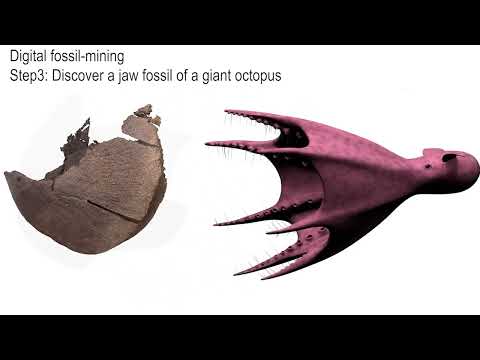
The work involved a total of 27 Cretaceous octopus fossils. Of those, 15 were already known, classified as the remains of Octobrachia and held in museum collections.
The other 12 were new, found through a recently developed process of "digital fossil-mining" – carefully sanding down rock samples layer by layer, imaging them, and using AI to reconstruct the fossilized material therein.
The researchers did not use the same technique on the original 15 fossils, but did carry out new analyses of some specimens, alongside a new, detailed examination of their properties, including patterns of wear.
Analysis of all of the specimens revealed they belong to two species of finned octopuses: Nanaimoteuthis jeletzkyi and N. haggarti. Both of these would have been large animals, but N. haggarti would have been the larger of the two, based on a comparison with modern species, estimated to reach between 7 and 19 meters.

For context, most estimates for Megalodon's size settle between 13 and 18 meters, while the largest known mosasaur topped out at 17 meters.
The world's largest living cephalopod by length, the giant squid, grows up to about 12 or 13 meters. And blue whales can grow up to about 30 meters.
Other aspects of the fossils reveal more about these long-lost giants. The wear patterns, as previously mentioned, suggest crushing, and the size suggests a powerful bite force, but there's something else.
Some of the fossils, particularly the largest ones, were more heavily worn on one side, which the researchers believe indicates handedness – a preference for one side, referred to in the paper as laterality.
"Asymmetric loss of the jaw edges suggests lateralized behavior, which has been linked to a highly developed brain and cognition," the researchers write.
"This, in turn, suggests that the earliest octopuses already possessed advanced intelligence. Laterality is known in modern octopuses, whose high intelligence matches that of vertebrates."
Just as giant squids and sperm whales are deadly foes today, the researchers say that N. jeletzkyi and N. haggarti would have given their contemporaneous vertebrate predators a run for their money. Could they have gone fin-to-fin with Megalodon, had they lived at the same time? Maybe not, but it's an interesting thought.
Related: Cephalopods Pass Cognitive Test Designed For Human Children
This large size and advanced predation ability, the researchers say, could have been the direct result of evolving away from the strictures of rigid body parts. Marine vertebrate predators lost their armor plates and reduced their scales to become more smooth-bodied. Cephalopods largely minimized or lost their external shells and became soft-bodied.
These changes allowed both groups to maximize swimming performance and body size at the cost of armor – suggesting a brief octopus reign of terror among the top predators of Earth's ancient seas.
"Long after the rise of vertebrate top predators, octopuses evolved body plans capable of rivaling them, as demonstrated here," the researchers write.
"Our discovery of octopus top predators highlights that this convergent evolution of robust jaws and the reduction of superficial skeletons in cephalopods and vertebrates is essential for becoming a large, intelligent marine top predator."
The research has been published in Science.