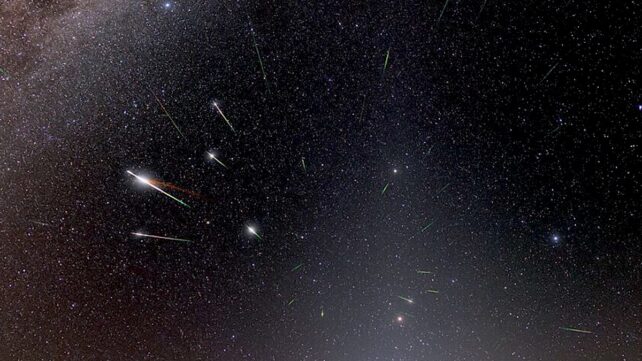
As the Northern Hemisphere progresses through the balmy days of Spring, it's a perfect time to get outside and enjoy one of the best meteor showers our sky has to offer.
Our planet is currently passing through debris left by the passage of Halley's Comet around the Sun, an annual event known as the Eta Aquariids – and the shower of comet dust burning through our atmosphere peaks around May 4 to 6.
The best time to view the shower, according to the American Meteor Society, is around 4 am local time on the morning of 5 May 2026, when the radiant is highest in the sky.
The best viewing experience this year will be in the Southern Hemisphere, where the radiant climbs higher in the sky, with up to 60 meteors per hour. Northern observers can expect closer to 10 per hour, with a bright waning gibbous Moon also washing out fainter streaks.
There are also ways to maximize your chances of viewing success so you don't have to miss out on one of Earth's best space shows, clear skies allowing. And the shower will continue until late May, so even if you miss the peak, you'll still have the opportunity to wish upon a few shooting stars.
Earth is frequently dusted by meteor showers of varying intensity – although it would be more accurate to say that Earth's orbit is threaded with streams of debris, which is why specific meteor showers happen at the same time every year.

This dust is the detritus left behind by comets or asteroids that trace their own orbits around the Sun. As they get closer to the Sun, the ice trapped just under the surface heats up and starts to sublimate, erupting outward as vapor and ejecting dust.
When Earth passes through that material, some of it falls into the atmosphere, searing with heat and often creating a glowing trail that can be seen with the naked eye. The point in the sky they seem to fall from is called the radiant, and the falling meteors appear as streaks speeding away from that central point.
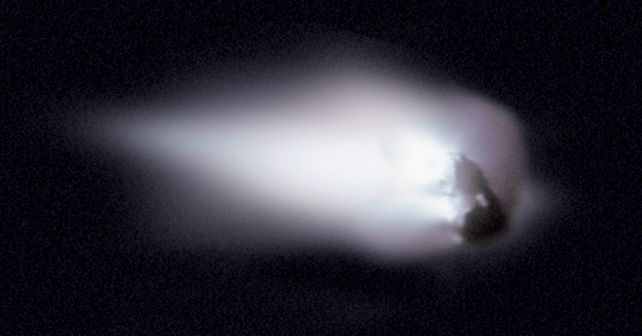
The Eta Aquariids are the debris left by a comet called 1P/Halley – better known as Halley's Comet – which comes around every 76 years. Its radiant is close to the constellation of Aquarius.
Because the Moon is due to set around dawn, it will still be in the sky when the Eta Aquariids peak, but there's some good news. Because Earth spins from west to east, most celestial objects appear to rise more or less from an eastern direction and set in a more or less western one.
The waning gibbous Moon rises in the evening. During this Eta Aquariids season, Aquarius will rise in the hours after midnight – so by the time of the pre-dawn peak, the Moon and Aquarius should be on opposite sides of the sky, with the Moon heading towards the western horizon and Aquarius rising in the east.

This means you can turn your back to the Moon to reduce the glare that outshines the fainter meteors. You could get an even better view by putting a large object between yourself and the Moon, such as a tree or a building.
Related: 4 Powerful Telescopes Agree: Interstellar Comet 3I/ATLAS Really Is Bizarre
The Moon will become less of a problem as the month of May progresses, and the shower will continue – albeit in a waning capacity – until around May 27 or 28, so if you continue to watch the skies, you may be able to extend your viewing experience.
The next meteor showers will be coming in July, with a triple whammy of the southern Delta Aquariids, the Alpha Capricornids, and the most beloved Northern Hemisphere shower of the year, the famous Perseids.
And the Perseids will peak on the new Moon of 12 to 13 August – the darkest sky possible for the very best meteor viewing. Get it in your calendar now.