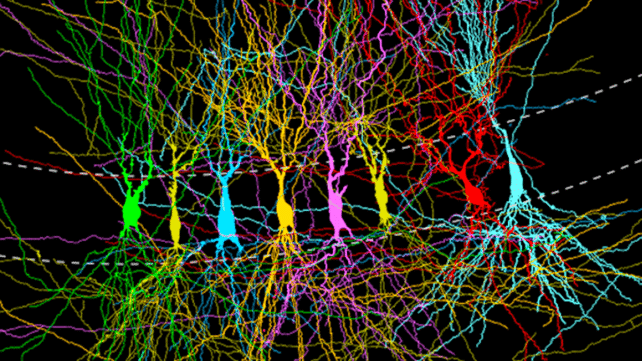
A strange mouse study suggests that the brain isn't a 'blank slate' at birth, waiting for memories to be written onto it.
Instead, it appears to start life 'full' and messy, optimizing itself as it learns.
Neuroscientists at the Institute of Science and Technology Austria (ISTA) examined mouse brains from birth to adulthood, focusing on the complexity of a key memory circuit in the hippocampus.
This region of the brain is involved in spatial memory and in consolidating short-term memories into long-term ones.
The team found that in the youngest mouse brains, this network of CA3 pyramidal neurons was very dense, with seemingly random connections. As they get older, however, they become more refined and organized.
"This discovery was quite surprising," says Peter Jonas, neuroscientist at ISTA.
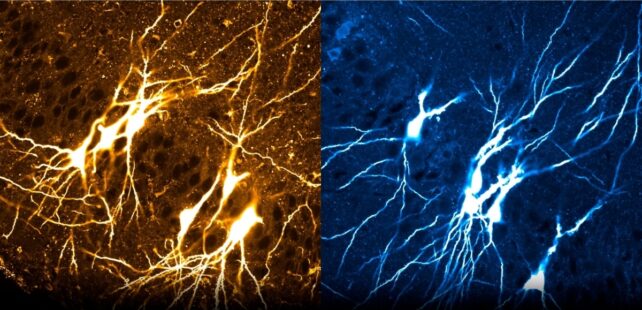
"Intuitively, one might expect that a network grows and becomes denser over time," Jonas explains.
"Here, we see the opposite. It follows what we call a pruning model: It starts out full, and then it becomes streamlined and optimized."
It's unclear exactly why the brain develops this way, but the researchers believe that neurons might connect more efficiently if the groundwork is already laid.
In a blank slate scenario, however, distant neurons would first have to find each other before they could communicate. That would take longer for a growing brain to learn.

Think of it this way: If you had to navigate from one spot to another, that would be much faster if you already had a dense network of roads, and all you had to do was pick which ones to take to get from A to B.
If, on the other hand, you had to build your own road from scratch to reach your destination, it's probably going to take a lot longer.
The team measured electrical activity and other cellular processes at three developmental stages in mice: just after birth, at around 7 or 8 days of age; in adolescence, between days 18 and 25; and in adulthood, around 45 to 50 days of age.
This revealed that neurons in this mouse hippocampal circuit start off dense and random but refine themselves into a more structured network over time.
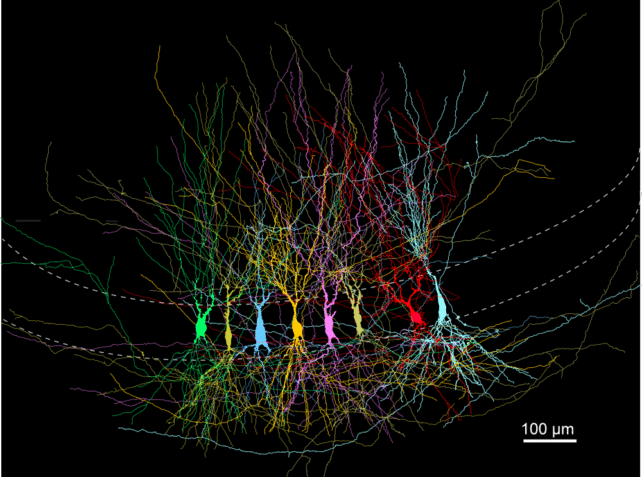
The researchers suggest that this may be because the hippocampus has a tough job of processing and linking information from your eyes, ears, and nose.
"That's a complex task for neurons," says Jonas.
"An initially exuberant connectivity, followed by selective pruning, might be exactly what enables this integration."
Related: Alzheimer's Risk Gene Alters Brain Activity Early, But It May Be Reversible
Whether or not these findings apply to human brains remains to be seen.
But either way, it's intriguing to think that your brain may be a work of art chiseled out of marble, rather than sculpted out of clay.
The research was published in the journal Nature Communications.