
Yawning is contagious. You've probably got one brewing just from reading about it, whether or not you're sleepy.
You can even catch a yawn from other animals: It's a universal phenomenon among vertebrates, which seems to serve an important function in maintaining our hard-working brains.
And for some reason, it's really socially infectious.
A team led by researchers at the University of Parma in Italy has just found out that the contagious effect of yawning may even begin before we are born.
This goes against existing assumptions about prenatal yawning, which emerges very early in the development of the fetus, after about 11 weeks of gestation.
Until now, it hasn't been clear whether fetuses are yawning purely on their own schedule, or if they might start to sync up with the important people in their lives before actually leaving the womb.
It turns out they do.
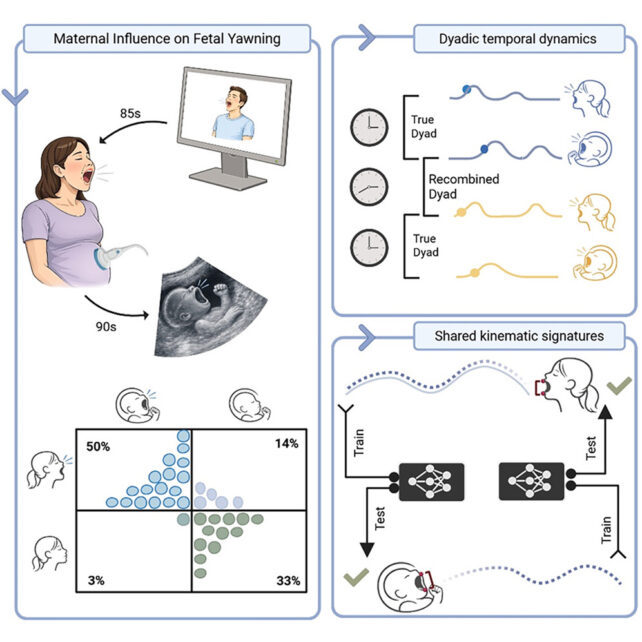
Thirty-eight women aged between 18 and 45 participated in the study. Each woman was in her third trimester of a healthy, singleton pregnancy (from 28 to 32 weeks into gestation).
For the experiments, the mothers sat in a quiet room watching a screen while their faces were recorded and their fetuses monitored by an ultrasound machine.
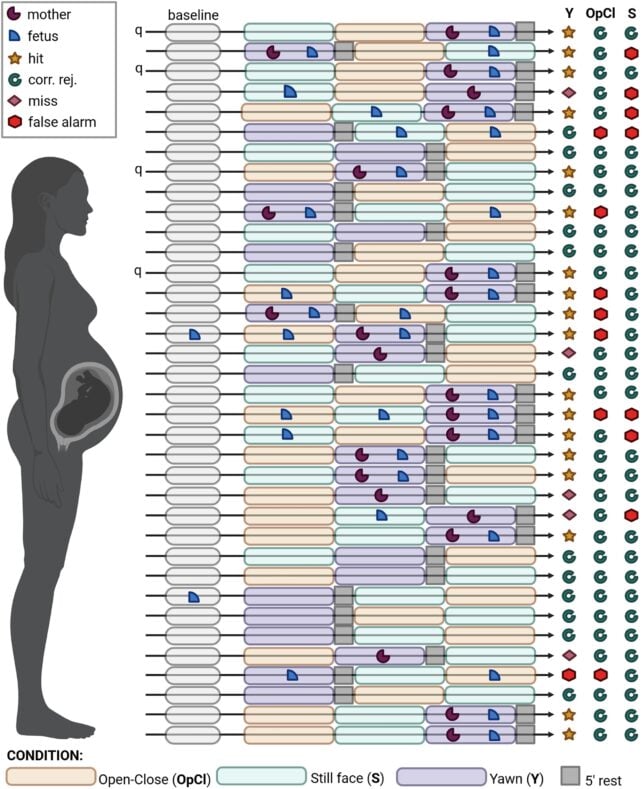
At first, the mothers were shown a minute of neutral landscape videos, giving researchers a baseline for how the mother and fetus behaved at rest.
Then, they showed the mothers three different 6-minute videos.
One showed people yawning; another showed people opening and closing their mouths in a movement similar but not quite the same as a true yawn; and a final video showed neutral faces at rest.
Then, to ensure no bias in interpreting the data, the mother and fetus recordings were analyzed, frame-by-frame, by three assistants who weren't aware of which videos the mothers had been watching when the recordings were made.
Most of the mothers yawned at least once while watching the yawn video, and among those that did, 18 seemed to set off their fetuses' yawns, too.
"Fetal yawning selectively increases following maternal yawns but not during non-contagious control conditions," the authors report.
It's hard to say whether the contagious video was somehow necessary for the wave of yawning to travel from mother to fetus, because yawns barely occurred outside of this condition.
Across all the yawning video sessions, mothers and fetuses yawned in sync in half of the cases, and in 33 percent of cases, neither of the two yawned.
In only 14 percent of cases did a mother yawn solo while viewing footage of yawning, while fetuses yawned alone during this experimental window just 3 percent of the time.
There was the occasional yawn during the control sessions, but 80 percent of the time neither mother nor fetus responded.
Interestingly, the team notes that "mothers who yawned more also tended to have fetuses that yawned more, revealing a robust positive association between maternal and fetal yawning frequencies."
All of this suggests the contagion of yawning runs deep, beginning at an earlier stage of life than we realized.

Of course, it's a pretty small sample size, with all participants being patients at an Italian maternity hospital.
The study also focuses on a rather narrow window of gestation.
We don't know yet when mothers and fetuses begin to synchronize their yawns, or whether this phenomenon even occurs consistently across the wider human population.
The authors acknowledge these limitations, calling for further study in large and more diverse populations to find clearer answers to these questions.
They also note this research "does not identify the physiological pathway through which maternal yawning influences fetal behavior," which gets to the bigger question of why any of us yawn at all.

The most robust hypothesis presently is that we yawn to cool down our brains. However, new technology that allows scientists to peer inside the human brain keeps turning up alternative – or perhaps additional – explanations.
As to why yawns are so darn catching, that remains a mystery, too. But in the case of mothers and their unborn babies, it may go beyond the perceptual mirroring that triggers yawn contagion in individuals.
Related: Mothers And Kids Sync Brain Activity, Even in Non-Native Languages
"Rather, they are more consistent with a form of intrauterine physiological contagion, likely grounded in the bodily and interoceptive consequences of maternal actions," the authors write.
"Contagious yawning may be understood as the socially recruited expression of a motor pattern that is already robust and available early in development."
The research was published in Current Biology.