
A new study shows that mothers and their children display synchronized neural activity when playing together, even when speaking in their non-native language, demonstrating that this brain-bonding effect does not get lost in translation.
This so-called interbrain synchrony is described as the "simultaneous activity of neural networks across the brains of people who are socially interacting," and it isn't limited to mothers and their children.
Synchrony occurs when people work, learn, talk, play, or sing together, potentially explaining humanity's love affair with karaoke. And while it's known that synchrony improves social bonding and facilitates successful interactions, it hasn't been studied in the context of bilingualism.
Bilingual children are especially underrepresented in developmental neuroscience research, even though bilingualism boosts brain health and supports the development of language skills, social cues, and cultural norms – skills strengthened through synchrony.
So a research team led by neurologists at the University of Nottingham in the UK designed an experiment to explore the effects of language on interbrain synchrony in mother-child pairs for whom English is not their first language, as described in a recent paper in the journal Frontiers in Cognition.
The researchers observed 15 bilingual mother-child pairs in a lab setting as they played under three different conditions: playing together while speaking in their native language; playing together while speaking exclusively in English; and playing independently in silence while separated by a screen.
The mothers and children each wore fNIRS (functional near-infrared spectroscopy) caps, which measured neural activity in the prefrontal cortex and the temporoparietal junction, two brain regions that regulate social behaviors.
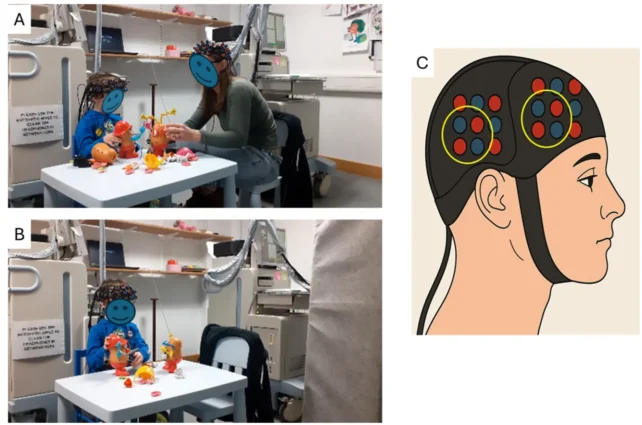
The fNIRS scans revealed that brain synchrony increased significantly when mothers and children played together – regardless of which language they used to communicate – compared with independent play.
Synchrony was especially strong in the prefrontal cortex, the brain region responsible for executive functions such as decision-making and expression of personality. Synchrony was weaker in the temporoparietal junction, which is associated with social cognition, language, and the sense of self.
These findings also suggest that parent-child differences in language acquisition do not significantly affect brain synchrony. As is often the case, bilingual children learn two languages in parallel at a young age. In contrast, bilingual parents often acquire their second language later in life, sometimes causing a purported emotional rift.
"[Second-language] speakers often report a sense of emotional distancing when using their non-native language, which may influence how they express affection, discipline, or empathy in parent-child interactions," the authors explain.

Fortunately, this sense of linguistic distance did not seem to prevent brain synchrony, which is vital for relationship quality and behavioral alignment between parents and children.
"Bilingualism is sometimes seen as a challenge, but can give real advantages in life. Our research shows that growing up with more than one language can also support healthy communication and learning," says Douglas Hartley, a professor of otology at the University of Nottingham and the study's senior author.
The researchers propose that future experiments should broaden their scope to include families with parents who are less fluent in their non-native language and children who learned their second language later in life.
Additionally, since familiar relationships tend to elicit greater brain synchrony than more distant ones, future studies should examine the strength of this effect between children and their teachers or between children and strangers.
Related: Couples Are More Likely to Share Psychiatric Disorders, But Why?
And since this study was not limited to verbal interactions, it may be worthwhile to disentangle the effects of nonverbal cues, such as eye contact and gestures, from those conveyed through language.
Most importantly, since a person's non-native tongue appears to pose no barrier to brain synchrony, these findings suggest that every language can be a love language – except maybe Klingon.
This research was published in Frontiers in Cognition.