
There's something living in the fog – but you'll be glad to know that it's mostly friendly.
Researchers at Arizona State University and Susquehanna University have found that bacteria are living and growing inside droplets of water in fog, at concentrations comparable to seawater.
While it does mean fog isn't as sterile as it may seem, those microbes are at least earning their keep: They've been found to break down pollutants in the air.
From ground-level sneezes to the highest of clouds, it's long been known that bacteria are floating around in the atmosphere in decent numbers.
But it's less clear whether these microbes are actively living in these airborne environments, or are just passing through on their way to other habitats.
Fittingly, fog is even more mysterious.
"There's very limited knowledge about what kinds of bacteria are present in fogs, which are like clouds at the ground level," says Thi Thuong Thuong Cao, a microbiologist at Arizona State University (ASU).
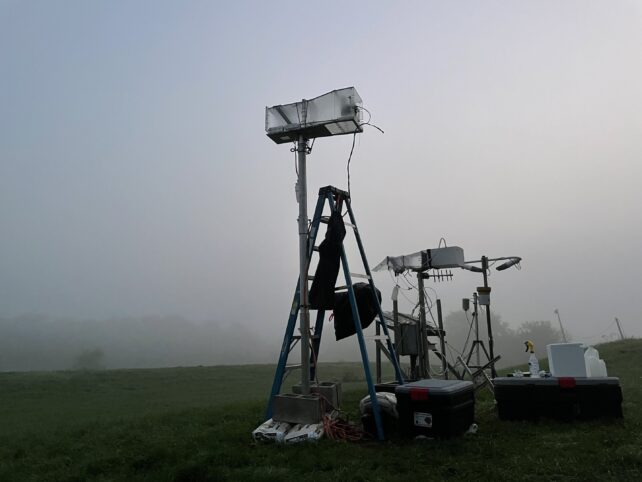
To investigate, the researchers on the new study collected air samples before, during, and after fog events on 32 different occasions over a two-year period.
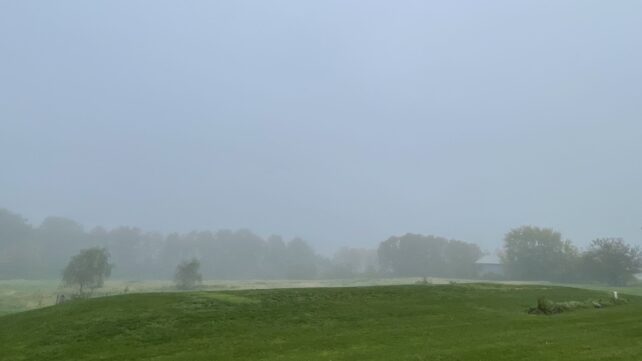
To control for wind blowing everything around and messing with readings, the team specifically examined radiation fog, a type that forms in calm, still air overnight.
And sure enough, a sizable microbiome was detected in that chilly morning air.
Bacteria were present in less than one percent of fog droplets. That doesn't sound like much, but it averages to around 1 million 16S rRNA gene copies – a common marker for estimating bacterial abundance – per milliliter of water.
"When you take all of the droplets together, the concentration of bacteria is the same as in the ocean," says Ferran Garcia-Pichel, a microbiologist at ASU.
To answer the question of which bacteria are present, the team conducted genetic analyses. This revealed that those in the Methylobacterium genus dominated the picture.
And they didn't seem to be inert, either.
"If they are growing, then the droplets are a habitat. That's a mindset change," says Ferran Garcia-Pichel.
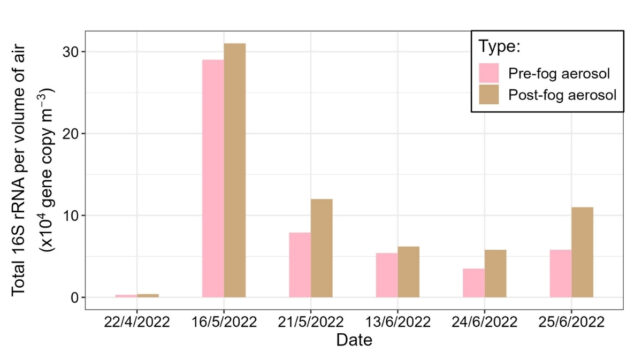
In a subsample of six fog events, the team found that even after the fog cleared, the air contained around 45 percent more bacteria than at the same location before the fog settled in.

That suggests that something about the foggy atmosphere is actively culturing the bacteria.
"We observed them under the microscope to see that yes, the bacteria are getting bigger and they're dividing, so there is growth," says Cao.
Methylobacteria are known to eat volatile carbon compounds such as formaldehyde, so the team suspected this might be the source of their growth.
To check, the researchers incubated samples of fog water and measured how levels of these compounds changed over time.
Unsurprisingly, these levels dropped – but what was surprising was the speed with which the compounds were consumed.
"Existing formaldehyde at the start of the incubation was swiftly consumed to undetectable levels," the researchers write, "roughly 200-fold faster than rates measured elsewhere in cloud water."
Related: Tiny Microbes Hiding in Soil May Help Pull Rain From The Sky, Study Reveals
That's much too fast to purely be a source of food, the team says. Instead, it's probably for "detoxification purposes" as well, since high levels of formaldehyde can be toxic to the bacteria.
The good news is that these compounds are pollutants for us too, meaning this aerial microbiome may have a cleansing effect. Exactly how beneficial this is in the real world will require more research, though.
"The sky's the limit," Garcia-Pichel says.
The research was published in the journal mBio.