
Around a third of people with major depressive disorder don't respond to standard treatments – but an alternative therapy may be hiding right under our noses.
As strange as it sounds, a new approach targeting inflammation could help.
Tocilizumab is an anti-inflammatory drug commonly used to treat immune conditions such as rheumatoid arthritis – and it may help patients whose depression does not respond to standard treatments.
Across a four-week, proof-of-concept trial, 30 people with moderate-to-severe depression who hadn't responded to standard anti-depressants – and who had signs of inflammation in their blood – were given either tocilizumab or a placebo.
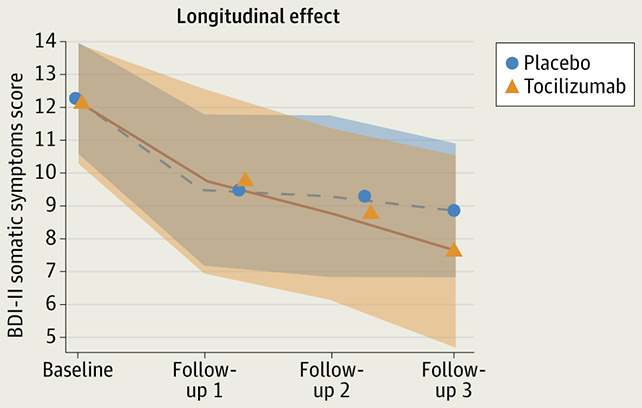
Compared to those taking a placebo, participants given tocilizumab showed improvements in depression severity, fatigue, anxiety, and quality of life.
By the end of the study, 54 percent (seven participants) of the tocilizumab group were considered to be in depression remission, against 31 percent (five participants) of the placebo group.
"This work represents an important milestone in the development of new treatments for depression – especially difficult-to-treat depression, which affects millions of people in the UK alone," says immunologist Golam Khandakar from the University of Bristol.
A previous meta-analysis found a significant link between depression and low-level inflammation in the body.
So could treating one condition help the other?
The tocilizumab therapy takes aim at receptors for interleukin 6 (IL-6), a type of protein known as a cytokine linked to inflammation in the body.
Earlier work by some of the same researchers had suggested that elevated IL-6 could be linked to depression in some people.
One of the changes that tocilizumab brings about in the body is to close off the IL-6 pathway to calm down the immune system and reduce inflammation – that's why it's effective for treating arthritis, and could be effective for treating depression.

Many current depression therapies focus on correcting chemical imbalances in the brain, and while we're seeing progress in these areas too, it looks increasingly likely that fighting persistent, background inflammation might help in many cases as well.
And something of note that the researchers observed: Those who started the study with signs of higher inflammation in their bodies were most responsive to the tocilizumab treatment, further strengthening the link.
However, this effect was seen only among people with higher initial levels of a different inflammation marker.
"This is one of the first randomized controlled trials to test immunotherapy for depression, the first to test IL-6R as the treatment target, and the first to use a targeted approach to select patients most likely to benefit, and to show that it works," says Khandakar.
It's worth bearing in mind that the results of the trial didn't reach statistical significance – but with only 30 participants, it wasn't designed to. This was a proof-of-concept study, and the main aim was to see if this was a research area worth investigating further.
In that respect, the team got an affirmative answer.
The findings here are enough to make larger studies worthwhile: across a larger, more diverse group of participants, and for a longer period of time. That will get us closer to understanding the link between inflammation and depression.
As tocilizumab is already available as a prescription drug safe for human consumption, it means that it'll be quicker to get regulatory approval for its use with depression as well – and no notable side effects were observed in this trial.
Related: Cannabis Use Disorder Strongly Linked to Major Depression, New Review Finds
The research also sheds more light on just how complex and nuanced depression is.
The condition looks different in different people – from symptoms to severity – and that's something that treatments might start to factor in more specifically in the years to come.
"Depression is estimated to affect around 10 to 20 percent of people worldwide during their lifetime, yet for many patients current treatments do not work well enough," says immunologist Éimear Foley, from the University of Bristol.
"Our study moves us closer to more tailored depression care, where treatments are chosen to better fit a person's biology. This will help us to provide the right treatment to the right patients at the right time."
The research has been published in JAMA Psychiatry.