Right on the brink of black hole formation, spacetime can get downright peculiar.
This is where familiar physics can become unnervingly strange, and understanding how cosmic processes play out often requires more esoteric math and creative solutions.
Now, physicists have mathematically described, for the first time, a quirk of spacetime geometry at the black hole formation threshold.
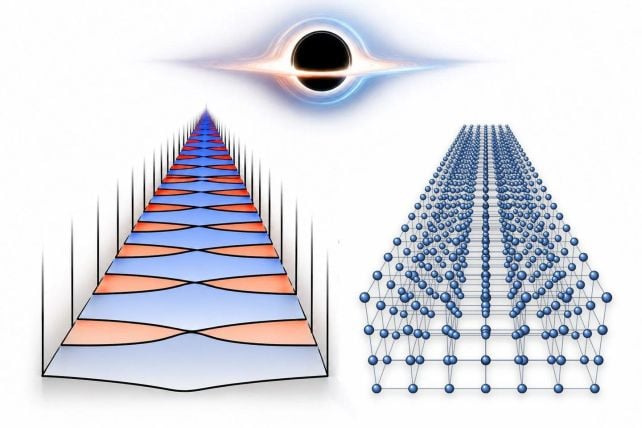
Here, the curvature of spacetime itself can organize into a highly ordered repeating state reminiscent of so-called "time crystals," exotic states of matter that repeat atomic patterns through time.
And this is where things get even spookier. With just a tiny nudge of energy, those crystal-like patterns of spacetime can collapse into microscopic black holes.
"Sometimes a tiny, seemingly insignificant cause is enough to trigger a huge and dramatic change," says physicist Daniel Grumiller of the Technical University of Vienna in Austria.
"Take liquid water at zero degrees Celsius, for example. A very small change is enough to make the water freeze. The water molecules then spontaneously arrange themselves into a regular pattern and form an ice crystal."
Throughout most of the Universe, physics behaves beautifully. From planetary orbits to colliding galaxies, Einstein's theory of general relativity describes gravity with remarkable precision.
But at the threshold of black hole formation – known as critical collapse – gravity becomes so gnarly that Einstein's equations are rendered all-but-impossible to solve analytically, forcing physicists to rely heavily on computer simulations.
This threshold describes a delicate regime where gravity is poised right on the edge of black hole formation. It could go either way: dissipating uneventfully, or completely collapsing into a black hole.
In 1993, theoretical physicist Matthew Choptuik made a major breakthrough.
Using computer simulations, Choptuik discovered that the critical state at the threshold of black hole formation exhibits what's known as discrete self-similarity: repeating patterns that echo through spacetime across smaller and smaller scales.
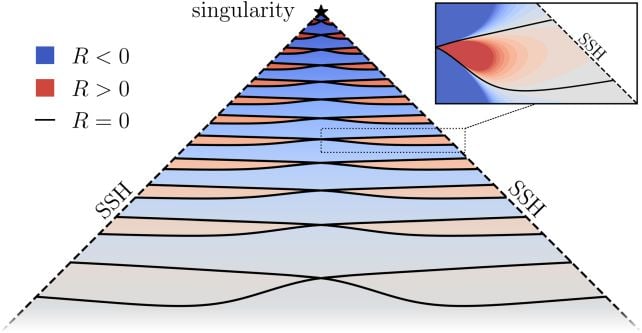
"This spacetime crystal is a very peculiar and fascinating object," Grumiller says.
"It is a kind of intermediate state, an unstable point that can evolve in two different directions. It may simply dissolve again, leaving behind ordinary spacetime filled with freely moving particles.
"But if a tiny amount of energy is added, the evolution takes a completely different path: the inconspicuous spacetime crystal turns into a black hole."
In the three decades since Choptuik's pioneering work, physicists had only been able to study these spacetime crystals computationally; because of the difficulty of solving Einstein's equations at the critical collapse threshold, no one had developed the mathematics to describe them.
The trick, Grumiller and his colleagues found, was to think outside of the relatively standard four dimensions of conventional spacetime.
In our Universe, spacetime has three spatial dimensions and one temporal. Mathematically, however, general relativity can be written for any number of dimensions.
The researchers approached the problem with the mindset: What if we imagined the Universe with a much larger number of dimensions?
"Our Universe has four dimensions – three dimensions of space and one dimension of time," says physicist Christian Ecker of the Institute for Theoretical Physics at Goethe University Frankfurt in Germany.
"But in principle, nothing prevents us from writing down physical equations for a larger number of dimensions – five dimensions, forty-two dimensions, or even infinitely many."
As strange as it sounds, pretending the Universe has huge numbers of dimensions can actually make Einstein's equations easier to solve – gravity becomes less sprawling and more locally concentrated near the collapsing region.
By imagining a Universe consisting of hundreds of dimensions, the researchers were able to derive analytical formulae that actually describe the repeating, fractal-like structures in spacetime curvature that spontaneously emerge during black hole collapse.

The equations didn't just work in absurdly high-dimensional universes, either.
The researchers found the same mathematical structures persisting even at far lower dimensions, suggesting that these bizarre crystal-like states may reflect something fundamental about gravity itself.
Related: Scientists Discovered a Time Crystal That Reveals a New Way to Order Time
The Universe may or may not contain hundreds of hidden dimensions. But by imagining that it does, scientists can gain insight into the gravitational mischief that unfolds in extreme regimes and would otherwise be extraordinarily difficult to understand.
"Our technique turns out to be remarkably stable. Depending on the desired precision, we can systematically improve our formulas using additional approximation methods," says physicist Florian Ecker of the Technical University of Vienna.
"This gives us a new method for studying black-hole-related phenomena that could previously not be analyzed analytically."
The findings have been published in Physical Review Letters.