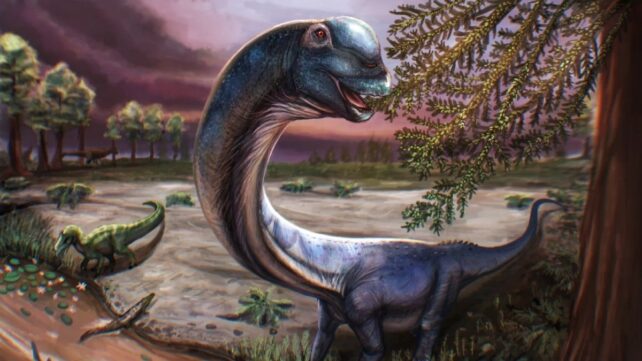
An ancient giant – as massive as nine elephants – has emerged from Thailand.
The dinosaur, named Nagatitan chaiyaphumensis, lived more than 100 million years ago during the Early Cretaceous.
It was a sauropod, sporting a lengthy tail, a long neck, and a prodigious appetite for plants, à la the on-again off-again Brontosaurus.
It likely weighed up to 28 tons and stretched some 27 meters (89 feet) long.
That's truly immense – more than 10 tons more massive than the hugely famous (and famously huge) Dippy the Diplodocus.
And it makes Nagatitan the largest dinosaur ever discovered in Southeast Asia.
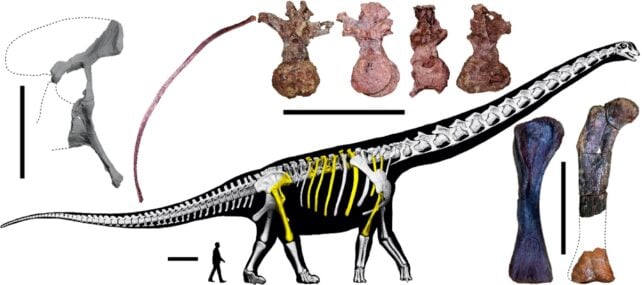
Yet Nagatitan would have been only modestly mammoth compared with Patagotitan, a sauropod thought to have weighed approximately 70 tons and which may have been the largest land animal to ever walk the Earth.
Nagatitan has also been bestowed with an interesting etymology.
"Naga" refers to mythological water serpents frequently featured in Asian and Buddhist mythos. "Titan" derives from the Titans, or elder deities of Greek myths.
"Chaiyaphumensis" comes from the Chaiyaphum province of Thailand, where the bones were found.
As described in a recent paper published by a collaboration of researchers from Thailand and University College London (UCL), the remains of Nagatitan were discovered in 2016 on the edge of a dried pond in northeastern Thailand.
To tease out fine details and safely study bones across institutions, the researchers used a surface-scanning technique to create three-dimensional models.
"The material was studied both in Thailand and at UCL – 3D scanning and printing has meant that we can study the specimen and collect data without having to travel," says Paul Upchurch, paleobiologist at UCL and one of the study's co-authors.
In relation to other dinosaur fossils, it presented a fairly comprehensive collection of bones that exhibited a few morphological differences from those of other known sauropods.
The fossil find included eight vertebrae, five ribs, parts of the pelvis, a humerus, and a femur, along with some indeterminate fragments.
The dinosaur appears to be somewhat of an endling. The researchers have dubbed it "the last titan" because it was found in the Khok Kruat Formation, the youngest dinosaur-fossil-bearing stratigraphic region in Thailand.
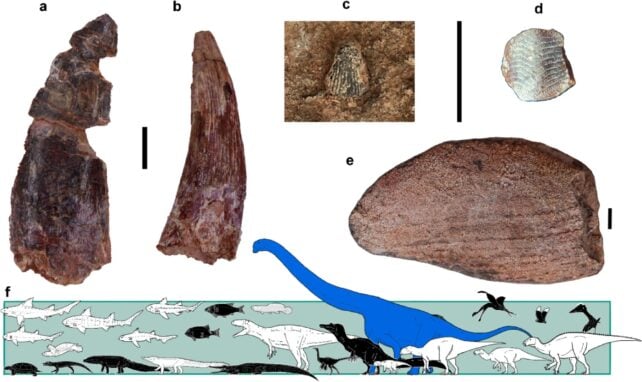
The Khok Kruat Formation preserves a diverse array of fossils, including sharks, turtles, pterosaurs, ancestral crocodiles, and fearsome, predatory theropods, including an 8-meter-long shark-toothed predator.

In the Early Cretaceous, this area may have hosted shrublands and savannas, cut through by a meandering river system. As flying reptiles swiftly swooped up fish from the currents, Nagatitan could have dipped its long neck to gulp vast mouthfuls of water.
A product of their environment, as creatures usually are, sauropods seemed to have adjusted well to rising temperatures, despite their size. Perhaps they evolved their large surface area to dissipate heat.
The landscape then shifted dramatically, ending the dinosaurs' reign in Southeast Asia.
Related: Giant Dinosaurs Were Riddled With a Devastating Disease, Fossils Show
"Younger rocks laid down towards the end of the time of the dinosaurs are unlikely to contain dinosaur remains because the region by then had become a shallow sea," explains Thitiwoot Sethapanichsakul, a paleontologist at UCL, and first author of the study.
"So this may be the last or most recent large sauropod we will find in Southeast Asia."
Nagatitan isn't just an important 'last' – it's an exciting first for its discoverers, too.
"I've always been a dinosaur kid," says Sethapanichsakul.
"This study doesn't just establish a new species but also fulfils a childhood promise of naming a dinosaur."
This research was published in Scientific Reports.