
A major barrier to harnessing energy via nuclear fusion is the fuel source.
Most proposed fusion reactors (the donut-shaped tokamak reactors) are powered by the fusion of tritium and deuterium.
Both are isotopes of hydrogen, but tritium is radioactive, and deuterium is stable.
The fusion reaction between these two isotopes produces one helium nucleus, a loose neutron, and 17.6 megaelectronvolts. As far as fusion goes, this particular combination has a very high reaction rate, and a very high energy yield.
Unfortunately, tritium is next to non-existent on Earth.
The only place it's known to naturally occur is in the atmosphere, where it is produced by interaction with cosmic rays. Even then, it only occurs in trace amounts.
However, if scientists can find an efficient way to 'breed' tritium, it could become a more viable source of power.
Now, for the first time, quantum-centric supercomputers have just been used to identify nine configurations of the material used to breed tritium – the latest evidence that these high-tech simulations could help physicists knock down one of the greatest barriers to fusion.
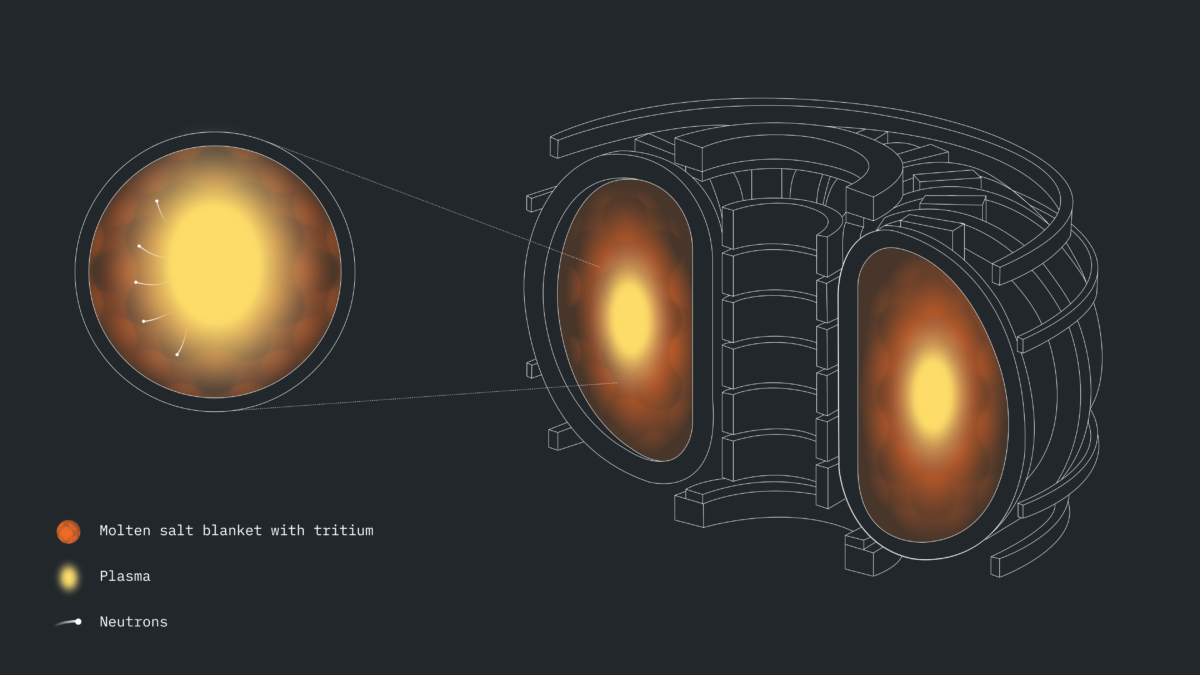
Advocates of fusion energy say it is a 'clean' energy source, since it does not release greenhouse gas emissions like fossil fuels do, and it produces far less radioactive waste than its more controversial counterpart, nuclear fission.
But so far, fusion has been floundering to take off, with technological barriers so far constraining it to laboratory settings.

It was only at the end of 2022 that scientists at the US Lawrence Livermore National Laboratory achieved a 'breakeven' for fusion, meaning that more energy was produced in a fusion reaction than was needed to actually kick it off.
New records have also recently been set in maintaining the hot plasma required: 1,337 seconds.
But if fusion has any real future, scientists need to solve the tritium problem.
Researchers at the Cleveland Clinic, Oak Ridge National Laboratory, IBM T.J. Watson Research Center, and Michigan State University have now turned to supercomputing.
Specifically, they've employed a quantum-centric supercomputing technique that the Cleveland Clinic has been using to simulate protein configurations.
"Quantum computers… are key tools that accelerate the discovery and design cycles needed to produce sufficient tritium to fuel fusion reactors," Oak Ridge National Laboratory computational chemist Tom Beck explains.
These powerful computers have come up with nine different molecular configurations of a substance called FLiBe, a molten salt made from lithium fluoride and beryllium fluoride.
FLiBe is a star candidate for tritium production: Inside a fusion reactor, it provides the 'breeding blanket' where tritium is formed under extremely high temperatures.

So far, the research is more about seeing whether quantum computers can actually be relied on to help solve this problem. The results are promising, but that doesn't mean researchers have cracked actual tritium production just yet.
So far, the supercomputers are just doing simulations. They will still have to be tested in a lab.
But the process has allowed researchers to get a better sense of FLiBe's electronic structure, atomic behavior, and the strength of molecular bonding within the tritium that could arise from each configuration.
This means fusion scientists can use this workflow to identify configurations worth investigating before they test them in real life, saving them from wasting time on difficult and expensive experiments that lead nowhere.
Related: The First Room-Temperature Quantum Material of Its Kind Is Spun From Atoms of Gold
"These results add to mounting evidence that quantum-centric supercomputing is now a practical scientific tool for problems that have long challenged chemists, engineers, and materials scientists," says Jerry Chow, an experimental quantum computing researcher at IBM.
"As quantum computers scale, the path ahead is promising."
A preprint of the research is available at arXiv.
This article was fact-checked by Rebecca Dyer and edited by Peter Dockrill. While we pride ourselves on our process, we are only human. If you spot a mistake, please let us know.