
If someone turns up with crumbs on their chin, it's natural to wonder where the cookies went.
Astronomers have found themselves asking that same question about a handful of very strange stars.
Among thousands of stars studied by astronomers, six red dwarfs stood out for carrying traces of a strange element in their atmospheres.
In normal circumstances, this element should long ago have been annihilated deep within the stars' interiors.
Its presence here suggests that these six stars have been raiding the cookie jar – if the cookie jar were full of Earth-like planets.
"We found that a few of the red dwarf stars we studied contained lithium, a chemical element that should not be there," says astronomer Robin Jeffries of Keele University in the UK.
"Therefore, even a small amount of lithium stands out clearly in these stars – a bit like throwing paint onto a blank canvas."
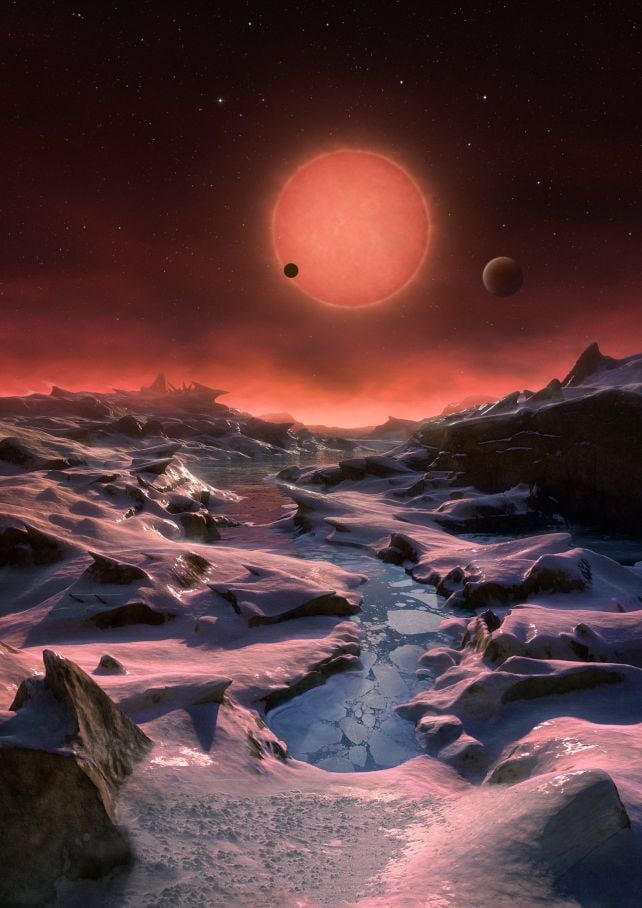
In space, crime scenes rarely include the bodies.
When stars consume planets, the evidence is usually destroyed along with the victim. Astronomers therefore have to hunt for subtler clues – chemical traces, unusual stellar behavior, and other lingering signs of cosmic chicanery.
The forensic search for these signs has its own special term: necroplanetology.
Necroplanetology is usually performed on dead or dying stars whose swollen outer layers or well-characterized chemistry make such traces relatively easy to spot.
Red dwarf stars are not stars at the end of their lifespans. They are relatively small, cool, and dim, which means they take a lot longer to burn through their fuel than hotter, more massive stars.
The Sun has a lifespan of about 10 billion years. Red dwarfs have lifespans that are tens of billions to trillions of years.
At an age of 13.8 billion years, the Universe is not yet old enough for a red dwarf star to have reached the end of its natural lifespan.

But there's something else about red dwarfs that makes them a prime candidate for necroplanetology.
Low-mass stars destroy lithium quickly and efficiently. This means that, if fresh lithium shows up in a red dwarf's atmosphere, it must be a recent arrival.
Which, in turn, makes it an excellent tracer of star-on-planet violence.
Jeffries and his colleagues pored over data from the Gaia-ESO Spectroscopic (GES) survey, which collected data on the chemical composition of thousands of stars in the Milky Way.
They were looking at clusters of stars, because clusters are born from the same cloud of star-forming material, and the stars therein tend to share very similar chemical properties.
That's important because red dwarfs rapidly destroy lithium in their youth. By the ages of the stars studied here, any lithium left over from their formation should have been almost entirely erased.
This makes it much easier to spot a star that has acquired fresh lithium than it would be for an isolated red dwarf. If a cluster red dwarf star has lithium crumbs, and its siblings do not, it warrants a closer look.
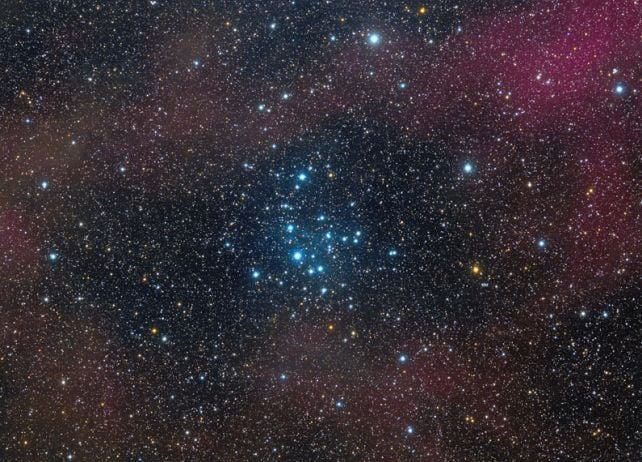
When they narrowed down the search to include only stars that could show a lithium signature, they were left with 318 red dwarfs. Of these, six had way more lithium than they should.
The next step was to rule out other possible explanations for the lithium signature.
A newborn star, for example, would have higher lithium levels than an older one, and it's possible that a younger star could move into an established cluster and pretend it belongs there. The motions and colors of the stars ruled that out – each of the six stars was in its home cluster.
Another possibility is that something about the star's behavior may have prevented it from destroying lithium. Spinning very fast, for example, or intense magnetic activity could alter how the star mixes and burns lithium.
Again, this was a dead end. Far from being unusually active, the stars were among the slowest rotators in their respective clusters.
The final question was whether a recent lithium delivery could explain the observations. The researchers' models showed that the lithium signal in each of the six stars was consistent with a new acquisition.
We know that small rocky planets are common around red dwarf stars, and that some stars can devour their planets. The calculations suggest that around three to 10 Earth masses worth of planet would need to have disappeared down a stellar gullet to produce the observed signal.
That's about as clear a smoking gun as it gets for necroplanetology.
But it may not be uncommon, depending on how long lithium can last in a red dwarf's atmosphere. Six out of 318 stars suggests that 2 to 3 percent of red dwarfs are scurrilous planet-munchers, but that's assuming that the lithium hangs around for a while.

If the lithium disappears quickly, that rate could be much higher – because the window we have to catch them in the act is much narrower, yet here we are looking at six allegedly planet-smeared red dwarfs.
Related: Rogue Planets Floating in Space Appear to Be Forming Their Own Moons
Some astronomers believe that, particularly during the formative years of a planetary system, when gravity is playing pinball with newly forming worlds, stellar planetary devourment is relatively common.
This finding suggests that red dwarf stars may offer a new way to investigate this phenomenon that reveals the mechanics of system formation.
The prosecution rests – but perhaps we may want to avoid a life sentence. Trillions of years is a very long time.
The research has been published in the Monthly Notices of the Royal Astronomical Society.