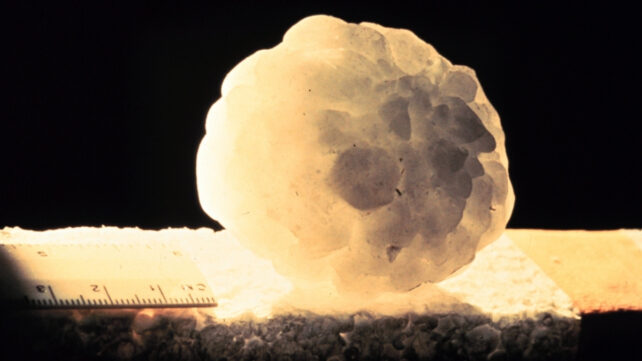
Everyone has a storm story – whether it's that time you just escaped a downpour, or the hailstorm that wrote off your car.
Even though hailstorms are relatively rare, they cause significant damage.
Two new studies shed light on how hail might change as the world warms.
In our study, published today in Nature Climate Change, we show that hail conditions may move towards the poles with global warming and shift a bit from summer to winter.
This could lead to more hailstorms in places such as northern Europe, Canada, southeastern Australia and New Zealand's South Island.
Another new study led by Shiyi Zhang at Peking University shows that hail may also become more damaging.
Hailstorms are costly.
In Australia in 2025, hail in New South Wales and Queensland caused AU$1.9b in insurance claims, and in recent years severe storms have caused enormous losses globally.
Severe storm costs are increasing. Much of this increase is because people and assets are more exposed to storms as populations increase and cities expand.
But is climate change also playing a role?
How does hail form? To get hail, you need a thunderstorm, and to get a thunderstorm you need an updraught.
Updraughts form when buoyant air rises in a localized area. They bring up water vapor, which condenses into clouds made of tiny water droplets.
Inside a storm, those drops hit each other, and if it's cold enough, liquid drops freeze onto ice particles, growing them into hailstones.
For hail to affect us at ground level, a strong updraught needs to keep hailstones aloft for long enough to grow, and the hailstones must then survive melting as they fall to Earth's surface.
Wind shear, or shifts in wind with height, increases storm severity by moving falling rain and hail away from the updraught, so the updraught is not inhibited and can grow stronger.
Buoyancy and wind shear form the basic atmospheric "ingredients" required for hail.
How might climate change affect hailstorms?
Climate change is warming the atmosphere and adding moisture to it. Moisture is the fuel for storms, and a warmer atmosphere is more likely to make strong updraughts that can support larger hail.
A warmer atmosphere also melts falling hail faster, which might make hailstones shrink or melt away before they reach the ground. So, these two changes work against each other.

According to past research, the broad expectation of climate change's impact on hail is that it will bring less frequent hail, but the hailstones will be larger when hail does happen.
That's because more melting would mean smaller hail reaches the ground less often, but stronger updraughts would enable larger hailstones.
However, these changes vary regionally, depending on variations in the delicate balance between hailstorm ingredient changes.
Global climate models generally can't tell us about individual storms, let alone hailstones – think of a low-resolution image that only shows the broad picture but no details.
So, instead of looking at hail directly, our study examined how the ingredients for hailstorms change.
Because the exact relationships between ingredients and hail risk remain unclear, we used several so-called "proxy" relationships, including one that we previously developed for Australia and the wide range of weather regimes here.
We applied three proxies to outputs from eight climate models to look at a range of possible future warming scenarios.
First, the proxies and models agree that in the warming scenarios hail-prone conditions are shifting toward the poles – decreasing across mid-latitudes in the southern hemisphere, and increasing in mid-high latitudes, particularly in the northern hemisphere.
We project more frequent hail conditions in northern Europe, Canada and the northwestern US, southeastern Australia, and the South Island of New Zealand; and less frequent hail conditions in northern Australia, most of Africa, southern India and southeastern China.
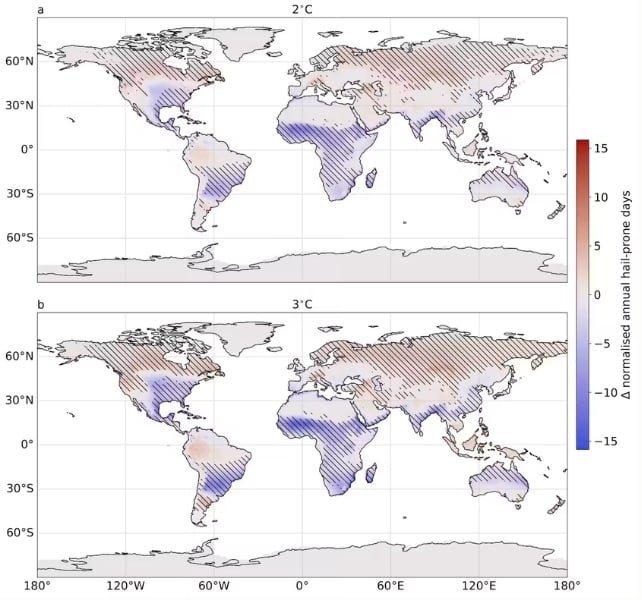
Second, our results predict less frequent hail conditions in summer and more in winter.
That means winter crops like wheat may see increasing risk, while risk may decrease for summer crops like maize. If climate change shifts arable regions closer to the poles, these crops may be subjected to increased hail frequency there.
Third, the different proxies don't always agree, particularly in the tropics where some show increases and others decreases.
These disagreements highlight the difficulties in estimating changes in hail environments and how that connects to whether hail happens.
What about the severity of hail when it occurs?
Zhang and colleagues took a different approach to ours. They applied a model of hailstone growth and melting to climate simulations, to examine possible hail sizes and changes in potential damage they might cause.
Their new global simulations overall predict more large hailstones and fewer small ones.

This result is in line with previous reasoning – a warmer atmosphere can melt smaller hailstones away but produce larger hail through stronger updraughts.
Like ours, their study shows regional differences in changes.
Both studies show increasing hail risk with increased frequency and hail damage potential in the mid-high latitude northern hemisphere and southeastern South America.
In sub-tropical regions of Africa and northern South America, both studies show decreasing hail risk.
In southeast US, mid-northern Africa, southern India, and northeastern Australia, we project decreasing frequency while Zhang and colleagues project increasing damage potential.
Related: Sea Level Rise Is Accelerating, And We Now Know The Biggest Reason Why
These two studies point to increasing risk from hail damage in a warming world, even though the details of where this will be experienced are still not clear.
The more warming occurs, the more this risk will increase.
Quickly reducing greenhouse gas emissions is the surest way to blunt the most damaging effects of climate change.
Timothy H. Raupach, Scientia Senior Lecturer, Institute for Climate Risk and Response, UNSW Sydney and Steven Sherwood, Professor of Atmospheric Sciences, Climate Change Research Centre, UNSW Sydney
This article is republished from The Conversation under a Creative Commons license. Read the original article.