
Echolocation is a fascinating way that animals like bats and whales find their way around the world.
By emitting sounds and decoding the echoes that come back, these species are able to detect what's around them in their local environment.
It's something we know that humans can do too – and it takes less training than you might think.
A study published in PLOS One in 2021 by researchers from Durham University in the UK showed that with 10 weeks of training, both blind and sighted people could learn to echolocate using verbal clicks.
While the technique is already used by a number of people with impaired vision – sometimes using the taps of a cane instead of clicks made by their mouth – those findings suggest that many of us can learn the necessary techniques.
Some of the same researchers who made that discovery are part of the team behind a follow-up study published in Cerebral Cortex, looking at how the 10 weeks of training that the 26 participants went through actually changed the physical structure of their brains.
Specifically, the team analyzed brain scans of the V1 (the primary visual cortex, processing visuals), and the A1 (the primary auditory cortex, processing sounds).
Strikingly, the scans showed that the V1s of both blind and sighted people had developed sensitivity to sound echoes during echolocation training.
"We show here, for the first time, functional and structural brain changes in primary sensory areas V1 and A1 in blind and sighted people who learn click-based echolocation in adulthood," write the researchers in their published paper.
"These results are a key finding with respect to previous studies that found plasticity in blind and sighted adult people primarily in higher-order sensory areas."
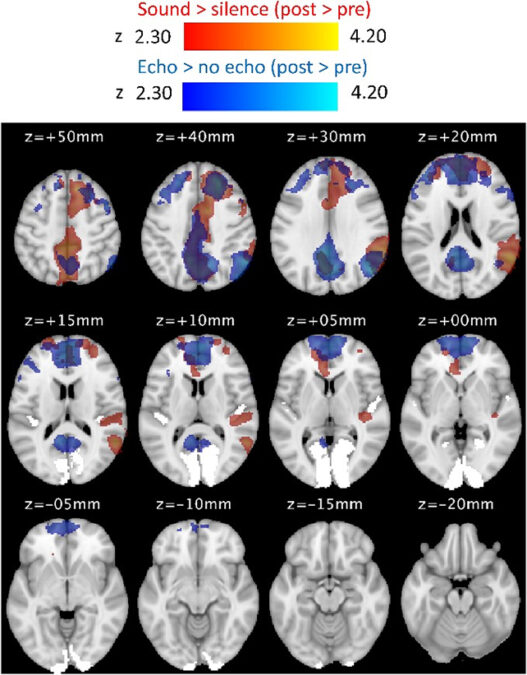
The suggestion is that being blind or sighted doesn't affect the brain's ability to adapt in this scenario – that the plasticity doesn't rely on long periods of one kind of sensory deprivation to hone the brain's sensitivity in another area.
It's more evidence that many of us can learn echolocation, if we put our minds to it – brains can all adapt well enough (although it's worth noting that some of the specific structural changes differed between blind and sighted people).
"This provides strong evidence that the ability of a primary sensory area (V1) to exhibit sensitivity to input from a different modality (here: sound echoes) can be considered a normal characteristic of the typical adult human brain," write the researchers.
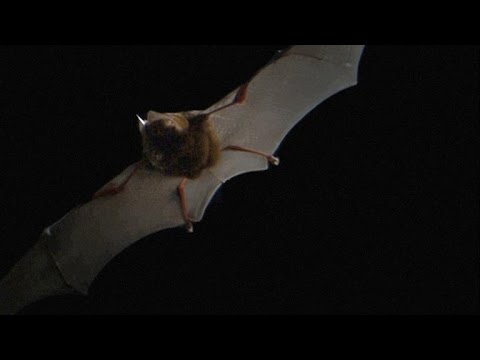
Adding more context to the idea around echolocation changing brain structure and wiring, researchers from the US and UK published a study in PLOS One in 2025 that looked at how 30 million years of evolution – rather than 10 weeks of training – has altered the brains of dolphins and baleen whales.
The researchers analyzed the auditory systems in the brains of three dolphins (which can echolocate) and one baleen whale (a species which can't echolocate, but which still relies on a keen sense of sound to navigate dark environments).
Somewhat surprisingly, there were a lot of similarities, with one exception: The dolphins had a specific brain connection leading to the cerebellum that was significantly stronger.
"While neuroscientists used to think of the cerebellum largely as a center for balance and motor (muscle/movement) control, newer evidence strongly suggests that it serves as an integration center for sensory and motor information, and, importantly, a rapid prediction center," says biologist Peter Tyack, from the Woods Hole Oceanographic Institution in the US.

It means we've got a lot to learn about how echolocation might affect the brain – and changes aren't necessarily going to show up where we expect them. In the case of dolphins, the adaptations are in brain regions more closely related to touch than vision.
The more data we can collect, the more we can discover about echolocation, and about how the brains of animals and humans alike use different senses in tandem.
Related: Human Echolocators Can 'See' With Sound, And Brain Scans Reveal How
"The technology is finally there to start to crack open these mysterious nervous systems and find out how they tick," says marine scientist Peter Cook from the New College of Florida.
The studies are published in PLOS One, Cerebral Cortex, and PLOS One.
This article was fact-checked by Rebecca Dyer and edited by Peter Dockrill. While we pride ourselves on our process, we are only human. If you spot a mistake, please let us know.