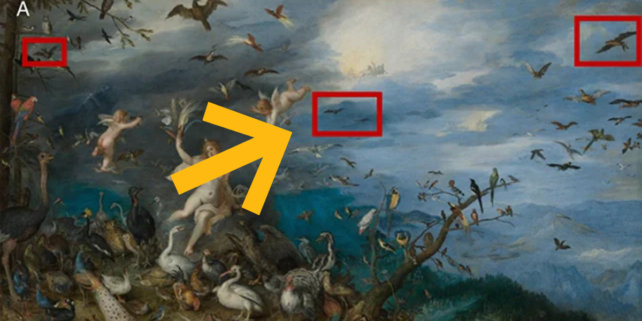
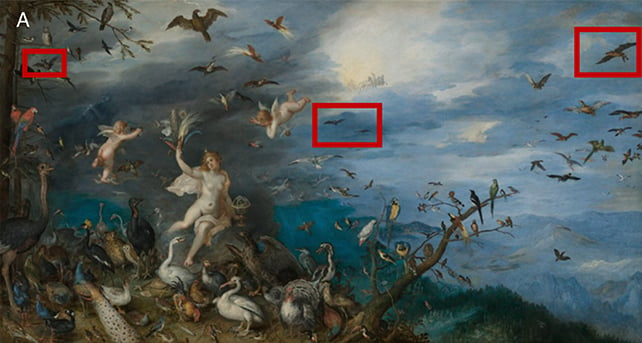
For more than 400 years, an oil painting titled Air by Flemish master Jan Brueghel the Elder has been hiding a scientific secret about bats and their nighttime feeding behavior – and we've only just spotted it.
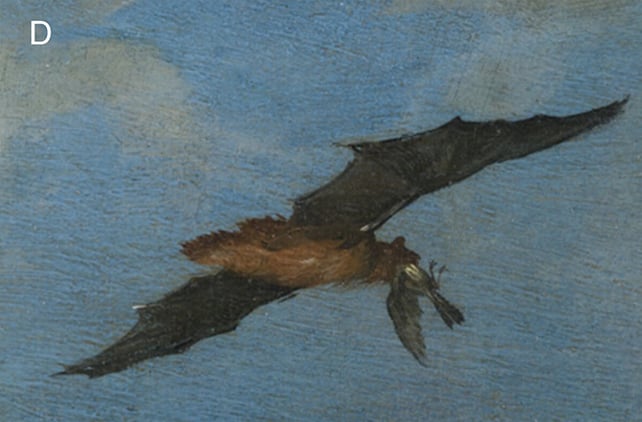
The painting depicts dozens of bat and bird species, but in amongst the menagerie is a recognizable noctule bat (of the genus Nyctalus), holding a bird in its mouth.
This is very unusual behavior for a bat, and it wasn't until 2025 that scientists confirmed that greater noctule bats (Nyctalus lasiopterus) do indeed snack on migratory passerines (or perching birds), whilst flying in mid-air.
That discovery relied on advanced 3D biologging tags and a battery of acoustic, altitude, and movement monitoring equipment.
Back in 1611, Jan Brueghel the Elder apparently revealed the same behavior with oil on canvas, reports a team of researchers from Spain in PNAS.
"Several versions of Air were produced – by Brueghel or apprentices – and only the version analyzed here includes the scene of noctule predation," write the researchers in their published paper.
"Yet the mere depiction of this now well-known predation phenomenon centuries before the advent of modern biologging or ultrasound detectors constitutes a remarkable fact."
While the bird-snacking tendencies of greater noctule bats were only confirmed last year, the evidence has been building for a couple of decades – including the discovery of robin and blue tit feathers in the poop of N. lasiopterus bats.
Passerines are the largest order of birds, and the bats grab them during migratory flights at night, biting off their wings and chewing on their meal for up to 20 minutes – all while staying airborne.
Only three bat species have been found to eat birds, and only N. Iasiopterus is known to do it on the wing.
There is the question of how Brueghel knew about this behavior, carried out at high altitude in the dead of night. The researchers suggest that he might have seen a rare instance of it happening in the day, or been told about it by someone else.
Bird feathers in bat droppings could conceivably have been noticed as far back as the 17th century.
"We acknowledge interpretations of historical artworks must be cautious, particularly in the case of allegorical paintings, which often incorporated symbolic elements," write the researchers.
"However, the fact that a noctule bat, and no other bat species, is represented in the scene suggests an observational inspiration rather than purely symbolic convention."

The size, shape, and color used in the painting give the bat away as coming from the Nyctalus genus, though identifying the bird it has in its jaws is trickier – it is clearly of the passerine type, though.
As for the rest of the painting, held at the Musée des Beaux-Arts de Lyon in France, it depicts the Greek muse Urania, linked to astronomy and astrology. The gods Apollo and Diana can also be seen in the distance.
"The painting represents more than 60 species, including nearly 40 recognizable native European bird species, at least 14 exotic ones, and a few representatives of domestic taxa," write the researchers.
The bat secret hiding in Air was found via a systematic review of historical art featuring birds and mammals – and the researchers are confident that there are more discoveries like this to be made.
Museums and art galleries across the world are continuing to digitize their collections at a large scale, meaning they can be more easily reviewed by human experts and electronic scanning tools.
Related: This Famous Van Gogh Painting Features Astonishingly Accurate Physics
"As the digitization of art collections accelerates and analytical tools continue to advance, the value of these sources to provide valuable data – previously difficult to extract and often overlooked – and complement modern research approaches will notably increase," write the researchers.
The research has been published in PNAS.
This article was fact-checked by Rebecca Dyer and edited by Carly Cassella. While we pride ourselves on our process, we are only human. If you spot a mistake, please let us know.