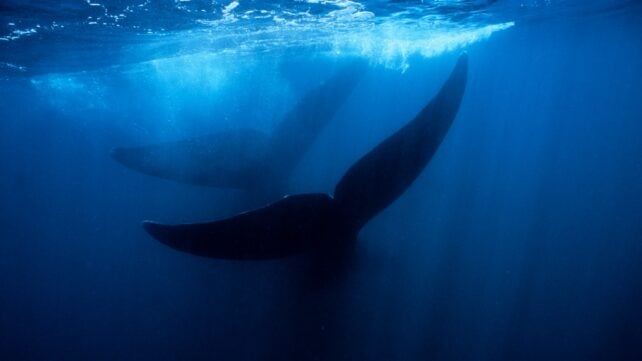
In an abyssal chasm yawning deep beneath the Indian Ocean, a vast 'city of the dead' has slowly been growing in the frigid darkness.
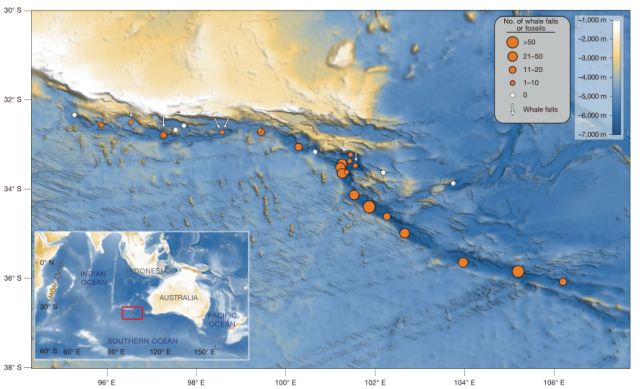
Along some 1,200 kilometers (745 miles) of the Diamantina Fracture Zone, which splits the ocean floor between Australia and Antarctica, and reaches depths of 7,002 meters, scientists have found an unprecedented necropolis containing the remains of nearly 500 whales.
Some of those bones have been dated to 5.3 million years ago – long before the emergence of humans.
It is the biggest, deepest, and oldest whale graveyard ever found, and it may have been accumulating continuously for millions of years.
"These findings," writes a team led by deep-sea scientist Xiaotong Peng of the Chinese Academy of Sciences, "reshape the understanding of the limits and biogeography of whale-fall ecosystems and establish some deep-sea floors as a fossil archive for tracing cetacean evolution over geological time."
There's not much that lasts at the bottom of the deepest depths of the sea.
Below 1,000 meters (3,280), no sunlight reaches; it's reflected and refracted higher up in the water column and never penetrates further.
The weight of all the water above creates crushing pressures, and temperatures are just above freezing – the only warmth can be found clustered around volcanic fissures in the seafloor.
It's a harsh and unforgiving place, where food is relatively scarce; very little goes to waste.
Fallen whale carcasses – known as whale falls – represent an absolute feast for seafloor life, turning a barren sandscape into a thriving, albeit temporary, ecosystem. Even the bones of whales are food for Osedax worms, which usually consume them until there is nothing left.
The researchers were exploring the Diamantina Fracture Zone as part of the Global Trench Exploration and Dive Programme (Global TREnD), now known as the Global Hadal Exploration Programme (GHEP) – a research project focused on understanding our planet's final true frontier – the deepest parts of the ocean.
In February 2023, during a dive in a crewed submersible called Fendouzhe, researchers spotted their first whale fall.
In the ensuing weeks, they dove 32 more times in the submersible, and what they found was nothing short of astonishing.
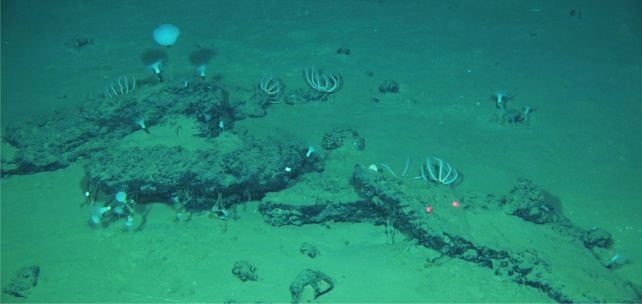
Across a 1,200-kilometer stretch of the chasm, the researchers recorded and sampled 485 whale-fall sites. Their finds included the fossilized remains of 476 whales and five currently active whale-fall ecosystems.
They also collected many samples from the seafloor; the oldest skull obtained dated back to 5.26 million years ago.
Therein lurked a clue about how this region was able to retain such a remarkable record of whale fossils.
Most of the remains were the skulls of modern and extinct beaked whales, a family of elusive deep-sea whales named for their dolphin-like snouts (dolphins are not beaked whales).
The bones of these snouts are extremely dense, which means they could survive long enough for ferromanganese oxides to accumulate therein, halting further degradation.
So why beaked whales, and why this part of the ocean? Well, on these points, the researchers could only guess.
It's possible that the Diamantina Fracture Zone is a natural accumulation point for many different species of whales, but others decompose too readily to be preserved.
It's also possible that the beaked whale lifestyle – specializing in predation of deep-sea squid and fish – contributes to their accumulation in the fracture zone.
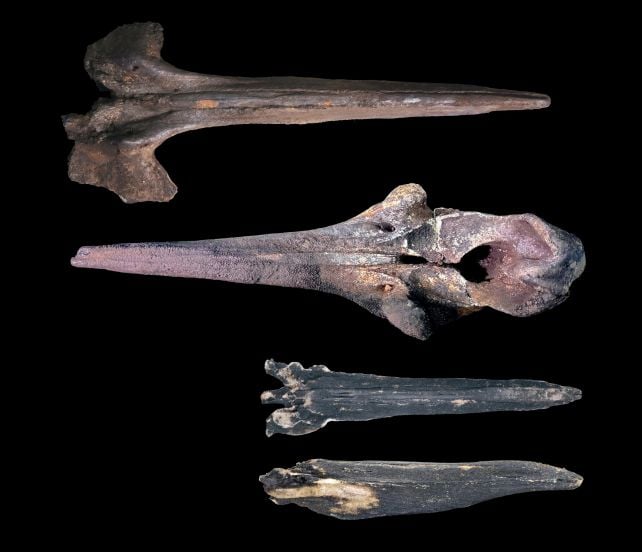
"The maximum dive depth for beaked whales is estimated to be more than 3,000 meters on the basis of lung collapse and oxygen storage. Thus, foraging at depths exceeding 3,000 meters would be too physiologically taxing for beaked whales and may heighten the risk of fatal exhaustion or decompression sickness," the researchers write in their paper.
"Ultimately, the V-shaped topography of the Diamantina Zone may further contribute to this accumulation by funneling and concentrating onto the sea floor the sinking carcasses caused by natural and accidental mortality."
However it came about, the site is truly extraordinary.
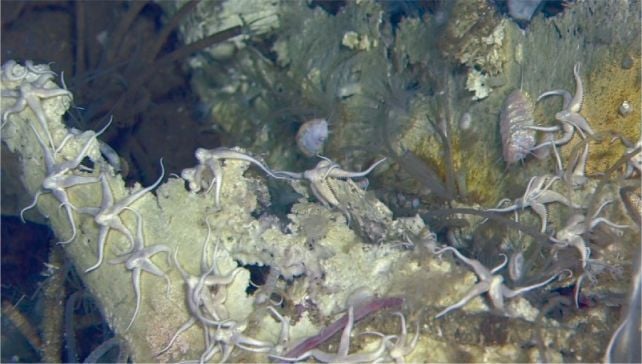
The researchers documented a rich biota flourishing at the five active whale falls, including microbial mats, Osedax worms, brittle stars, and bivalve mollusks that have a symbiotic relationship with chemical-eating microbes similar to those found around hydrothermal vents, where life is powered not by sunlight, but by chemistry.
This shows that whale-fall ecosystems can thrive much deeper than we knew, perhaps offering oases for organisms that usually live in far harsher environments.

In addition, it represents an evolutionary archive, preserving millions of years of beaked whale evolutionary history in one place. The researchers documented at least one previously unknown extinct species, and suspect more are just waiting to be found.
Related: Alien-Looking Species Seen For First Time Ever in Ocean's Darkest Depths
Paleontologist Stephen J. Godfrey of the Calvert Marine Museum in the US says in an accompanying editorial that the site represents a rare Wachsend-Lagerstätte – an exceptional fossil bed that is still growing – and likened its importance to the discovery of the living coelacanth and hydrothermal vents.
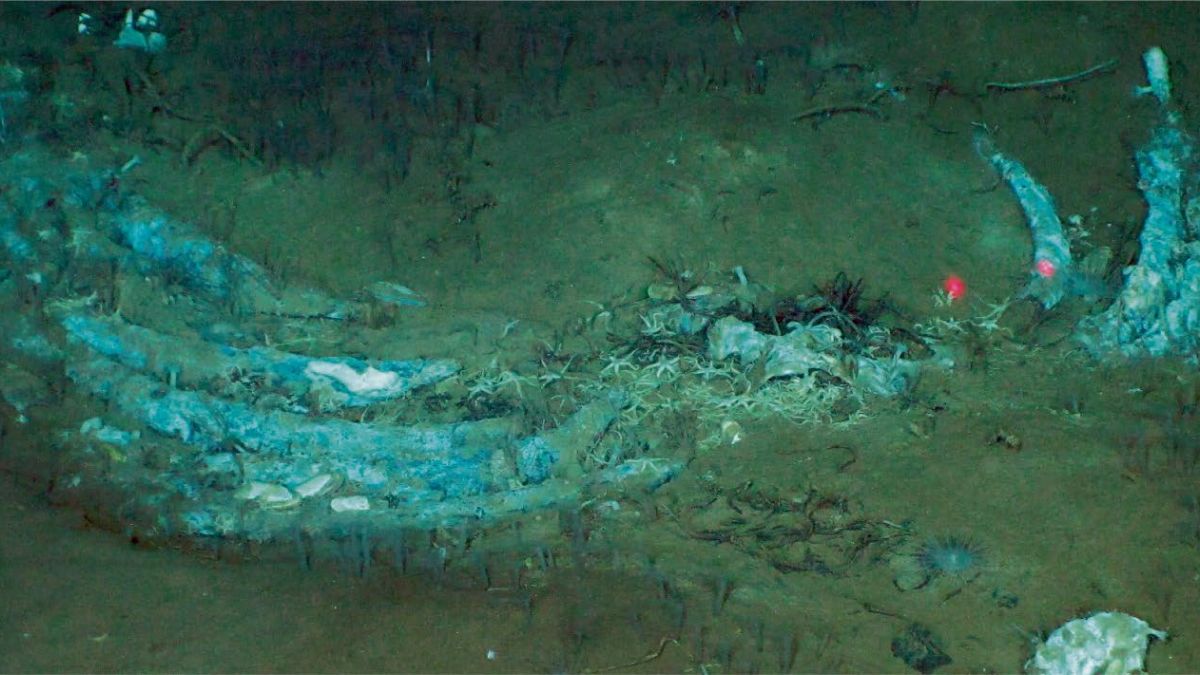
"Just as the surprising discoveries of the coelacanth and first hydrothermal vents reshaped our view of life in the deep ocean, Peng and colleagues' encounter with a vast fossil graveyard is a truly unique discovery," he writes.
"Peng and colleagues' paper reminded me of a trailer for the first in a series of epic movies. I hope that there will be many more of these blockbusters to come."
The discovery has been published in Nature.