An eagerly awaited and controversial clinical trial to 'wind back the clock' on aging cells in the eye and restore them to a more youthful state has officially begun.
This week, the United States biotechnology company Life Biosciences, Inc. announced that it had dosed its first patient with an experimental therapy designed to reverse age-related vision loss.
The ambitious idea is to turn back aging by activating three genes in retinal ganglion cells, which connect the brain to the eyes.
These nerves do not naturally regenerate. If they are damaged by disease, like glaucoma, it can lead to sudden and symptomless vision loss that is ultimately permanent.
An experimental therapy, called ER-100, is now being tested in humans to reverse the irreversible.
But whether it should be happening at all is up for debate.
The hope is that a single injection of the gene therapy, along with several weeks of antibiotics, could preserve or even restore vision in those who have lost sight in one or both eyes.
It's one of the most anticipated clinical trials of the year, and some think it could be a pivotal moment for the field of longevity research.
Other scientists argue it is "extraordinarily high-risk" and are skeptical it will work at all.
"This is an important moment for Life Bio and for the field of aging biology," says Life Bio co-founder David Sinclair, a geneticist at Harvard University, who has been studying ER-100 for several years.
"Our research has suggested that aging is driven in large part by the loss of epigenetic information, not irreversible damage. This clinical study represents the first opportunity to test whether restoring that information can ameliorate human disease."
Sinclair and his colleagues at Harvard University have been working on ER-100 for several years now.
In 2020, they found they could partially reprogram old cells in mice using ER-100 to behave more like younger cells.
The Harvard researchers licensed the technology to Life Bio, co-founded by Sinclair, which has been running preclinical tests ever since.
On January 15 of this year, the US Food and Drug Administration (FDA) approved the novel treatment for its first clinical trial.
The therapy is designed to 'reset' chemical marks that build up on DNA as we age.
If old cells in the human body can safely be restored to a more youthful state, the possibilities are seemingly endless.
But it's important not to get carried away until the first results roll in. And it's only a small trial focused on safety first, involving up to 18 people. There is great potential, but there is also immense risk.
Initial research in non-human primates suggests that ER-100 has potential to restore function of damaged cells. But altering gene expression can go wrong at any turn and carries known and unknown dangers, such as turning some cells cancerous.
"One challenge is that ER-100, even under ideal reprogramming conditions (which no one knows in the human eye), will not lower the eye pressure of glaucoma," argued stem cell biologist Paul Knoepfler from the University of California, Davis earlier this year on his blog, The Niche.
"So, if there is rejuvenation, it may not last."

ER-100 works by injecting a virus – which lacks the ability to cause infectious disease – into the body.
This virus is responsible for shuttling genetic instructions to the retinal ganglion cells. These recipes produce three proteins that help restore the cells to a more youthful and functional state – at least by some measures.
The genes are controlled by a genetic switch that turns them on only when participants take a specific antibiotic.
If a participant stops taking the antibiotic, the genes switch off, which allows for some level of control.
"ER-100 does not alter the participant's existing genes," claims the clinical trial.
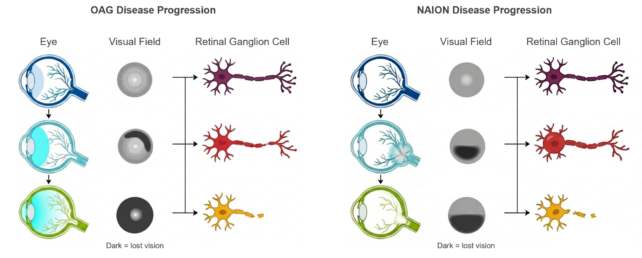
The first human study of ER-100 will start by treating 12 participants, one at a time, with a specific type of glaucoma called open-angle glaucoma (OAG).
Then, researchers will include up to 6 more participants with optic nerve damage called nonarteritic anterior ischemic optic neuropathy (NAION).
Participants will be followed for at least five years, but not everyone will necessarily receive the same dose. Scientists will adjust the amount as they go, depending on how the patients respond.
This first trial will primarily be testing for safety concerns, but it will also publish initial findings on how the treatment affects vision.
Whether a dose of this therapy can actually 'reverse aging' in retinal ganglion cells is unknown. In fact, scientists don't even agree on what that would actually look like.
At the moment, biological aging is measured via numerous different 'clocks', all of which seem to have an impact on the health, function, and longevity of cells.
But which clocks are most important? And do all of them need to be wound back in order to make claims about aging 'reversal'?
Related: Promising Anti-Aging Drug May Cause Brain Damage, Scientists Warn
Sinclair has previously received criticism from other scientists. His general theory of aging, on which the treatment is based, will now be put to the test in the clinical trial.
Critics say that Sinclair can overstate claims about experimental longevity treatments, which have not been properly tested for safety or efficacy.
The first clinical trial on ER-100 may provide some initial answers, but Knoepfler isn't convinced the therapy is ready for humans yet.
"As a stem cell biologist, I find reprogramming of all kinds, especially to try to treat diseases, fascinating," wrote Knoepfler on The Niche in February.
"We just have to keep it real. A lot can go wrong."