A sprinkling of radioactive plutonium atoms hidden in the ocean floor may trace back to a cosmic cataclysm more than 100 million years ago.
What's more, that stardust appears to still be raining down on our world today – the lingering detritus of an ancient event that may have been the collision of two neutron stars.
Such collisions trigger brilliant explosions known as kilonovae, which forge some of the Universe's heaviest and most valuable elements.
This is not the first time scientists have invoked a kilonova to explain strange elemental signatures found in the seafloor.
But the new findings, led by physicist Dominik Koll of Helmholtz-Zentrum Dresden-Rossendorf in Germany, may help pin down when the event occurred, shedding light on the changing galactic seas through which our planetary spaceship has sailed for eons.
"Our results suggest that the plutonium originated from very rare cosmic explosions, such as those that would occur during the merger of two neutron stars or in extremely energetic supernovae," says physicist Anton Wallner of Helmholtz-Zentrum Dresden-Rossendorf.
"Since then, it has dispersed throughout the interstellar medium."

Plutonium is one of the heaviest naturally occurring elements in the Universe, and the radioisotope relevant to this new research – plutonium-244 – is thought to form only in rare cosmic events capable of flooding atoms with neutrons.
During this rapid neutron-capture process, or r-process, atomic nuclei rapidly absorb neutrons and grow heavier, forging some of the Universe's heaviest elements. One leading candidate site is a kilonova, the explosion produced when two neutron stars collide.
So any naturally occurring plutonium-244 found on Earth today is inferred to have a cosmic origin.
The sting in the tail here is that plutonium-244 only has a half-life of about 81 million years. Any primordial plutonium incorporated into Earth when the Solar System formed should therefore have decayed away long ago.
One of those places is the ferromanganese crust found in parts of the ocean floor. It grows slowly, millimeter by millimeter, building up over millions of years, preserving a snapshot of its environment with each layer.
It's essentially a recording of the particulate matter that has settled to the bottom of the sea, which scientists use to tell us about the space environment around our planet.
Previously, astronomers had interpreted the presence of plutonium-244 in a section of ferromanganese crust as indicative of an r-process explosion around 3.5 million years ago.
They arrived at this timeline by estimating how far the explosion may have been, and how long the ejecta would have taken to reach Earth, based on how much plutonium they found in the crust.
Koll and his colleagues took a different approach.
Rather than working backward from the quantity of plutonium-244, they looked for signs of another radioactive isotope that should form alongside plutonium in r-process explosions – curium-247, which has a half-life of 16 million years.
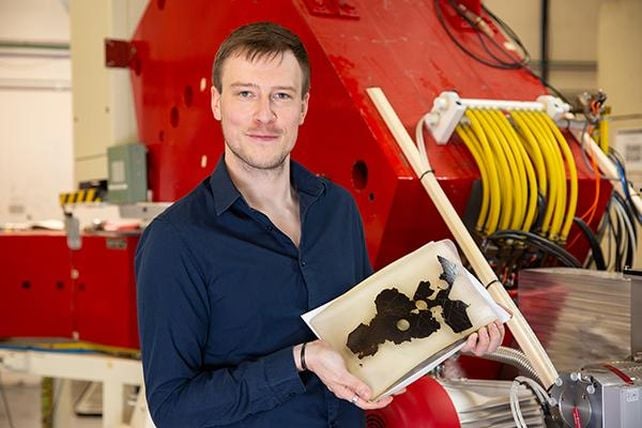
Using a section of ferromanganese crust dredged from 4,830 meters (15,850 feet) beneath the Pacific Ocean in 1976, the researchers conducted a survey, looking for plutonium-244, curium-247, and a radioisotope of iron, iron-60, which is also cosmogenic in origin.
Iron-60 has a half-life of just 2.6 million years. Its presence in prior samples has been interpreted as evidence of debris from more recent supernova events – namely, two supernovae estimated to have occurred at around 2.5 and 7 million years ago, respectively.
"Iron-60 is a clear fingerprint of conventional supernovae, so we searched for both iron-60 and plutonium-244 and compared the traces," Koll explains.
If the plutonium-244 had been produced in a relatively recent event, traces of curium-247 should still have been present in the crust.
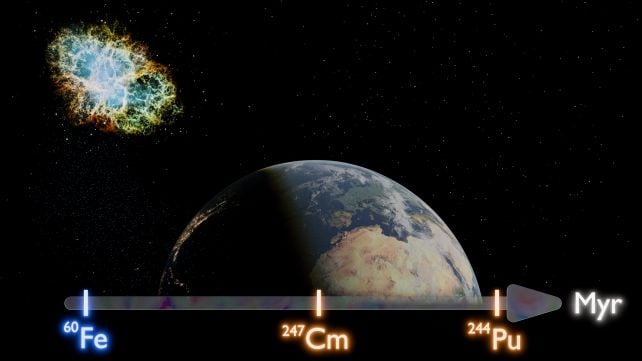
But they found no convincing evidence of it.
This suggests that the plutonium-244 was not produced in the same supernovae that produced the iron-60.
Instead, the plutonium appears to come from a much older r-process event whose debris has long since dispersed through interstellar space. The curium-247 produced alongside it would have decayed, whereas some plutonium-244 remains because it decays much more slowly.
"The absence of the curium radioisotope curium-247, which was also produced in the explosion, tells us it happened a very long time ago," says physicist Michael Hotchkis of the Australian Nuclear Science and Technology Organisation.
"But not more than about 1 billion years ago – otherwise the plutonium-244 would also be undetectable."

While we can't know what kind of explosion produced the plutonium-244, the researchers believe that it most likely came from an ancient rare r-process event, with a kilonova among the leading candidates, and that it took place more than 100 million years ago.
And Earth is now moving through the debris it left behind.
Related: Stardust Trapped in Antarctic Ice Reveals Earth's Journey Through The Cosmos
The explosion probably wasn't very close to Earth at the time it detonated.
But traces such as these give scientists a way to understand the explosion history of the Milky Way and the Solar System's journey through the cosmos.
It may also help us understand a little more about Earth's history – where its heavy metals came from, and the role past explosions may have played in our planet's evolution.
"Did this event affect life on Earth?" Hotchkis says.
"That's an open question, to be investigated in further research."
The findings have been published in Nature Astronomy.