In recent years, our perception of the ocean's pecking order has been turned on its head.
Ever since Jaws, great white sharks have loomed large in the popular imagination as the undisputed rulers of the sea.
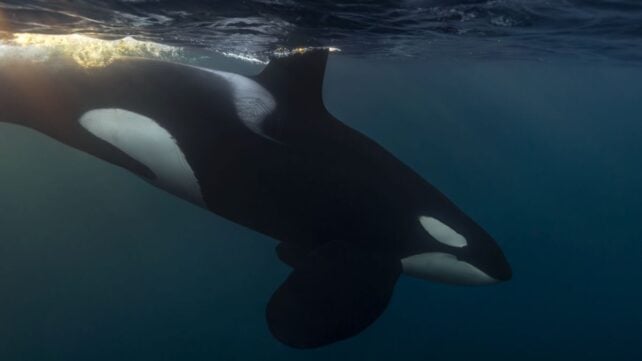
Then scientists discovered that these fearsome predators had a nemesis of their own: the mighty orca (Orcinus orca), sleek and cunning, hunting white sharks for their tender, nutrient-rich livers.
You might think there's very little that could rattle an orca.
You'd be wrong.
Just the hint of a squeal from a pod of long-finned pilot whales (Globicephala melas) can send orcas packing.
And the best part is that nobody really knows why.
"Killer whales, the oceans' apex predators, respond to acoustic signals of pilot whales and likely perceive their presence as a threat," wrote a team led by marine biologist Anna Selbmann of the Sudurnes Science and Learning Center in Iceland in a paper published in Scientific Reports in January 2026.
"However, it remains unclear why this apex predator avoids a smaller, seemingly inferior aggressor."
The story begins in 2012, when a group led by marine biologist Charlotte Curé published a curious observation. Playing orca vocalizations to long-finned pilot whales in the wild acted as a sort of siren call that the pilot whales couldn't resist.
If they were within hearing range, they moved towards the sound.
Then, another group led by marine scientist Renaud de Stephanis of the Spanish National Research Council documented something even curiouser.
In a paper published in 2014, they noted that in every documented encounter between pilot whales and orcas in the wild from 2004, the orcas skedaddled. Once the pilot whales show up in orca-infested waters, the orcas no longer want to be there.
The reason this is so curious is that there didn't appear to be a good ecological reason for it.
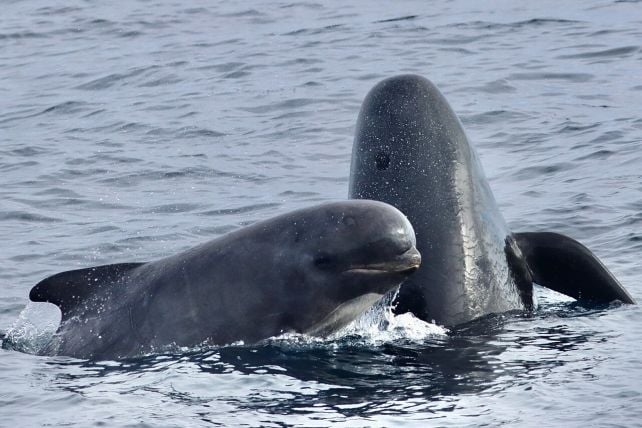
After conducting a field investigation in the Strait of Gibraltar, de Stephanis and his team found that two cetacean species don't compete for the same food, nor do they prey upon each other.
In addition, the long-finned pilot whale is significantly smaller than the orca. It should not pose a significant threat.
They concluded that maybe, at some point in the past, orcas may have preyed upon the pilot whales, and the pilot whales have a long memory, but there's not much evidence for that interpretation either.
Selbmann and her colleagues were perplexed – but fascinated.
They wanted to study more interactions between the two species.
In a 2022 paper, they analyzed data from research platforms and whale-watching tours in six regions of Iceland from 2007 to 2020, documenting when each species was in the area. Pilot whales were only seen during the summer months – but they often showed up in the orcas' favorite hangout spots.
Here's where it got weird.
In most of the 24 encounters – 68 percent – the orcas simply avoided meeting the pilot whales by moving away before the latter muscled in.
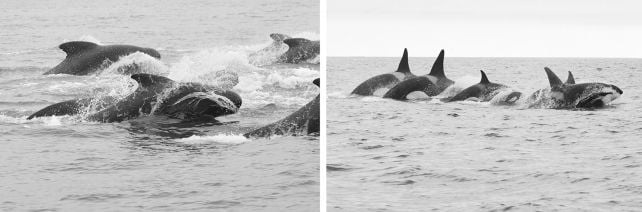
But in 28 percent of the encounters, a high-speed chase ensued, with both species porpoising along at a rate of up to 13.5 knots (25 km/h) – a type of motion that involves repeatedly leaping from the water to increase speed.
By 2026, the observations now span more than two decades, and they all point in the same direction: Orcas really do avoid long-finned pilot whales.
But one question lingered. Were the orcas really reacting to the pilot whales, or to something else happening during these encounters?
Previous studies had played recorded orca sounds to pilot whales.
Selbmann and her colleagues took the pilot whales out of the equation. Instead of waiting for the species to meet in the wild, they played recordings of pilot whale calls to tagged orcas.
The response was striking. The orcas tightened up their group formations, changed their vocal behavior, turned away, and sped up. The pilot whale calls alone were sufficient to invoke an aversive reaction in orcas.
"As previous work demonstrated that pilot whales are attracted to killer whale sounds, our study further demonstrates that acoustic signaling can mediate these interspecific interactions in both directions," the researchers wrote.

We still don't really know why the pilot whales gun so hard for orcas, or why the orcas flee; as the researchers point out, no direct physical attacks by pilot whales on orcas have been reported, despite the many observed interactions.
One possibility is a behavior known as mobbing. Rather than fleeing a dangerous predator, some animals band together to harass it until it leaves the area.
Related: Orcas Keep Punching Giant Sunfish to Smithereens, And Scientists Are Mesmerized
It's most frequently observed in birds – think of how crows might harass a student wearing a mask, or mynahs yelling about a cat, for example. It's less effort to get up and leave than to deal with a dive-bombing flock of birds, so that's what the predator does.
It's only a theory, though. Other explanations, such as competition for resources or protection of vulnerable calves, cannot be ruled out.
Still, there might be a life lesson in this for all of us. If you can't be the biggest and the strongest, you might be able to achieve your dreams by being the most annoying.
This article was fact-checked by Rachel Garner and edited by Peter Dockrill. While we pride ourselves on our process, we are only human. If you spot a mistake, please let us know.